AP Latin Unit 3 Cheatsheet: Required - Pliny's Letters: Ghosts and Apparitions, Letters to Trajan and Calpurnia

AP Latin Unit 3 Cheatsheet: Required - Pliny's Letters: Ghosts and Apparitions, Letters to Trajan and Calpurnia

Start with the first 3 sections of the Unit 3 one-page cheatsheet below. The full sheet is a PDF you can print.

Vocabulary & Translation Foundations

Core approach: Identify word meaning in context, then build translation.

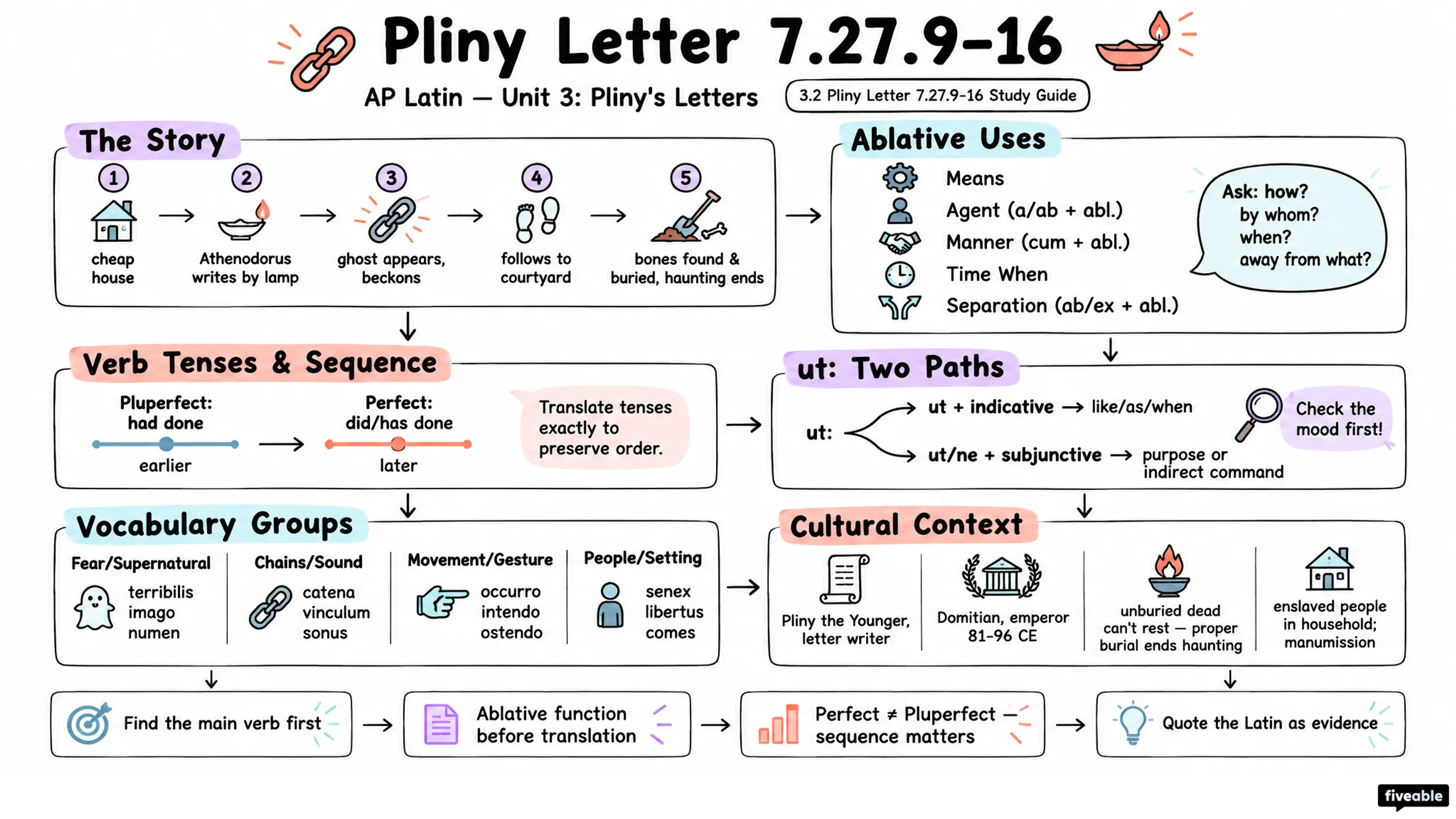
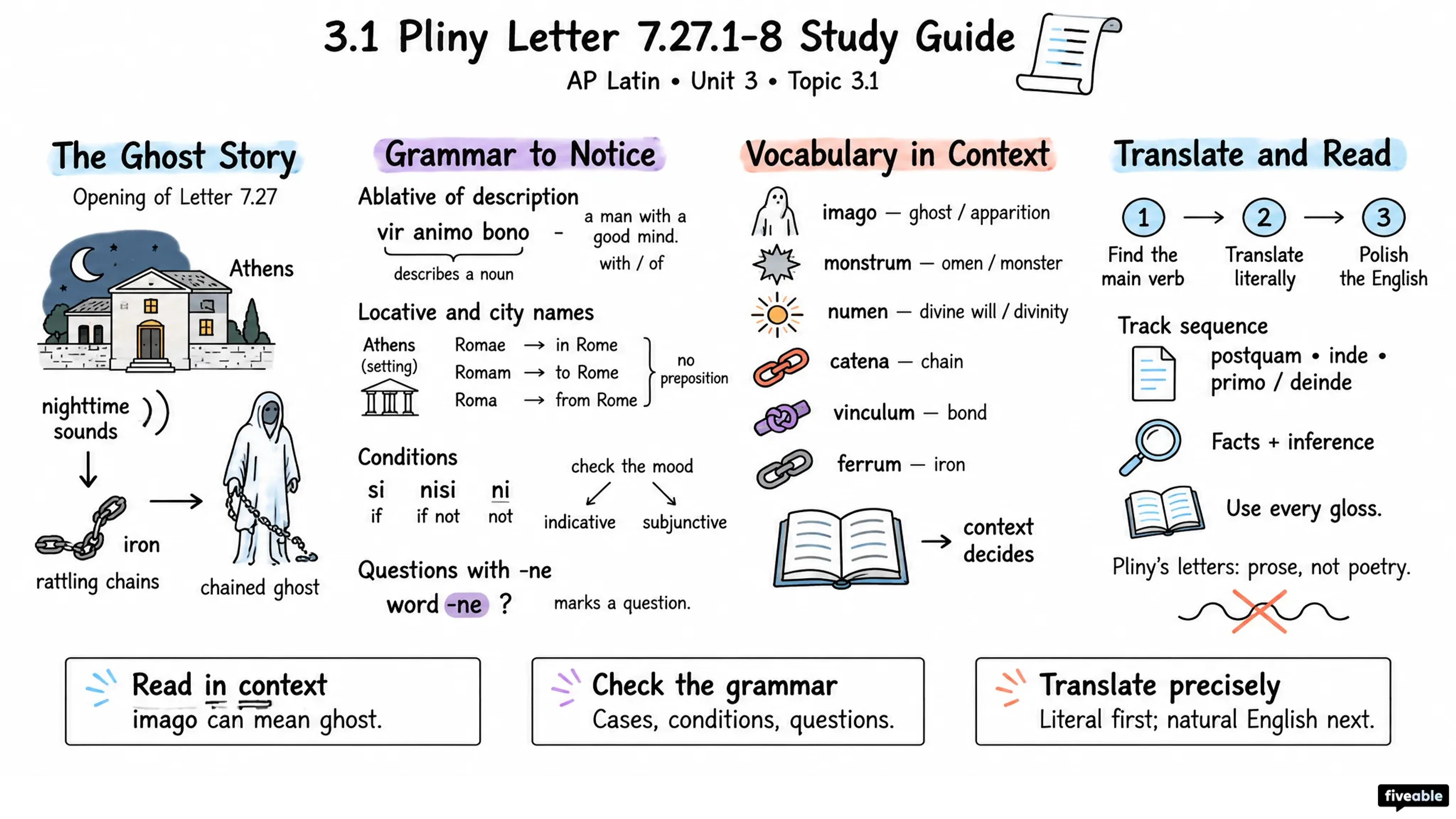
  • Ablative of description (quality): An ablative noun with an adjective describes a quality. vir animo bono = “a man with a good disposition” or “a man of good character.”
  • Locative case: Shows location at a place. Romae = "in Rome." Use accusative without preposition for "to" (Romam); ablative without preposition for "from" (Romā).
  • Genitive case: Shows possession. villa amici = “a friend’s house.”
  • Genitive + causa/gratia (ablative): Both translate "for the sake of." Example: sapientiae causa = "for the sake of wisdom."
  • Vocative case: Addresses a person or object directly. Musa, mihi causas memora (Vergil addressing the Muse).
Pliny the Younger: Life & Letters

Author context (61–c. 113 CE):

  • Lawyer, magistrate, and prolific letter writer.
  • Served under Emperor Trajan.
  • Wrote hundreds of letters providing insight into daily life, the legal system, and Roman public administration in the first century CE.
  • Letters were heavily revised between sending and publication—highly literary, not raw documents.

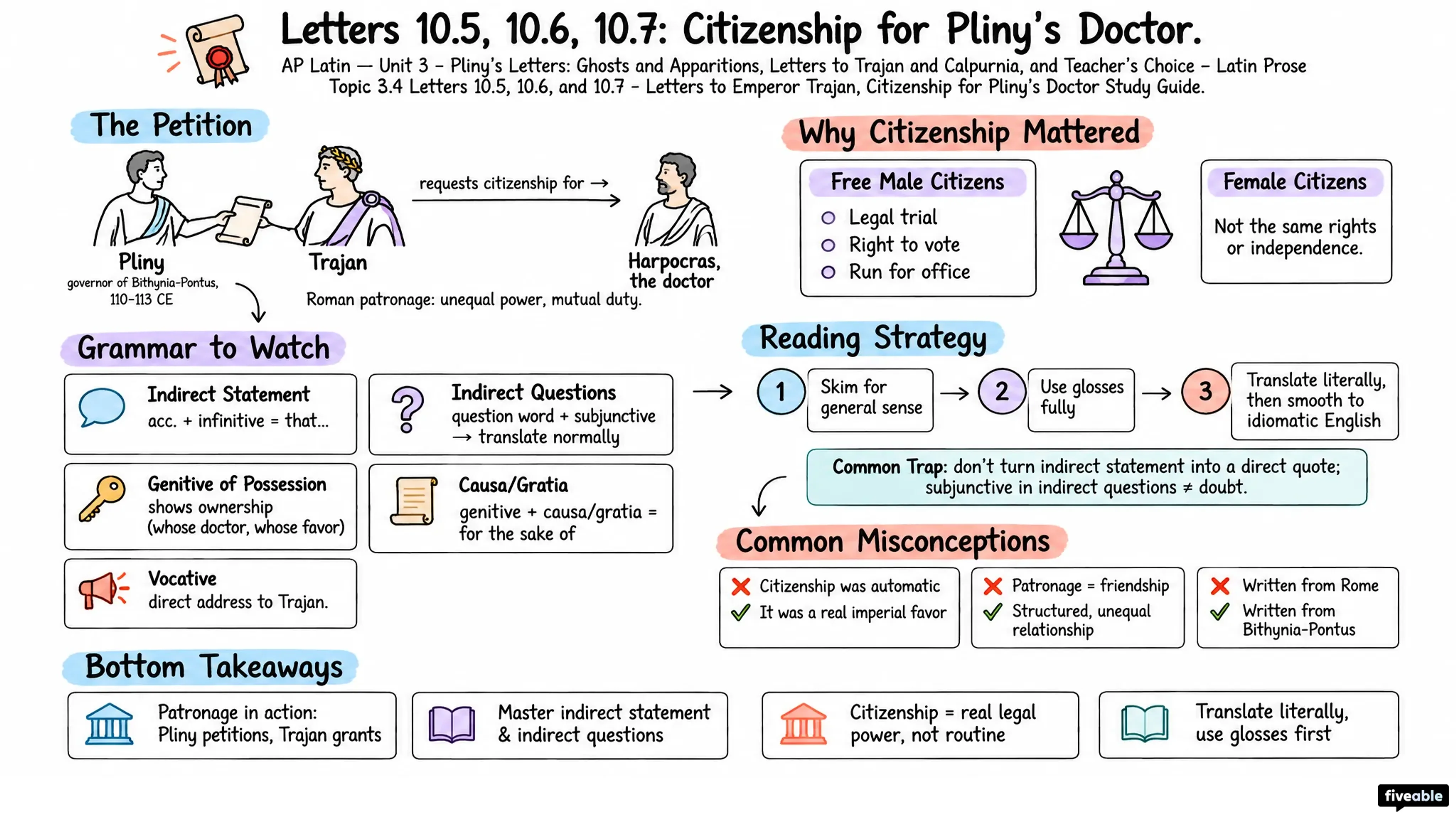
Governor of Bithynia-Pontus (110–113 CE): A province on the southern shore of the Black Sea (modern Turkey). Letters 10.37 and 10.90 were written from this post to Emperor Trajan; 10.5 and 10.6 are earlier letters to Trajan from Rome (the Harpocras citizenship request), and 10.7 is Trajan's reply.

Roman Society: Slavery & Patronage

Enslaved people:

  • Considered property; few legal rights or protections.
  • Often manual/domestic labor, but could be highly educated (bookkeepers, physicians).
  • Many were war captives or piracy victims from across Europe and Mediterranean.
  • Manumission: Freed person became client of former master, could gain citizenship and wealth, but barred from political office. Most never freed.

Patronage system: Mutually beneficial relationships between powerful patrons and less powerful clients. Patrons provided legal defense, gifts, assistance; clients offered political support and public presence. Example: Pliny–Trajan relationship; Vergil–Maecenas (Maecenas patronized Vergil and supported his poetry within the Augustan literary circle).

The rest of the Unit 3 sheet

6 more sections are on the one-page PDF:

  • Verbs: Tense, Mood & Function

  • Roman Citizenship & Gender

  • Stylistic Devices: Repetition & Structure

  • Conditions & Questions

  • Historical Context: Emperors & Empire

  • Interpretation & Evidence

Made by Fiveable

Text-Based Cheatsheet

Unit 3: Required - Pliny's Letters: Ghosts and Apparitions, Letters to Trajan and Calpurnia on one page, aligned to the 2026-2027 course. Made and checked by the Fiveable Content Team.

Or get the whole course

Made by you

Visual Cheatsheets

Pick a Unit 3 topic and a format: flowchart, comparison chart, vocab sheet, Cornell notes and more. Ready in about a minute.

Printable PDF · from the Fiveable shop

AP Latin Unit 3 Cheatsheet

1 page · Required - Pliny's Letters: Ghosts and Apparitions, Letters to Trajan and Calpurnia · PDF

Visual Cheatsheets

One topic, the format you pick, ready in about a minute

Format

Topic

Takes 30–60 seconds

Preview: Standard

Unit 3: Pliny's Letters: Ghosts and Apparitions, Letters to Trajan and Calpurnia, and Teacher's Choice – Latin Prose, topic by topic

Each topic has a full study guide. See the whole unit.