
AP Cybersecurity Unit 4 Cheatsheet: Securing Devices

AP Cybersecurity Unit 4 Cheatsheet: Securing Devices

Start with the first 3 sections of the Unit 4 one-page cheatsheet below. The full sheet is a PDF you can print.

Device Types & Vulnerabilities

Servers: Computers defined by their role of providing services (DNS, DHCP, FTP) to other computers on a network; they are often, but not necessarily, built with greater processing power, storage, and uptime reliability than a personal computer.

Personal Computers: Desktops, laptops, notebooks for individual work or recreation.

Handheld/Mobile: Tablets, smartphones, wearables; battery-powered, smaller.

Embedded Computers: Part of machines (cars, medical devices, IoT). Slower, cheaper, minimal storage, specific instruction sets.

IoT Devices: Everyday physical objects that contain embedded computers AND connect to a network—smart appliances (washing machines, coffee makers), thermostats, the sensors and controllers used in critical infrastructure (power grids, water treatment), and connected medical devices (pacemakers, IV pumps). Network connectivity is what makes them part of the 'Internet of Things'—and what gives attackers a remote way in.

Key Vulnerability: Unpatched software allows adversaries to crash systems, view actions, enable/disable services, or take control.

Password Attack Methods

Online Attacks: Attempt credentials in active authentication portal. Blocked by account lockout.

Offline Attacks: A stolen file of password hashes (and salts) is cracked on the adversary's own computer by hashing guesses and comparing — unlimited, fast guessing that bypasses online account lockout and rate limits; defenses are slow salted hashing (bcrypt, scrypt, Argon2) and long passwords.

Common Passwords: Users reuse passwords across services. Stolen/leaked credentials tried first.

Password Spraying: One common password tested against many user accounts.

Credential Stuffing: Username/password pairs stolen in one breach are replayed against accounts on other services.

Brute Force: Automated tool tests all possible passwords.

Dictionary Attack: Automated tool tests list of common passwords.

Rainbow Table: Pre-computed hash/reduction chains in which only each chain's start and end points are stored. To crack a hash, the adversary repeatedly applies reduction and hashing to the target hash until it matches a stored endpoint, then regenerates that chain from its start point to recover the password — a space-for-time tradeoff compared with storing every password-hash pair.

Cannot Detect: Offline attacks happen on adversary's computer—undetectable.

Authentication Factors & MFA

Knowledge Factor: Something user knows—password, PIN, challenge question answers. Hard to guess = hard to remember.

Possession Factor: Object unique to user—access card, bank card, phone, authentication token. Security depends on difficulty to obtain/copy.

Biometric Factor: Body features—fingerprints, palm prints, facial recognition, iris/retina scans, voice. Difficult to duplicate.

Location Factor: Wi-Fi signals, GPS, time zone, IP address. Rules allow/deny based on location.

Multifactor Authentication (MFA): Uses 2+ factors. More secure than single-factor because requires separate proofs.

The rest of the Unit 4 sheet

7 more sections are on the one-page PDF:

  • Malware Types & Characteristics

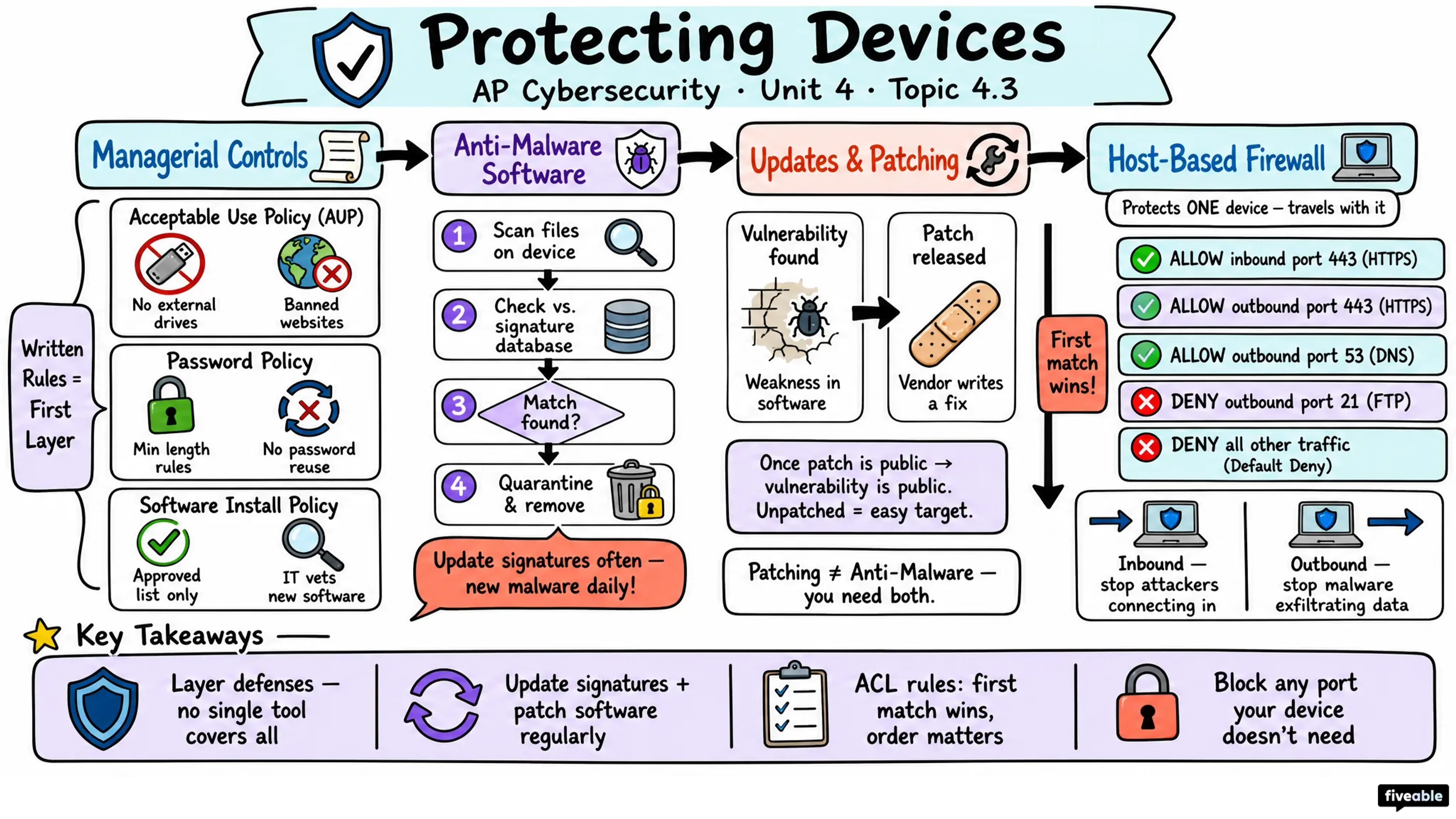
  • Device Protection Controls

  • Detection Methods & Password Attack Indicators

  • Common Device Attack Vectors

  • Cryptographic Hashing & Password Storage

  • Login Security Configuration

  • Host-Based Firewall & Detection

Made by you

Visual Cheatsheets

Pick a Unit 4 topic and a format: flowchart, comparison chart, vocab sheet, Cornell notes and more. Ready in about a minute.

Printable PDF · from the Fiveable shop

AP Cybersecurity Unit 4 Cheatsheet

1 page · Securing Devices · PDF

Visual Cheatsheets

One topic, the format you pick, ready in about a minute

Format

Topic

Takes 30–60 seconds

Preview: Standard

Unit 4: Securing Devices, topic by topic

Each topic has a full study guide. See the whole unit.