AP Computer Science Principles Written Response Practice
126 Written Response 2 questions written in the AP format. Pick one, read all three prompts, and write about your program.
Your first scored response is included. A plan unlocks unlimited scoring.
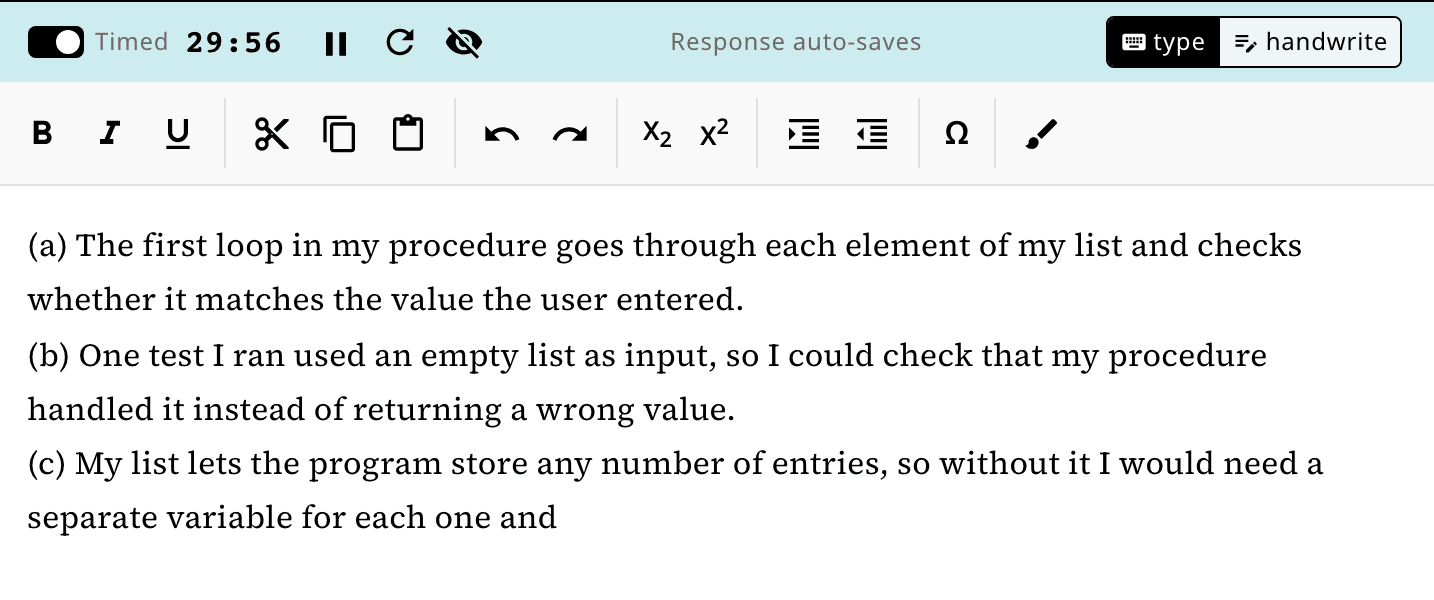
126 questions
sorted by unit
Test and explain a greeting-program prototype
Unit 1: Creative Development
Early-unit written response practice: three short tasks using a supplied example program. This adapts tracing, testing, and data reasoning from the written-response task family. It does not assess the full Create/PPR requirements for lists, iteration, or student-developed procedures. No personal project, code file, or video is required.
A school club wants a sign-in kiosk to display a greeting containing the visitor’s entered name. The following program is its prototype. INPUT reads the entered text, ← assigns a value to a named variable, + joins text, and DISPLAY shows text on the screen. The visitor enters Maya.
</>TEXTname ← INPUT() message ← "Hello, " + name DISPLAY(message)
Describe the sequence of actions the program performs and identify its displayed output for the supplied input.
Propose a different name as test input and state the exact expected output. Explain how this test checks the kiosk’s stated design requirement.
Suppose the first line is changed to name ← "Maya" so that it no longer reads input. Explain one limitation this change would create for visitors other than Maya and why the original input variable avoids that limitation.
What the Written Response asks
Written Response 2 is the second of two written-response questions on the AP Computer Science Principles exam. Its three prompts ask about your Create program: how an algorithm works, how errors and testing play out, and how your list and procedure manage complexity.
- 60 min
- for both written responses
- 3 points
- across prompts A to C
- 30%
- of your score, for the whole Create task
Part A: Algorithm development
How an algorithm or loop in your procedure works
1 pt
Part B: Errors and testing
A test, an error, or a code change and what it does to your program
1 pt
Part C: Data and procedural abstraction
How your list or procedure manages complexity in your program
1 pt
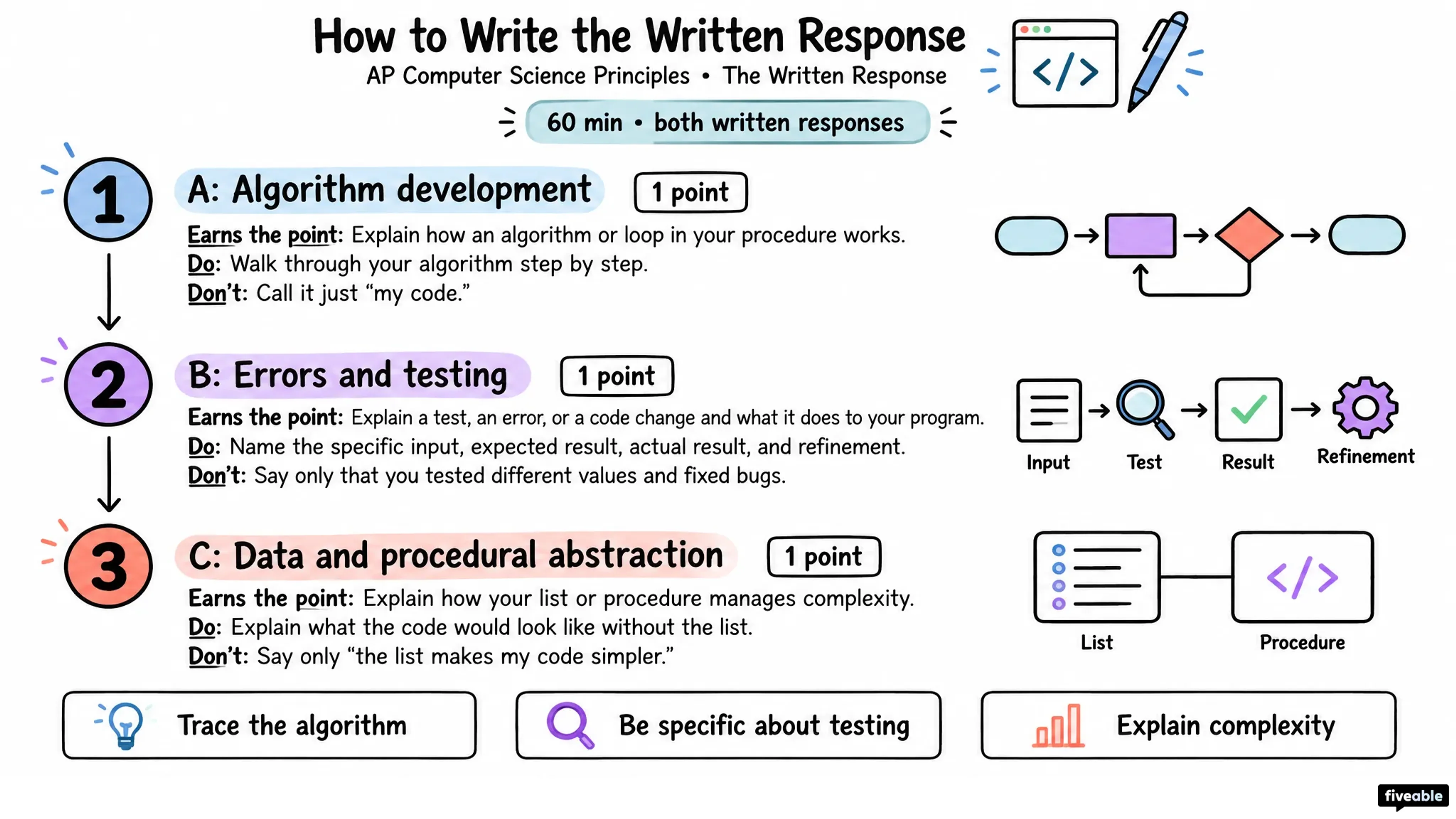
Written Response skill sheet
Every rubric point on one page: what earns it, what to do and what to avoid. Tap the sheet to see it full size.
How Written Response practice works
Each question follows the exam’s format, from the full prompt to a score on every part.
Read the full question
All three prompts, A to C, with a place to paste your program code or generate sample code to practice with.
Write on a 30-minute timer
Half of the 60-minute written-response section. Pause it or turn it off, and your response saves as you go.
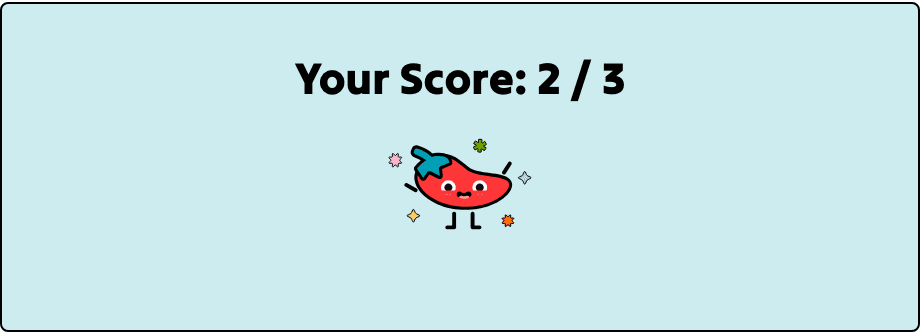
Submit for a score out of 3
Your response is scored against the scoring guidelines written for that question. Your first score is included.
Feedback on every part
A summary at the top tells you what to work on next. Below it, each part shows whether you earned the point and what the scoring guidelines were looking for.
Detailed Feedback
Part A: 0/1 point
Did not earn the point. You described the second iteration statement in your procedure (the loop that iterates through the teams array) instead of the first iteration statement. To earn this point, you needed to describe the specific task executed by the first loop in your code (`for (var k = 1; k <= 5; k++)`), which clears the team logos.
Part B: 1/1 point
Earned the point. You provided two distinct calls (`filterTeamsByDivision("Atlantic")` and `filterTeamsByDivision("Invalid")`) and correctly explained how they execute different code segments (the `count < 5` block versus the `if (results == "")` block).
Part C: 1/1 point
Earned the point. You correctly explained that no modifications are needed because the loop uses `teams.length`, which dynamically adjusts to the size of the list.
What 236 scored Written Responses show
Patterns from the practice Written Responses students have turned in on Fiveable. Students lose the most points on Part A: algorithm development.
C: Data and procedural abstraction
80%
B: Errors and testing
78%
A: Algorithm development
77%
63%
of responses earned all 3 points
2.3 of 3
average score
+1.1 points
average gain when students rewrote the same Written Response after feedback
236 practice responses from 62 students, scored on Fiveable through October 10, 2026.
Questions about the Written Response
How many responses can I get scored?
You can read every question without a plan. Your first scored response is included. A plan unlocks unlimited scoring.
Do I need my own Create program?
It helps, since the prompts ask about your list, your procedure, and your loops, as they do on the exam. Paste your own program code, or generate sample code to practice with.
How is Written Response 2 different from Written Response 1?
Written Response 1 is a single prompt about your program’s design, function, and purpose. Written Response 2 has three prompts on algorithms, testing, and abstraction.
Are these real College Board questions?
No. We wrote them in the AP format, with the same three prompt categories, and wrote scoring guidelines for each one.
Can I write my answer by hand?
Yes. Switch the editor to handwrite, write on paper, and add a photo of your page.
More AP Computer Science Principles practice
AP Computer Science Principles FRQs
Every FRQ type for AP Computer Science Principles, with practice for each.
Write your first Written Response
Pick one from the list, or let us choose for you.
Teaching AP Computer Science Principles? Assign these Written Responses to your class