generate your own visual cheatsheets
💻 AP Computer Science A Cheatsheets
Download the one-page AP Computer Science A cheatsheet PDF or browse AI-generated visual study aids with key formulas, concepts, and definitions for your exam review.
Text cheatsheets made by Fiveable, in print-ready PDF.

Compiled by students and teachers, then reviewed and updated every year.
1 page · PDF · updated every year
Same format, one unit at a time, aligned to the 2026-2027 course.
Unit 1
Unit 2
Unit 3
Unit 4


Printable PDF · from the Fiveable shop
6 pages · Subject + 4 unit cheatsheets · PDF
AI-generated one-pagers for a single topic. Make your own, or browse what other students have made.
choose a topic in AP Computer Science A
add custom requests (optional)

Unit 1 - 1.1 Why Programming? Why Java?

Unit 1 - 1.1 Why Programming? Why Java?

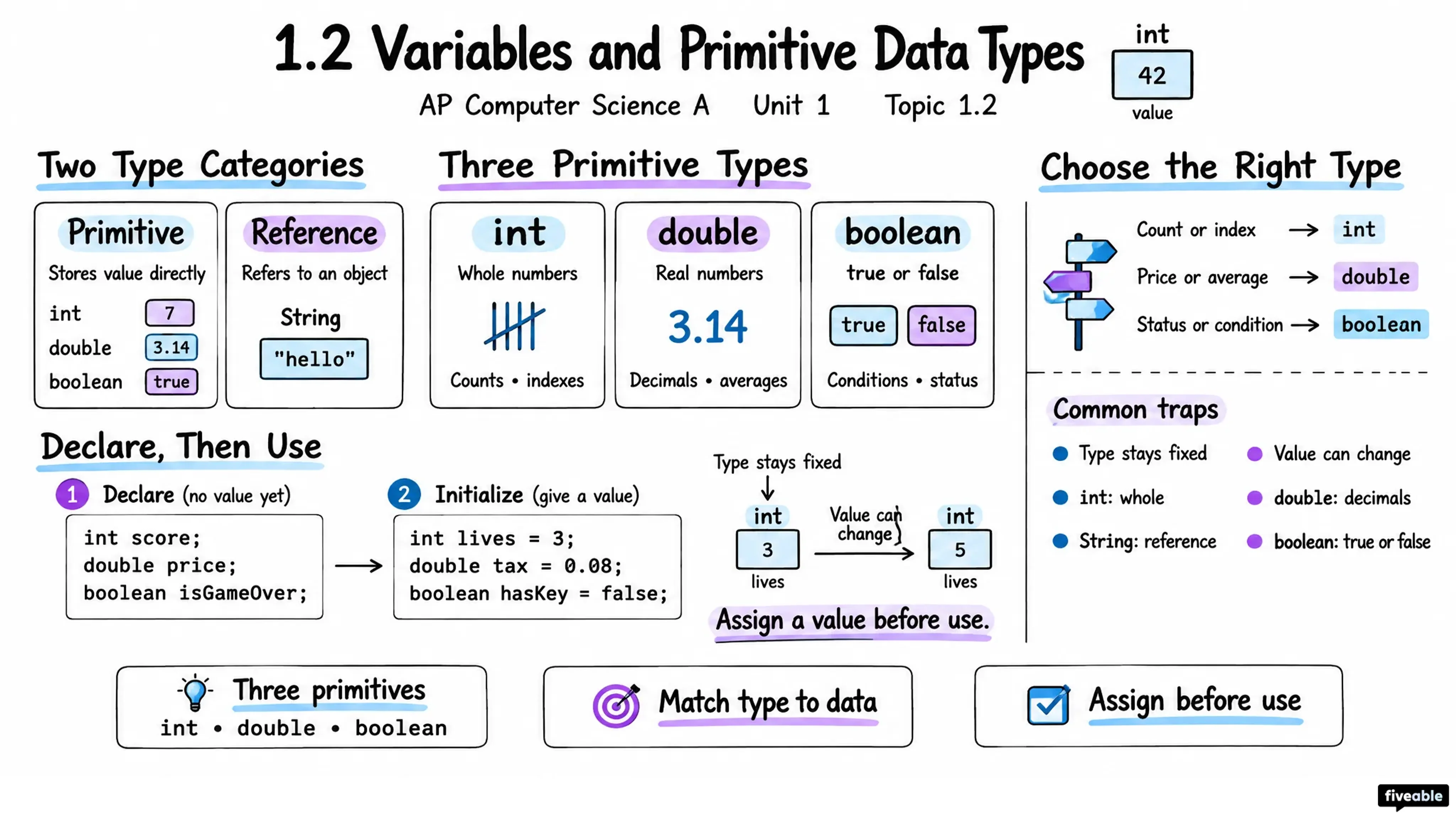
Unit 1 - 1.2 Variables and Primitive Data Types

Unit 1 - 1.3 Expressions and Assignment Statements

Unit 1 - 1.4 Assignment Statements and Input

Unit 1 - 1.4 Assignment Statements and Input

Unit 1 - 1.4 Assignment Statements and Input

Unit 1 - 1.5 Casting and Ranges of Variables

Unit 1 - 1.6 Compound Assignment Operators

Unit 1 - 1.7 Application Program Interface (API) and Libraries

Unit 1 - 1.8 Documentation With Comments

Unit 1 - 1.9 Calling a Void Method With Parameters

Unit 1 - 1.10 Calling a Non-Void Method

Unit 1 - 1.11 Using the Math Class

Unit 1 - 1.12 Objects: Instances of Classes

Unit 1 - 1.13 Creating and Storing Objects

Unit 1 - 1.14 Calling a Void Method

Unit 1 - 1.15 String Methods

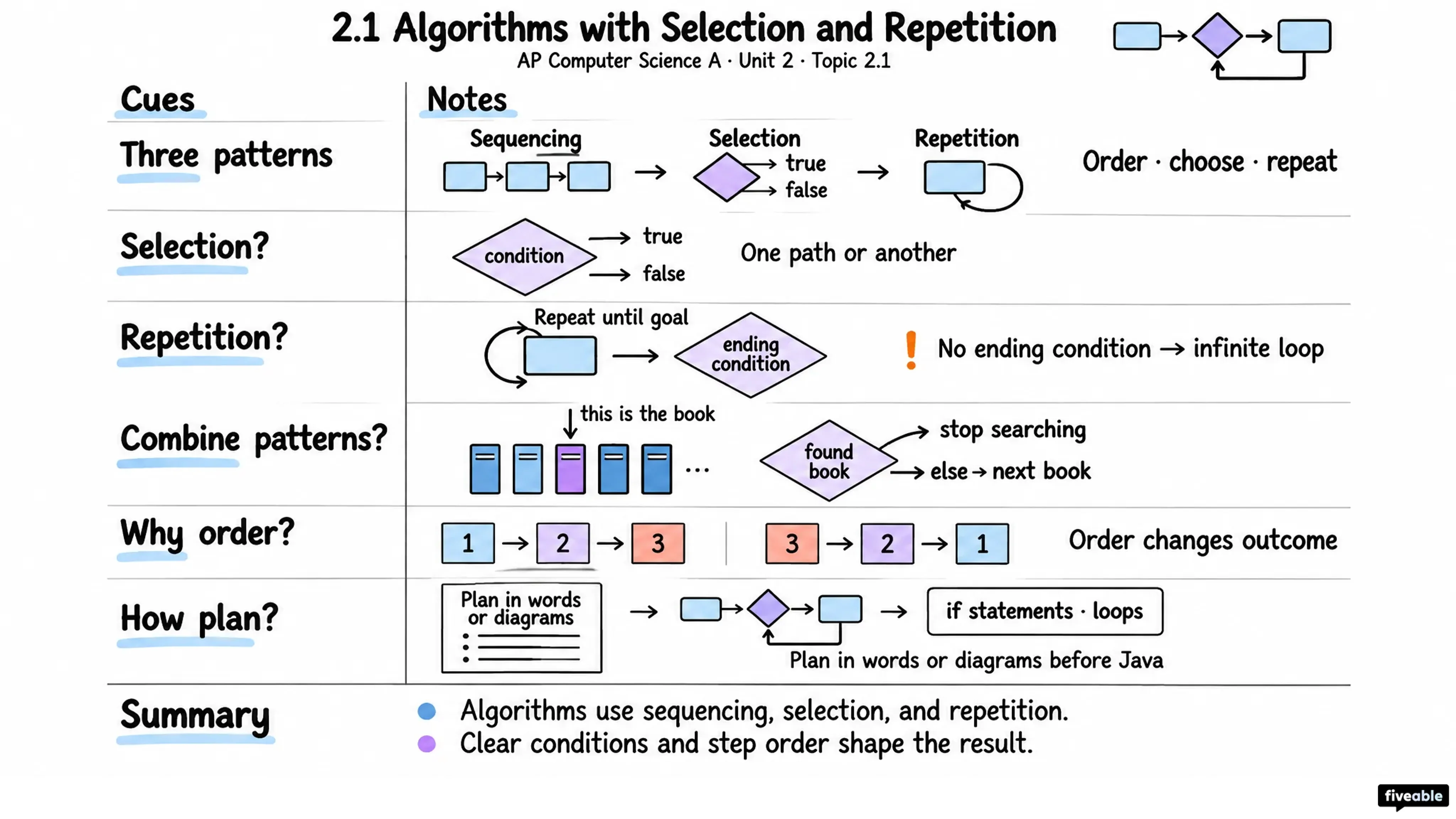
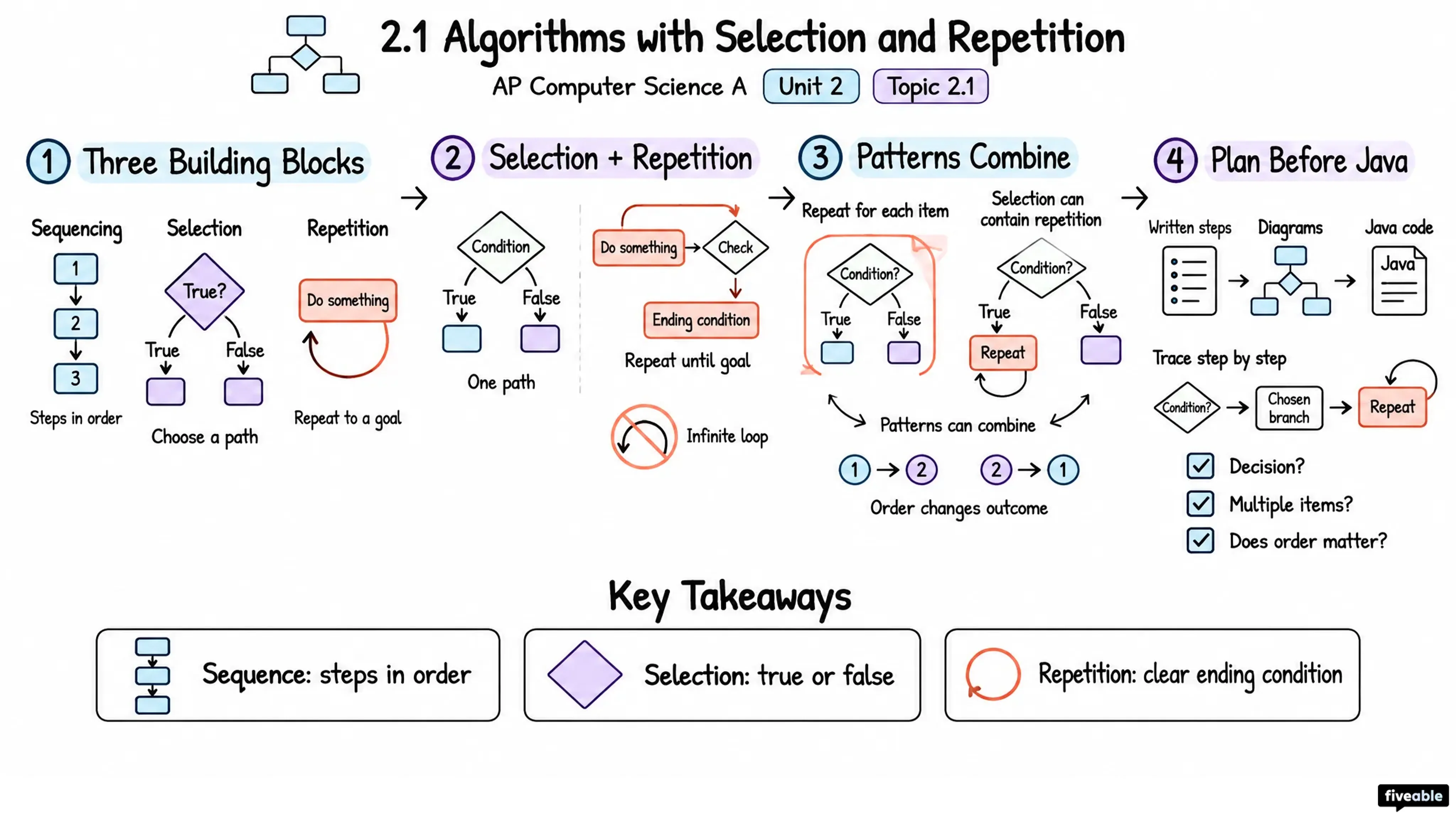
Unit 2 - 2.1 Algorithms with Selection and Repetition

Unit 2 - 2.2 Boolean Expressions

Unit 2 - 2.3 If Statements and Control Flow

Unit 2 - 2.4 If-Else Statements

Unit 2 - 2.5 Compound Boolean Expressions

Unit 2 - 2.6 Equivalent Boolean Expressions

Unit 2 - 2.7 While Loops

Unit 2 - 2.8 For Loops

Unit 2 - 2.9 Implementing Selection and Iteration Algorithms

Unit 2 - 2.10 Developing Algorithms Using Strings

Unit 2 - 2.11 Nested Iteration

Unit 2 - 2.12 Informal Code Analysis

Unit 3 - 3.1 Abstraction and Program Design

Unit 3 - 3.2 Impact of Program Design

Unit 3 - 3.3 Anatomy of a Class

Unit 3 - 3.4 Constructors

Unit 3 - 3.5 Writing Methods

Unit 3 - 3.6 Accessor Methods

Unit 3 - 3.7 Static Variables and Methods

Unit 3 - 3.8 Scope and Access

Unit 3 - 3.9 This Keyword

Unit 4 - 4.1 Ethical and Social Implications

Unit 4 - 4.2 Introduction to Using Data Sets

Unit 4 - 4.3 Array Creation and Access

Unit 4 - 4.4 Traversing Arrays

Unit 4 - 4.5 Developing Algorithms Using Arrays

Unit 4 - 4.6 Using Text Files

Unit 4 - 4.7 Wrapper Classes: Integer and Double

Unit 4 - 4.8 ArrayList Methods

Unit 4 - 4.8 ArrayList Methods

Unit 4 - 4.8 ArrayList Methods

Unit 4 - 4.8 ArrayList Methods

Unit 4 - 4.9 Traversing ArrayLists

Unit 4 - 4.10 Developing Algorithms Using ArrayLists

Unit 4 - 4.11 2D Arrays

Unit 4 - 4.12 Traversing 2D Arrays

Unit 4 - 4.13 Implementing 2D Array Algorithms

Unit 4 - 4.14 Searching

Unit 4 - 4.15 Sorting

Unit 4 - 4.16 Recursion

Unit 4 - 4.16 Recursion

Unit 4 - 4.16 Recursion

Unit 4 - 4.16 Recursion

Unit 4 - 4.16 Recursion

Unit 4 - 4.16 Recursion

Unit 4 - 4.17 Recursive Searching and Sorting

AP Computer Science A Exam - Multiple-Choice Questions (MCQ)

AP Computer Science A Exam - FRQ 1 – Methods and Control Structures

AP Computer Science A Exam - FRQ 2 – Class Design

AP Computer Science A Exam - FRQ 3 – Data Analysis with `ArrayList`

AP Computer Science A Exam - FRQ 4 – 2D Array
A cheatsheet condenses a whole course into the facts you actually need on exam day. The AP Computer Science A cheatsheets on this page summarize the key formulas, concepts, and definitions from each unit so you can review the entire course at a glance.
They work best as a final review: skim the one-page summary, spot the units you want to strengthen, then go deeper with the AP Computer Science A study guides. The visual cheatsheets in the gallery are organized by unit, and you can generate your own for any topic you want a quick refresher on.