AP Comparative Government Argument Essay Practice
81 Argument Essay questions written in the AP format. Pick one, read the full prompt, and write your essay. Fiveable scores each Argument Essay response part by part on the AP rubric.
Your first scored response is included. A plan unlocks unlimited scoring.

81 questions
sorted by unit
Federal versus unitary systems and political stability
Unit 1: Political Systems, Regimes, and Governments
Develop an argument about whether a federal system or a unitary system is more effective at maintaining political stability in a state.
Political legitimacy
Social cleavages
Centralization
Respond to the prompt with a defensible claim or thesis that establishes a line of reasoning using one or more of the provided course concepts.
Support your claim with at least TWO pieces of specific and relevant evidence from one or more course countries. The evidence should be relevant to one or more of the provided course concepts.
Use reasoning to explain why your evidence supports your claim or thesis, using one or more of the provided course concepts.
Respond to an opposing or alternate perspective using refutation, concession, or rebuttal.
What the Argument Essay asks
The Argument Essay is FRQ 4 on the AP Comparative Government exam. You take a position on a debate in comparative politics, support it with evidence from the course countries using the concepts the prompt provides, and respond to another view.
- 40 min
- suggested writing time
- 5 points
- across rows A to D
- 14%
- of your exam score
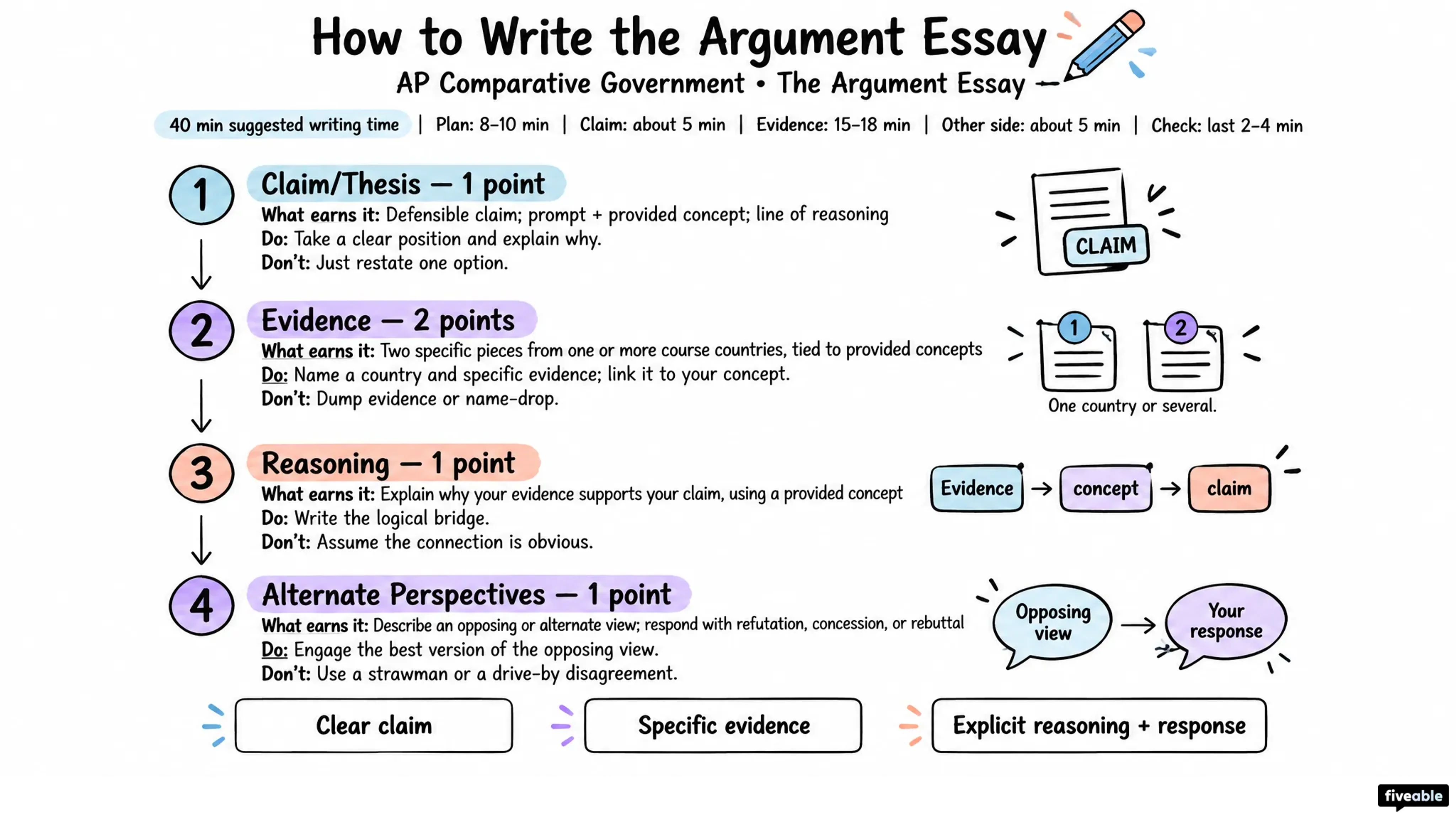
Part A: Thesis
A defensible claim that uses one of the provided concepts
1 pt
Part B: Evidence
Two pieces of specific evidence from one or more course countries
2 pts
Part C: Reasoning
Why your evidence supports your claim, using a provided concept
1 pt
Part D: Alternate perspective
An opposing view, answered with refutation, concession, or rebuttal
1 pt
Argument Essay skill sheet
Every rubric point on one page: what earns it, what to do and what to avoid. Tap the sheet to see it full size.
How Argument Essay practice works
Each question follows the exam’s format, from the full prompt to a score on every part.
Read the full prompt
The debate, the provided course concepts, and the four requirements, laid out the way the exam shows them.
Write on a 40-minute timer
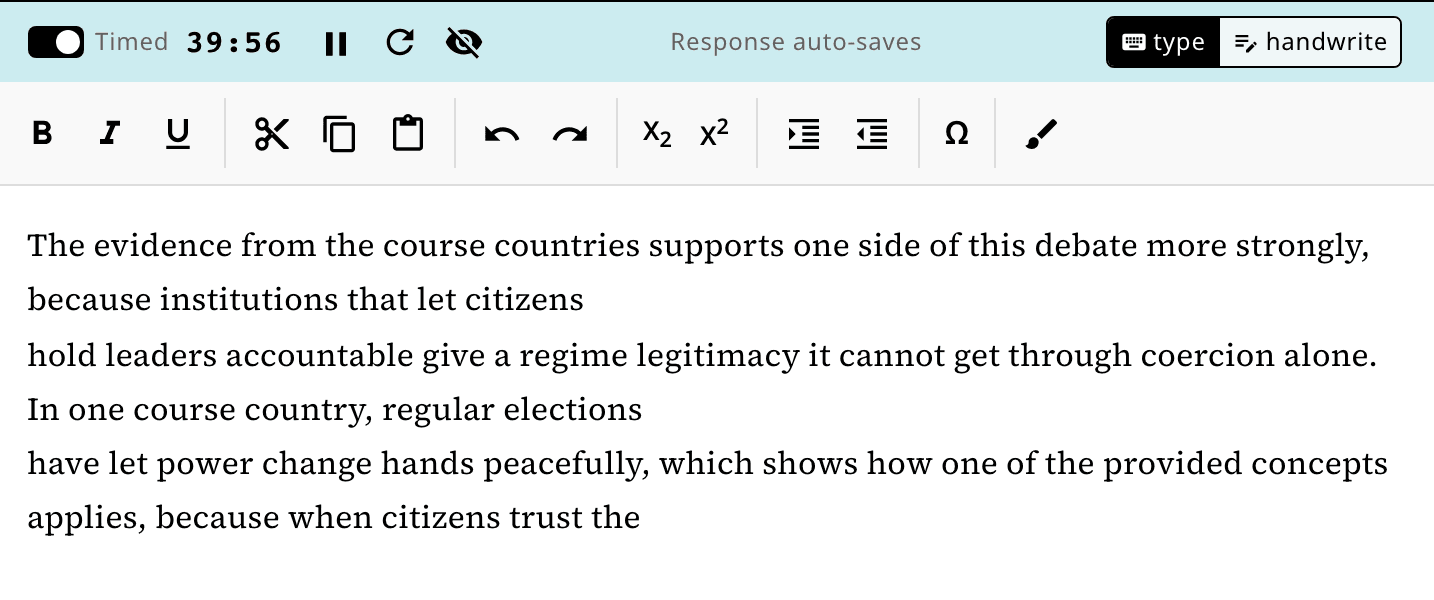
The time to plan for on exam day. Pause it or turn it off, and your response saves as you go.
Submit for a score out of 5
Your response is scored against the scoring guidelines written for that question. Your first score is included.
Feedback on every part
A summary at the top tells you what to work on next. Below it, each part shows whether you earned the point and what the scoring guidelines were looking for.
Detailed Feedback
Part A: 1/1 point
Earned the point. You provided a clear, defensible thesis that takes a position (restricting civil society decreases political stability) and establishes a line of reasoning using the course concepts of civil liberties and political legitimacy.
Part B: 1/1 point
Earned the point. You provided specific evidence from Iran by referencing the constitutional right to assemble under Sharia law and the government's violent suppression of specific protests, connecting this to the concept of civil liberties.
Part B: 0/1 point
Did not earn the point. Your second piece of evidence regarding China was too general. Stating that the government "heavily monitors" civil societies is a broad characterization rather than specific evidence. To earn this point, you needed to name a specific law, policy, institution, or concrete action used by China to restrict civil society (such as the 2016 NGO law or the detention of specific activists).
Questions about the Argument Essay
How many responses can I get scored?
You can read every question without a plan. Your first scored response is included. A plan unlocks unlimited scoring.
Do I need evidence from two countries?
No. You need two pieces of specific evidence, and they can come from one course country or several.
What are the provided concepts?
Each prompt lists a few course concepts, such as legitimacy or corruption. Your thesis and reasoning need to use at least one of them.
Are these real College Board questions?
No. We wrote them in the AP format, with the same four requirements, and wrote scoring guidelines for each one.
Can I write my answer by hand?
Yes. Switch the editor to handwrite, write on paper, and add a photo of your page.
More AP Comparative Government practice
Conceptual Analysis FRQ practice
Conceptual Analysis questions with all four parts, A through D.
Quantitative Analysis FRQ practice
Quantitative Analysis questions with the full data set and all five parts.
Comparative Analysis FRQ practice
Comparative Analysis questions with all three parts and two course countries.
AP Comparative Government FRQs
Every FRQ type for AP Comparative Government, with practice for each.
See the Argument Essay rubric points students miss most, from responses scored on Fiveable.
Write your first Argument Essay
Pick one from the list, or let us choose for you.
Teaching AP Comparative Government? Assign these Argument Essays to your class