AP Comparative Government Unit 1 Cheatsheet: Political Systems, Regimes, and Governments

AP Comparative Government Unit 1 Cheatsheet: Political Systems, Regimes, and Governments

Start with the first 3 sections of the Unit 1 one-page cheatsheet below. The full sheet is a PDF you can print.

How Political Scientists Work

Data sources & methods:

  • Analyze quantitative (charts, tables, graphs) and qualitative (speeches, documents, cartoons, maps, commentary) data
  • Use HDI, GDP per capita, GDP growth, Gini index, Freedom House, Transparency International, and the Fragile States Index
  • Make comparisons and inferences across course countries

Key distinctions:

  • Correlation: association between two variables
  • Causation: hard to prove—many variables influence outcomes
  • Empirical: factual, objective statements
  • Normative: value-based statements

Political scientists use empirical data to apply concepts, support generalizations, and build arguments.
State, Nation, Regime, Government

TermDefinition
StatePolitical organization with permanent population, governing institutions, defined territory, international recognition
NationGroup sharing race, language, religion, ethnicity, political identity, aspirations
RegimeFundamental rules controlling access to and exercise of power; endures across governments
GovernmentInstitutions/individuals legally empowered to make binding decisions for the state

Sovereignty: Independent legal authority over population in territory.

Political system: Laws, ideas, procedures addressing who rules and government's influence on people and economy.

Democracy vs. Authoritarianism

Key indicators:

  • Rule of law (governed by law, not arbitrary decisions)
  • Media independence
  • Elections (free, fair, competitive)
  • Governmental transparency
  • Citizen participation in policy-making
  • Branch independence (prevents power concentration)

Authoritarian regime types:

  • Illiberal democracies / hybrid regimes
  • One-party states
  • Theocracies
  • Totalitarian governments
  • Military regimes

Democratic regimes have more independent branches; authoritarian regimes concentrate power.

The rest of the Unit 1 sheet

6 more sections are on the one-page PDF:

  • Democratization: Goals & Obstacles

  • Change in Power & Authority

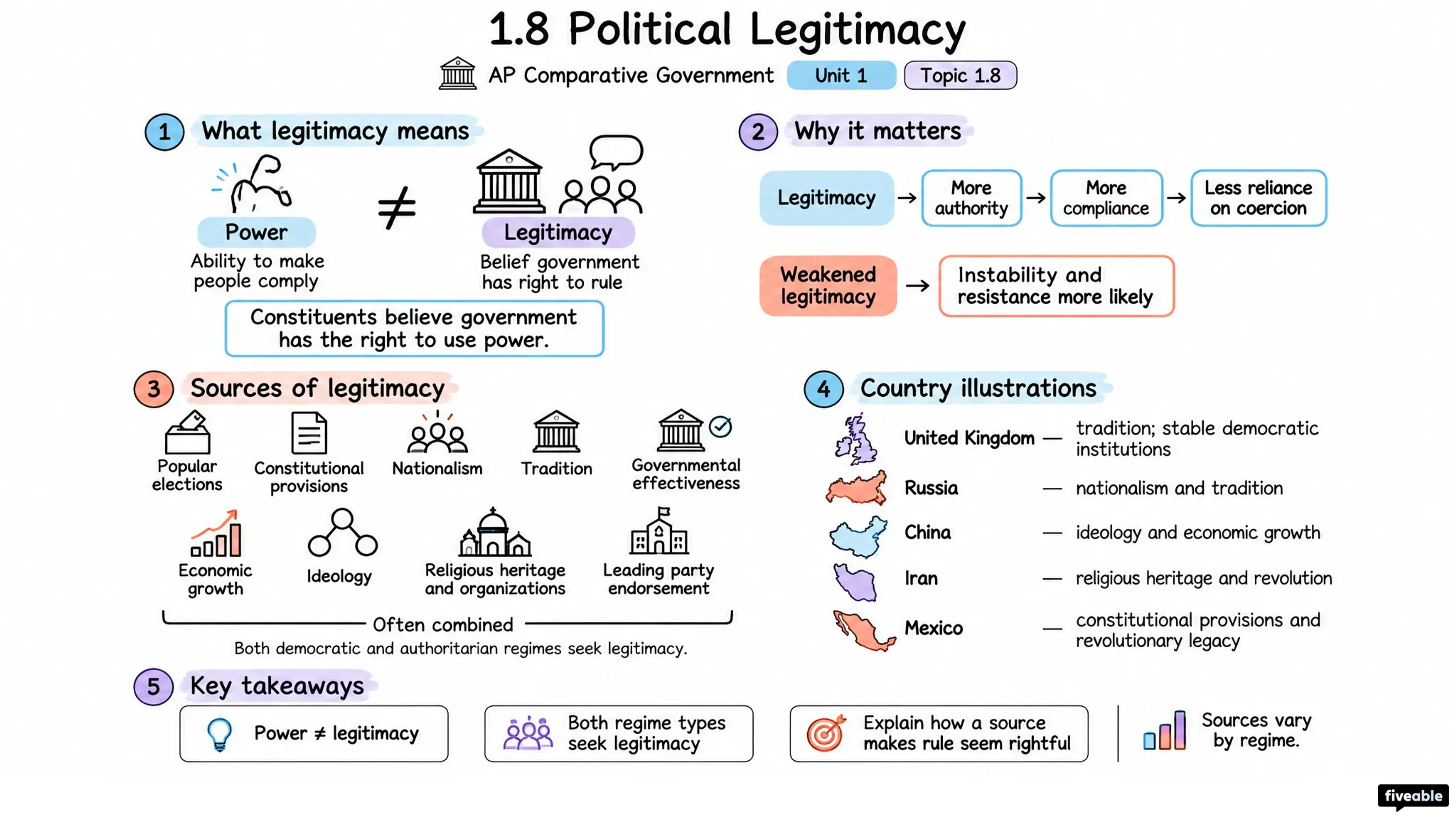
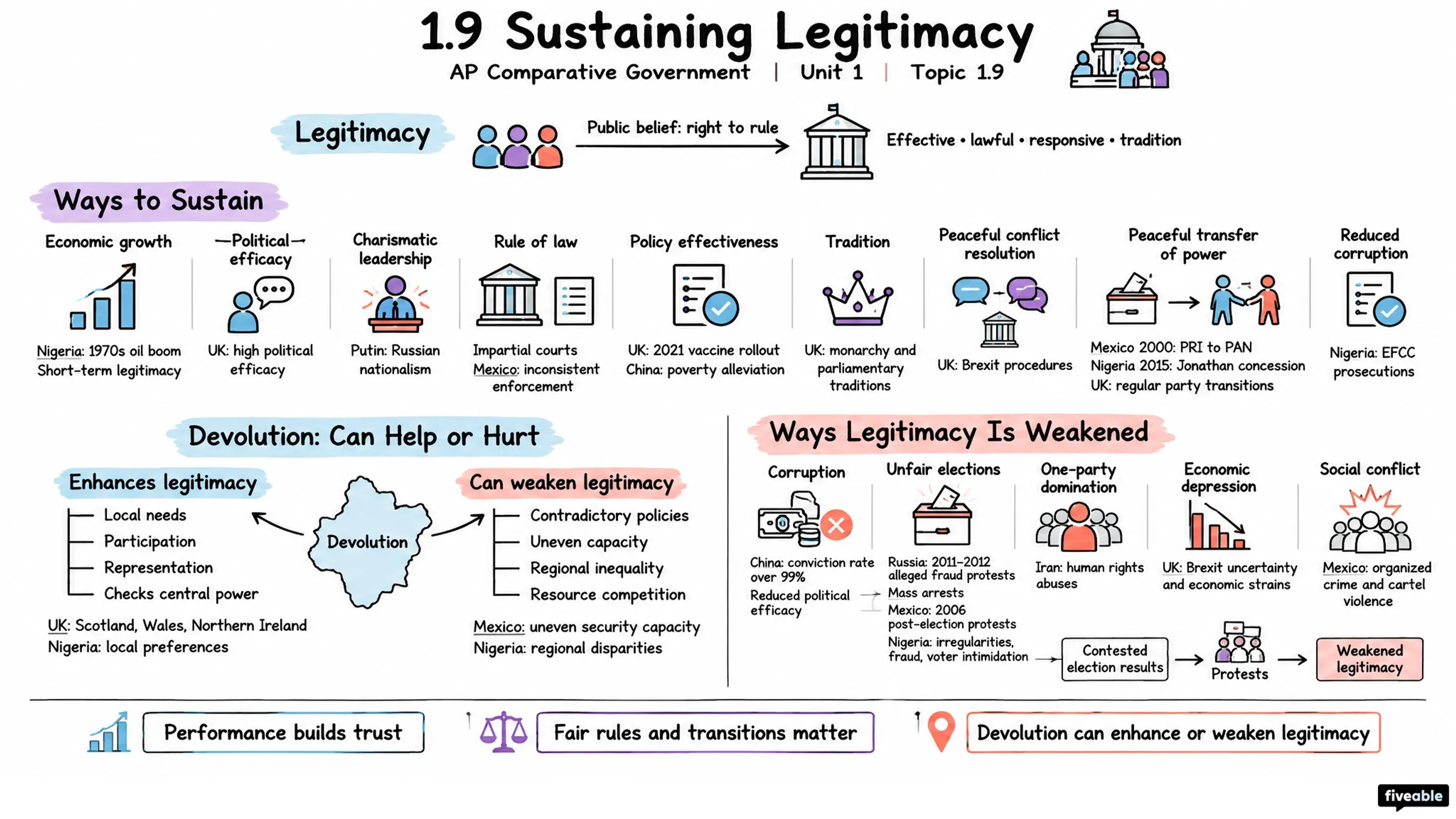
  • Political Legitimacy: Sources & Maintenance

  • Sources of Power & Authority

  • Federal vs. Unitary Systems

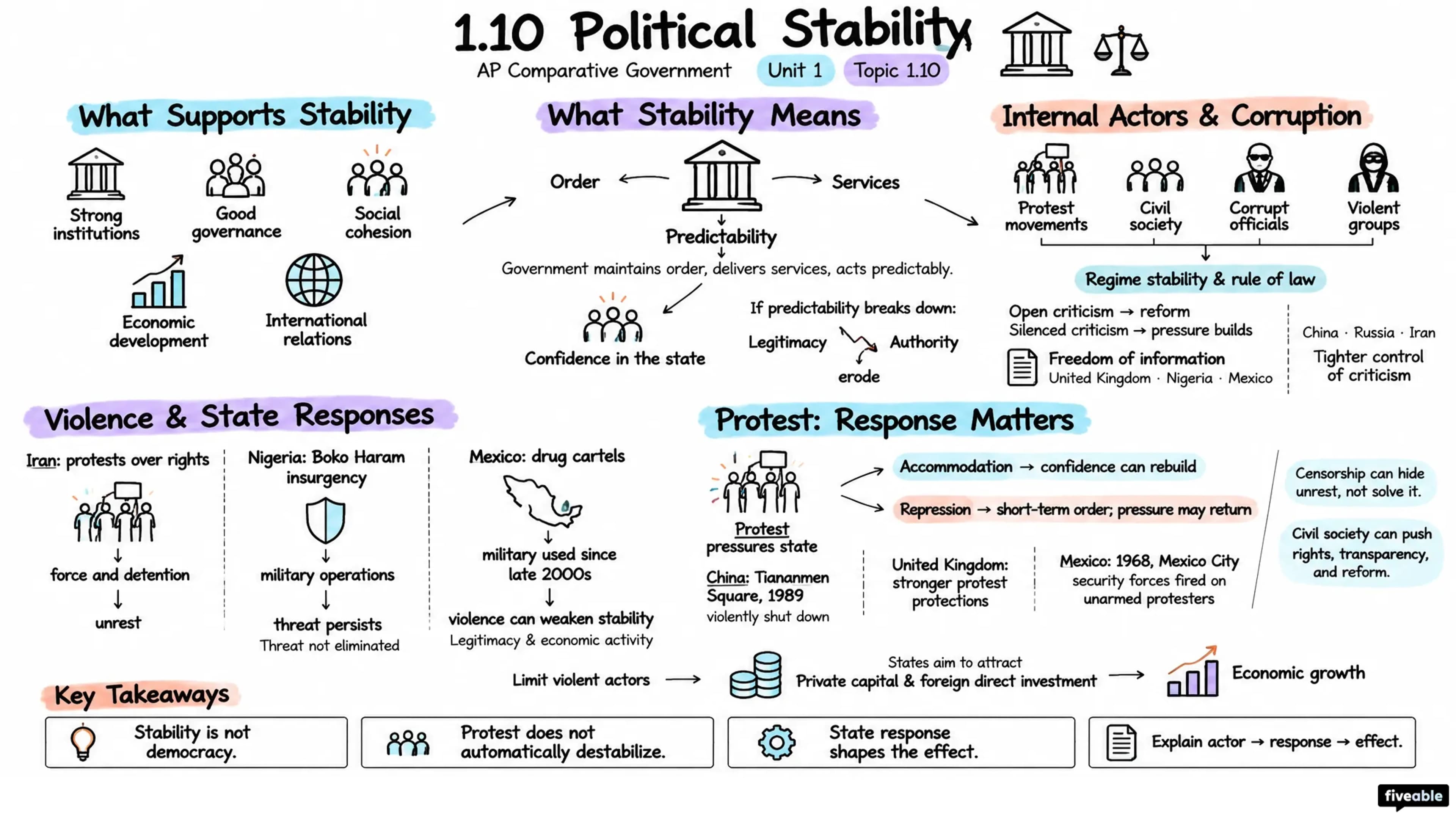
  • Devolution & Political Stability

Made by Fiveable

Text-Based Cheatsheet

Unit 1: Political Systems, Regimes, and Governments on one page, aligned to the 2026-2027 course. Made and checked by the Fiveable Content Team.

Or get the whole course

Made by you

Visual Cheatsheets

Pick a Unit 1 topic and a format: flowchart, comparison chart, vocab sheet, Cornell notes and more. Ready in about a minute.

Printable PDF · from the Fiveable shop

AP Comparative Government Unit 1 Cheatsheet

1 page · Political Systems, Regimes, and Governments · PDF

Visual Cheatsheets

One topic, the format you pick, ready in about a minute

Format

Topic

Takes 30–60 seconds

Preview: Standard

Unit 1: Political Systems, Regimes, & Governments, topic by topic

Each topic has a full study guide. See the whole unit.