AP Calculus AB/BC Calculator FRQ Practice
60 calculator-required FRQs written in the AP format for Calculus AB and BC. Pick one, read the full question, and write your response. Fiveable scores each Calculator FRQ response part by part on the AP rubric.
Your first scored response is included. A plan unlocks unlimited scoring.
60 questions
sorted by unit
Removable discontinuities and instantaneous rates of change
Unit 1: Limits and Continuity
The following functions are defined for this question:
The function is defined for . The function is defined for . Figure 1 shows the graphs of these functions. A graphing calculator may be used to help analyze the behavior of these functions near their points of discontinuity and as .
Figure 1. Graphs of y = k(x) and y = p(x) with discontinuities highlighted (hole at x = 2 for both; vertical asymptote at x = 3 for p).
Use correct limit notation to represent . Then find the value of the limit. Show the work that leads to your answer.
Let approach 2 through the values 1.9, 1.99, 2.01, and 2.1.
(i) Use a calculator to approximate the average rate of change of on the interval .
(ii) Use a calculator to approximate the average rate of change of on the interval .
(iii) Define by for and . Based on your results in parts (i) and (ii), estimate . Justify your reasoning.
Write a limit expression that describes the end behavior of as . Then evaluate the limit using limit theorems.
Define a new function by Continuity of a piecewise-defined function at is enforced by matching the function value to the two-sided limit.
Find the value of the constant such that is continuous at . Justify your answer using the definition of continuity at a point.
What the Calculator FRQ asks
Calculator-required FRQs are questions 1 and 2 on the AP Calculus AB and BC exams, in Part A of the FRQ section. Each has four parts built around a context, a function, a graph, or a table, and a graphing calculator is required.
- 30 min
- for the 2 questions in Part A
- 9 points
- across parts A to D
- 50%
- of your score, for all six FRQs
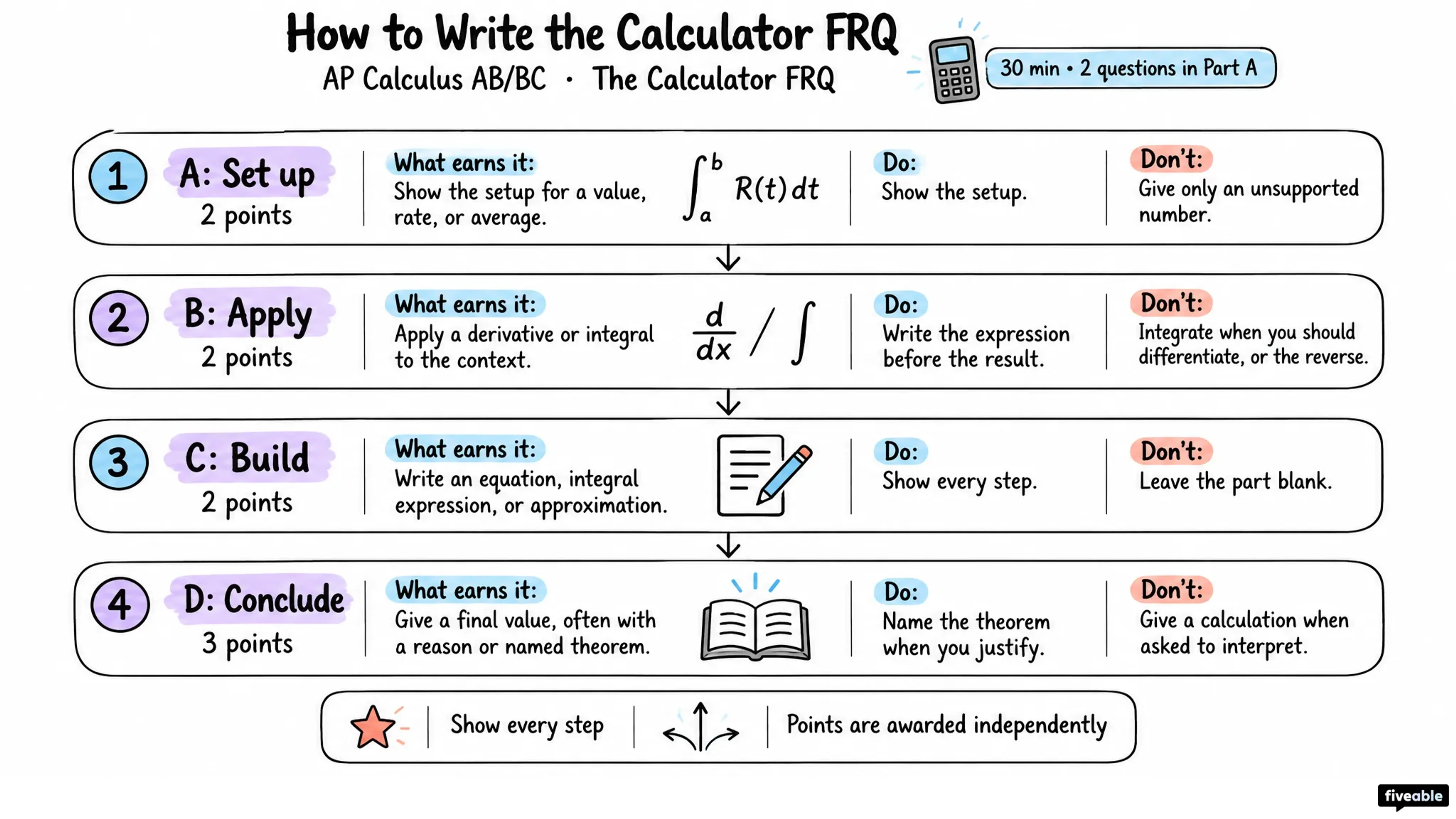
Part A: Set up
Often a value, rate, or average from the given model, with the setup shown
2 pts
Part B: Apply
A derivative or integral applied to the context, with the expression before the result
2 pts
Part C: Build
Often an equation, integral expression, or approximation to write
2 pts
Part D: Conclude
A final value, often backed by a reason or a named theorem
3 pts
Calculator FRQ skill sheet
Every rubric point on one page: what earns it, what to do and what to avoid. Tap the sheet to see it full size.
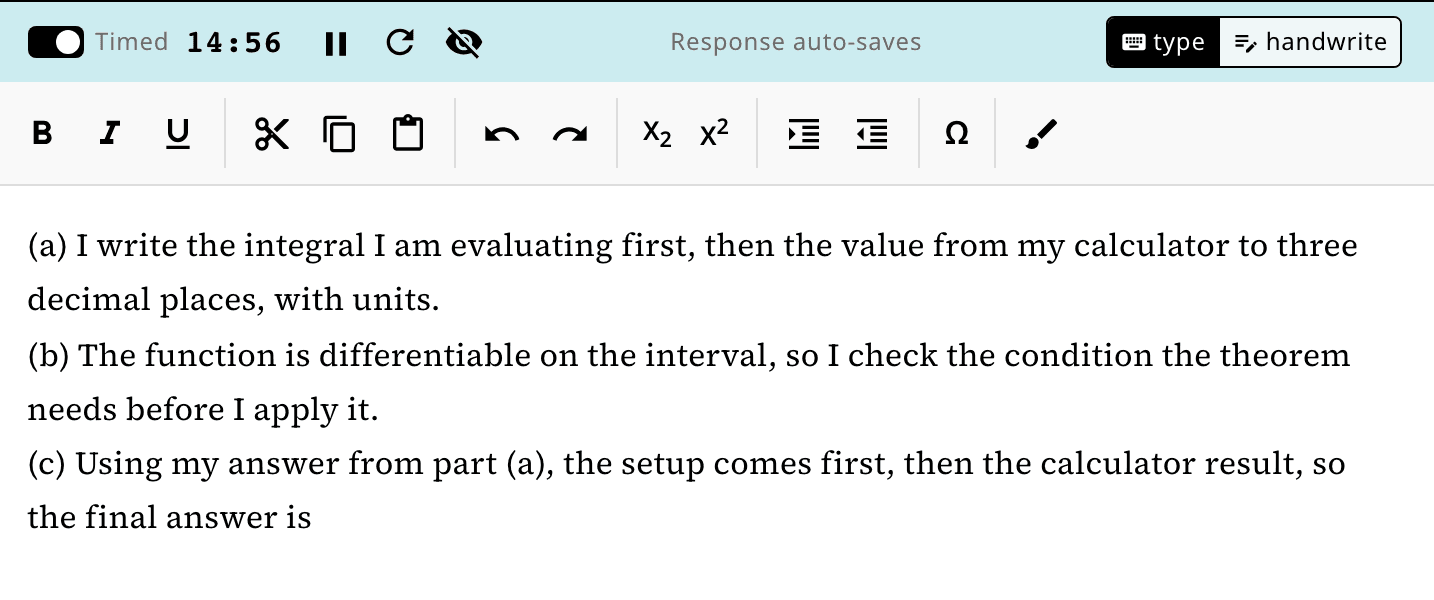
How Calculator FRQ practice works
Each question follows the exam’s format, from the full prompt to a score on every part.
Read the full question
The setup, any graph or table, and parts A to D, laid out the way the exam shows them.
Write on a 15-minute timer
About the time each question gets on exam day. Pause it or turn it off, and your response saves as you go.
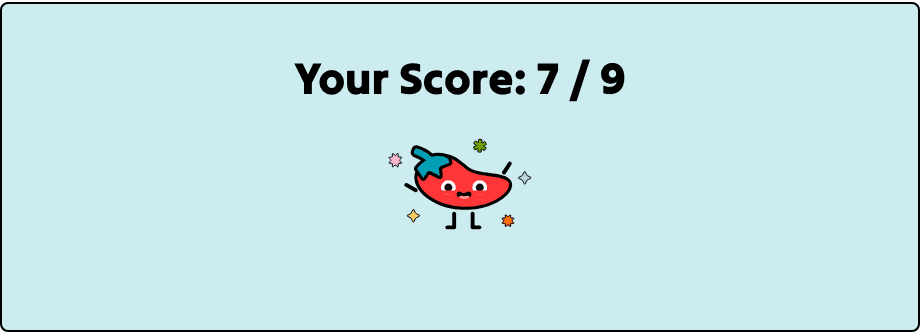
Submit for a score out of 9
Your response is scored against the scoring guidelines written for that question. Your first score is included.
Feedback on every part
A summary at the top tells you what to work on next. Below it, each part shows whether you earned the point and what the scoring guidelines were looking for.
Detailed Feedback
Part A(A1): 1/1 point
The student correctly sets up the difference quotient (W(2.1) - W(1.9)) / (2.1 - 1.9), which matches the required form. This earns A1.
Part A(A2): 0/1 point
The student's final answer of 1.225 is incorrect. The correct value is approximately 1.222. The student made a rounding error when computing W(2.1) ≈ 3.455 (correct is ≈ 3.4548) and W(1.9) ≈ 3.210 (correct is ≈ 3.2103), leading to a slightly off numerator. The answer 1.225 does not match the required 1.222 to three decimal places, so A2 is not earned.
Part B(B1): 1/1 point
The student explicitly references the interval [1.9, 2.1] from Part A, which contains t = 2, and sets up the difference quotient (W(2.1) - W(1.9)) / (2.1 - 1.9). This is a valid setup for estimating W'(2), earning B1.
Questions about the Calculator FRQ
How many responses can I get scored?
You can read every question without a plan. Your first scored response is included. A plan unlocks unlimited scoring.
Can I use a calculator while I practice?
Yes. Calculator-required questions open a graphing calculator from the question panel. Write the integral or equation you evaluated, then the result to three decimal places.
How do I type math in my answer?
Type it in plain text, use the superscript button for exponents, and pick symbols like ∫ and √ from the special characters menu. You can also switch to handwrite and add a photo of your work.
Are these for Calculus AB or BC?
Both. The AB and BC exams use the same FRQ format, and some of these questions cover BC-only topics like series and parametric equations.
How are the 9 points split?
Across parts A to D, most often 2, 2, 2, and 3. The split changes by question, and on the exam each part is scored on its own.
More AP Calculus AB/BC practice
No-Calculator FRQ practice
No-calculator FRQs with the full setup and all four parts.
AP Calculus AB/BC FRQs
Every FRQ type for AP Calculus AB/BC, with practice for each.
See the Calculator FRQ rubric points students miss most, from responses scored on Fiveable.
Write your first Calculator FRQ
Pick one from the list, or let us choose for you.
Teaching AP Calculus AB/BC? Assign these Calculator FRQs to your class