AP Art & Design Unit 1 Cheatsheet: Investigate

AP Art & Design Unit 1 Cheatsheet: Investigate

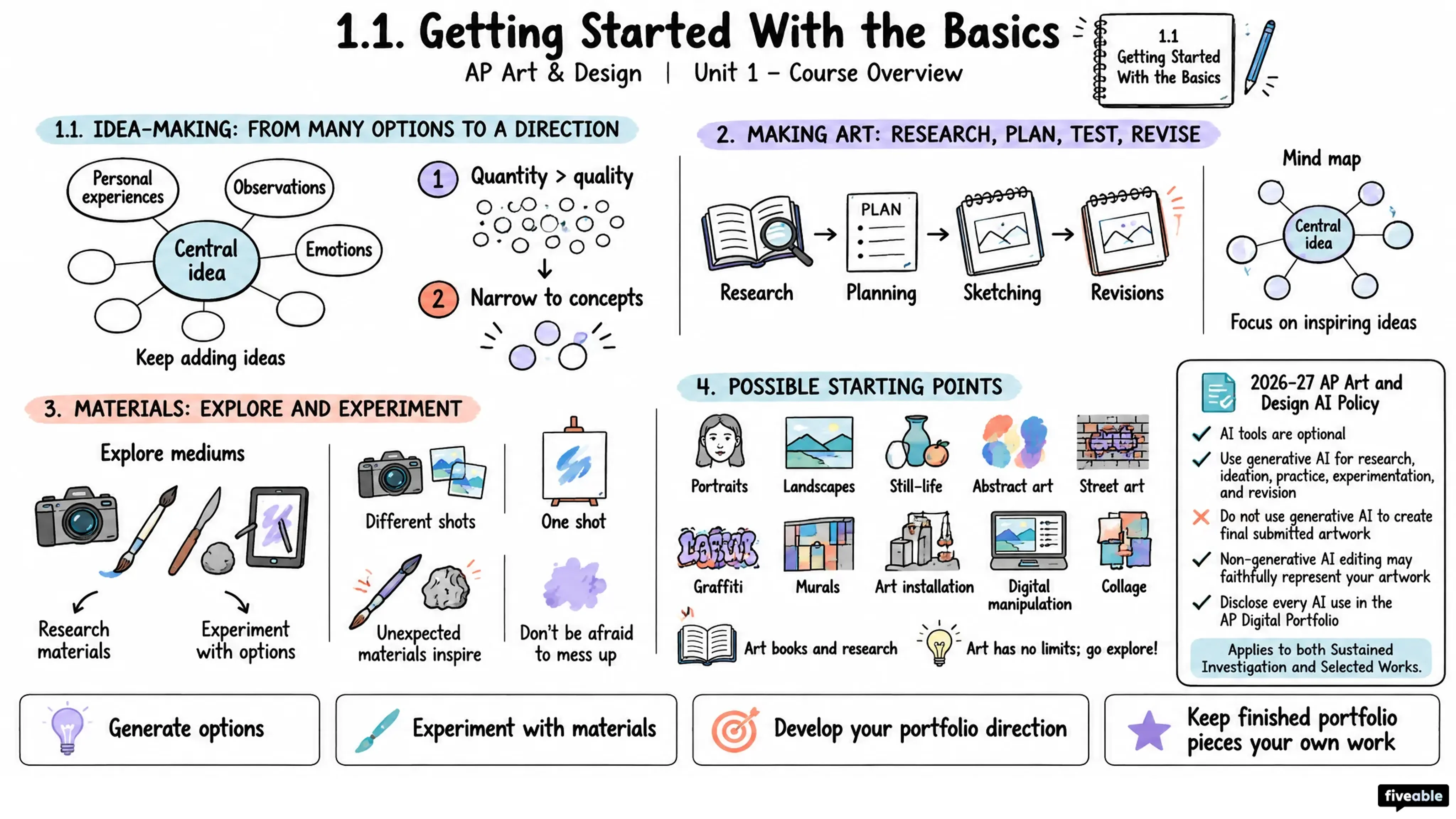
Start with the first 3 sections of the Unit 1 one-page cheatsheet below. The full sheet is a PDF you can print.

Generating Possibilities: Experience & Documentation

Experience = event or occurrence (actual surroundings, abstract concepts, communication, research).

  • Reflecting on experiences sparks questions and investigation
  • Document by recording observations and perceptions

Documentation formats: images (drawings, photos, diagrams, videos), material samples, models, verbal description, sound.

Key purpose: Documentation shared with viewers affects interpretation and generates feedback, deepening artist/designer understanding.

Interpretation = understanding based on personal experiences and perspectives.

Feedback = information about how someone responds (spontaneous/informal or formal/structured; conversation, written, nonverbal). Ideally constructive.

Viewers include the artist/designer themselves.
Selecting Materials, Processes & Ideas

Selection can be:

  • Intentional: based on experiences, interests, material/tool availability
  • Spontaneous: open to experimentation and discovery
  • Strategic: focused on a question, hypothesis, or goal

Consider attributes:

  • Inherent (observable, physical)
  • Interpreted (determined by context, personal and cultural perspectives)

Expand possibilities: Investigate materials, processes, and ideas beyond traditional use. Research how diverse thinkers and makers work.

Interconnection: Selecting one component (e.g., material) leads to questions about others (processes, ideas, connotations).

Document selections with images, material samples, models, verbal identification, questions, rationales, sound—becomes a resource and can be shared or presented as part of sustained investigation.

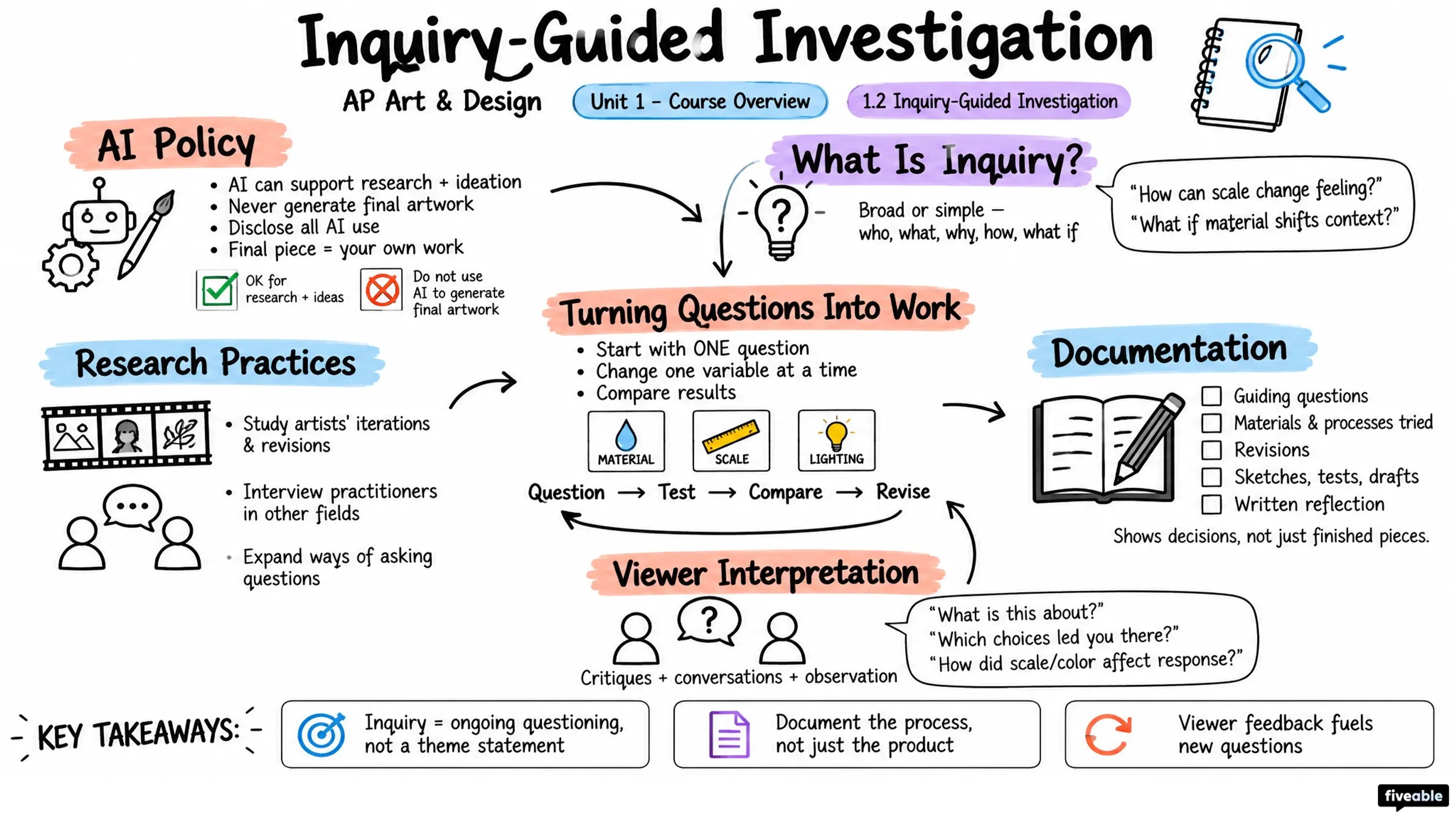
Sustained Investigation & Inquiry

Sustained investigation = inquiry-based, in-depth study of materials, processes, and ideas over time.

Expands awareness of possibilities for making; includes research across and beyond art and design disciplines.

Guided by questions: who, what, when, where, why, how, what if, why not.

Investigation involves: perception, curiosity, examination, discovery, imagination, interpretation, description, conversation.

Outcomes: Confirms and challenges thinking; reveals connections and opportunities.

Research examples:

  • Indirect: examine how a designer's work shows evidence of inquiry
  • Direct: talk with practitioners about their questions and investigative processes

Document: questions, lines of inquiry, investigative processes (practice, experimentation, revision), outcomes (learning, new questions).

The rest of the Unit 1 sheet

5 more sections are on the one-page PDF:

  • Context & Interpretation of Art and Design

  • Evaluation: Evidence & Relationships

  • Art & Design Traditions

  • Documentation as Resource & Communication

  • Common Study Moves for Unit 1 Test

Made by Fiveable

Text-Based Cheatsheet

Unit 1: Investigate on one page, aligned to the 2026-2027 course. Made and checked by the Fiveable Content Team.

Made by you

Visual Cheatsheets

Pick a Unit 1 topic and a format: flowchart, comparison chart, vocab sheet, Cornell notes and more. Ready in about a minute.

Printable PDF · from the Fiveable shop

AP Art & Design Unit 1 Cheatsheet

1 page · Investigate · PDF

Visual Cheatsheets

One topic, the format you pick, ready in about a minute

Format

Topic

Takes 30–60 seconds

Preview: Standard

Unit 1: Course Overview, topic by topic

Each topic has a full study guide. See the whole unit.