
Chebyshev's functions offer a new way to study prime numbers. By summing logarithms of primes and prime powers, they provide smoother growth compared to the prime counting function. This makes them easier to analyze and estimate.
These functions are closely tied to the distribution of primes. They grow similarly to x, which helps prove important results like Chebyshev's bounds and eventually led to the Prime Number Theorem. Understanding them is key to grasping prime number behavior.
Chebyshev's Functions
Defining Chebyshev's Theta and Psi Functions
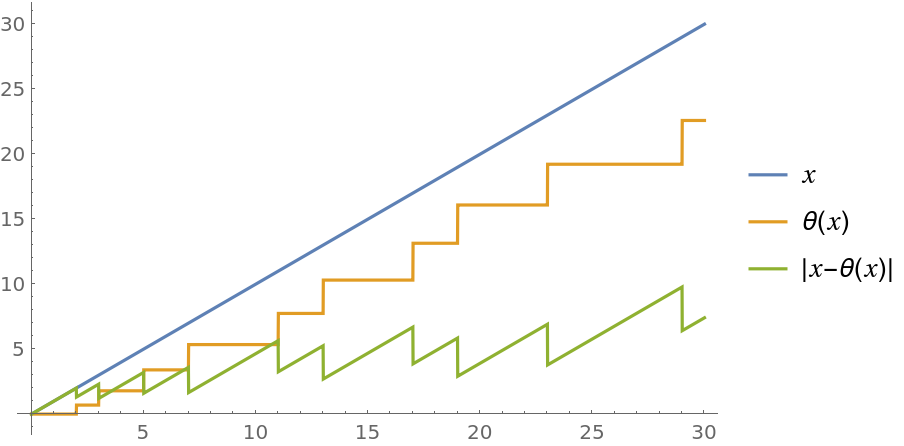
- Chebyshev's θ(x) function sums logarithms of primes not exceeding x
- θ(x) defined as
- Chebyshev's ψ(x) function sums logarithms of prime powers not exceeding x
- ψ(x) defined as
- Both functions provide alternative ways to study prime number distribution
- θ(x) focuses on primes while ψ(x) includes prime powers
- Functions grow similarly to x, providing insights into prime number behavior
Relationship to Prime Counting Function
- Prime counting function π(x) counts primes not exceeding x
- θ(x) and ψ(x) relate to π(x) through asymptotic equivalences
- Approximate relationship:
- These relationships allow for estimates of π(x) using Chebyshev's functions
- Studying θ(x) and ψ(x) often proves easier than directly analyzing π(x)
- Chebyshev's functions provide smoother growth compared to π(x)
Properties and Asymptotic Behavior
- Both θ(x) and ψ(x) exhibit step-function behavior
- Functions increase only at prime powers, remaining constant between them
- Asymptotically, θ(x) and ψ(x) grow similarly to x
- Prime Number Theorem equivalent to
- ψ(x) grows slightly faster than θ(x) due to inclusion of prime powers
- Studying these functions aids in understanding prime number distribution
Chebyshev's Bounds and Theorems
Chebyshev's Bounds for Prime Distribution
- Chebyshev proved existence of constants 0 < c < C such that for sufficiently large x
- These bounds demonstrate θ(x) grows linearly with x
- Chebyshev's work laid foundation for Prime Number Theorem
- Bounds apply to ψ(x) and π(x) with appropriate modifications
- Chebyshev's original values: c = 0.921 and C = 1.106
- Modern refinements have narrowed gap between c and C
Mertens' Theorems and Prime Number Products
- Mertens' First Theorem:
- Mertens' Second Theorem:
- Mertens' Third Theorem:
- γ represents Euler-Mascheroni constant
- M denotes Meissel-Mertens constant
- These theorems provide insights into prime number behavior and distribution
- Results useful in studying convergence of infinite products over primes

Explicit Formulas and Advanced Estimates
- Explicit formula for ψ(x) involves complex analysis and Riemann zeta function
- Formula expresses ψ(x) in terms of zeros of Riemann zeta function
- ρ represents non-trivial zeros of Riemann zeta function
- Formula provides deep connection between primes and complex analysis
- Allows for more precise estimates of prime-counting functions
- Riemann Hypothesis would imply strongest known error terms for these estimates
Connection to Riemann Zeta Function
Zeta Function and Prime Number Theory
- Riemann zeta function ζ(s) defined for Re(s) > 1 as
- Euler product formula connects ζ(s) to primes:
- This connection forms bridge between complex analysis and prime numbers
- Studying ζ(s) provides insights into prime number distribution
- Zeros of ζ(s) play crucial role in understanding prime number behavior
Analytic Continuation and Functional Equation
- ζ(s) analytically continues to entire complex plane except s = 1
- Functional equation relates values of ζ(s) and ζ(1-s)
- Γ(s) represents the gamma function
- Equation reveals symmetry in behavior of ζ(s)
- Critical strip 0 ≤ Re(s) ≤ 1 contains all non-trivial zeros of ζ(s)
- Understanding zeros in critical strip key to improving prime number estimates
Riemann Hypothesis and Prime Distribution
- Riemann Hypothesis states all non-trivial zeros have real part 1/2
- Unproven conjecture with profound implications for prime number theory
- Riemann Hypothesis would imply strongest known error term for π(x)
- Li(x) denotes logarithmic integral function
- Hypothesis would provide deep insights into distribution of prime numbers
- Verifying Riemann Hypothesis remains one of greatest unsolved problems in mathematics