
Types of Conflict
Conflict shows up in every collaborative writing project. That's not a bad thing by default. The key is recognizing what kind of conflict you're dealing with so you can respond appropriately and keep the project moving forward.
Interpersonal vs. Intergroup
Interpersonal conflict occurs between two or more individuals, often due to differences in personalities, values, or working styles. In a team writing context, this might look like two cowriters disagreeing about the tone of a document or clashing over who should draft which section.
Intergroup conflict arises between different groups or teams. Think of a situation where the design team and the content team have competing priorities for a shared deliverable, or two subgroups within a larger project disagree on the document's scope.
Constructive vs. Destructive
Not all conflict hurts a project:
- Constructive conflict leads to better outcomes. Team members challenging each other's ideas, questioning weak arguments, or pushing for stronger evidence can produce a much better final document.
- Destructive conflict damages relationships and stalls progress. Personal attacks, passive-aggressive behavior, gossip, and refusal to cooperate all fall here.
The difference often comes down to whether the conflict targets ideas or people.
Sources of Conflict
Common triggers in collaborative writing projects include:
- Miscommunication or lack of communication — unclear expectations about deadlines, roles, or document standards
- Differences in values or working styles — one member prefers detailed outlines while another wants to draft freely
- Competition for limited resources — time pressure, unequal workloads, or credit for contributions
- Power imbalances — one member dominating decisions or dismissing others' input
Conflict Management Strategies
Choosing the right strategy depends on the situation: how serious the conflict is, how important the relationship is, and how much time you have. Effective conflict management means balancing your own needs against the needs of others on the team.
Avoidance vs. Confrontation
- Avoidance means withdrawing from or sidestepping the conflict. This can be appropriate for minor issues, like a small stylistic preference that doesn't affect the document's quality. But avoiding serious problems usually makes them worse.
- Confrontation means directly addressing the conflict and working toward a resolution. For ongoing communication breakdowns or unequal contributions, this is necessary. Schedule a conversation rather than letting resentment build.
Compromise vs. Collaboration
- Compromise means each party gives up something to reach a workable solution. This is useful when time is tight or when no perfect answer exists. For example, two writers might agree to use one person's organizational structure but the other's introduction.
- Collaboration means working together to find a solution that genuinely satisfies everyone's concerns. This takes more time and effort but tends to produce the strongest results. A team might brainstorm a completely new approach to a document that incorporates the best ideas from each member.
Mediation and Arbitration
When a team can't resolve a conflict internally:
- Mediation involves a neutral third party (like an instructor or project manager) facilitating a discussion to help the conflicting parties reach their own agreement.
- Arbitration involves a neutral third party hearing both sides and making a binding decision. In a classroom setting, this might be an instructor deciding how to redistribute work on a group project.
Effective Communication in Conflict
Clear, respectful communication is the foundation of productive conflict resolution. Most team conflicts escalate because of how things are said, not just what is said.
Active Listening Skills
Active listening means fully focusing on understanding the other person's perspective rather than planning your rebuttal. Key techniques include:
- Paraphrasing — restating what someone said in your own words to confirm understanding ("So what you're saying is...")
- Asking clarifying questions — "Can you give me an example of what you mean?"
- Acknowledging feelings — "I can see why that deadline change would be frustrating"
Assertive vs. Aggressive Communication
Assertive communication expresses your needs directly and respectfully. Use "I" statements: "I feel overwhelmed when assignments are added at the last minute without discussion."
Aggressive communication uses hostile, confrontational, or manipulative language. Yelling at a teammate for missing a deadline or making sarcastic comments about their writing quality will escalate the conflict and erode trust.
The distinction matters: assertive communication protects your boundaries while respecting others. Aggressive communication prioritizes dominance over resolution.
Emotional Intelligence and Empathy
Emotional intelligence is the ability to recognize and manage your own emotions while understanding and responding to others' emotions. In a heated team discussion, this might mean noticing you're getting defensive and pausing before responding.
Empathy means putting yourself in someone else's position and understanding their perspective, even when you disagree. Acknowledging a teammate's frustration with a difficult section before jumping to solutions builds trust and makes collaboration easier.
Problem-Solving Approaches
When conflict stems from a genuine problem (missed deadlines, unclear direction, quality concerns), a structured problem-solving process keeps the team focused on solutions rather than blame.
Defining the Problem
- Gather information from all team members involved.
- Identify the key issues and separate facts from assumptions.
- Write a specific problem statement focused on root causes, not symptoms.
For example, "Our drafts keep contradicting each other" is a symptom. The root cause might be "We never agreed on a central argument before splitting up sections."
Generating Alternative Solutions
Brainstorm a range of potential solutions before evaluating any of them. Techniques include:
- Mind mapping to visually connect related ideas
- Round-robin brainstorming where each person contributes one idea at a time
- Seeking input from outside the team for fresh perspectives
The goal is quantity first, quality second. Don't shut down ideas too early.
Evaluating and Selecting Solutions
Once you have a list of options, evaluate them against clear criteria:
- Feasibility — Can the team actually do this given time and resources?
- Effectiveness — Does it address the root cause?
- Consequences — What are the risks or trade-offs?
- Alignment with goals — Does it serve the project's purpose?
Ranking alternatives against these criteria, or using a simple decision matrix, helps the team make a choice they can all support.
Decision-Making Processes
Teams need to decide how they'll make decisions before conflicts arise. Otherwise, every disagreement becomes a meta-argument about who gets to decide.
Individual vs. Group Decisions
- Individual decisions are faster. A team leader might decide formatting standards or assign sections. This works for low-stakes choices where efficiency matters more than input.
- Group decisions bring more perspectives and build buy-in, but they take longer and can be vulnerable to groupthink (where the desire for harmony overrides honest evaluation of alternatives). Use group decision-making for high-stakes choices like the document's thesis, structure, or audience approach.
Rational vs. Intuitive Decisions
- Rational decision-making follows a structured process: define the problem, gather information, evaluate alternatives, and select the best option based on objective criteria. This works well when you have time and data.
- Intuitive decision-making relies on experience and judgment. A team member who's written many similar documents might sense that a particular approach won't work. Intuition is useful under time pressure, but it should be checked against evidence when possible.
Decision-Making Models and Tools
Several frameworks can structure team decisions:
- Decision trees map out potential outcomes and their probabilities
- Cost-benefit analysis weighs the advantages and disadvantages of each option
- Multi-criteria decision analysis scores options against weighted criteria
Even a simple pros-and-cons list, done collaboratively, is better than an unstructured debate.
Overcoming Decision-Making Biases
Cognitive biases are mental shortcuts that can distort judgment. In team settings, these biases often go unchecked because everyone assumes the group is being objective.
Common Cognitive Biases
- Confirmation bias — seeking out information that supports what you already believe. A team might only look for evidence that their chosen approach is correct while ignoring signs it isn't working.
- Anchoring bias — relying too heavily on the first piece of information encountered. If the first draft sets a particular tone, the team may resist changing it even when a different tone would be more effective.
- Sunk cost fallacy — continuing with a failing approach because of the time already invested. "We've already written 10 pages this way" is not a good reason to keep going if the approach is wrong.
Strategies for Unbiased Decisions
- Actively seek out dissenting opinions rather than treating disagreement as a problem
- Use structured decision-making tools (decision matrices, criteria-based evaluation) to ground choices in evidence
- Assign a devil's advocate role: one team member argues against the preferred option to test its strength
Benefits of Diverse Perspectives
Teams with members who think differently produce better work. Different backgrounds, expertise, and viewpoints help challenge assumptions, surface blind spots, and generate more creative solutions. This is one of the core reasons collaborative writing exists in the first place.
Diversity also counteracts groupthink. When everyone on a team shares the same perspective, it's easy to mistake agreement for correctness.
Implementing and Evaluating Decisions
Choosing a direction is only half the work. The team also needs to plan how to carry it out, track progress, and adjust when things don't go as expected.
Action Planning and Timelines
Break the selected solution into specific, time-bound steps:
- Identify each task that needs to happen.
- Assign clear ownership for each task.
- Set deadlines and milestones.
- Identify dependencies (what needs to be done before something else can start).
Tools like shared project boards, Gantt charts, or even a simple spreadsheet with tasks, owners, and due dates keep everyone accountable.
Monitoring Progress and Outcomes
Regular check-ins help catch problems early. Establish what success looks like upfront:
- Are drafts being completed on schedule?
- Is the document meeting quality standards?
- Are team members communicating effectively?
Tracking these indicators lets the team course-correct before small issues become major problems.
Adjusting and Adapting as Needed
No plan survives contact with reality perfectly. Build in flexibility:
- Schedule regular review points (weekly check-ins, milestone reviews)
- Plan for contingencies ("If this section takes longer than expected, here's how we'll adjust")
- Treat changes as normal, not as failures
Building Consensus and Buy-In
A decision that half the team resents will be poorly implemented. Getting genuine agreement takes effort, but it pays off in commitment and follow-through.
Stakeholder Engagement Strategies
- Identify who has influence, interest, or will be affected by the decision
- Involve team members in defining problems and generating solutions rather than presenting them with a finished plan
- Communicate regularly about progress, challenges, and changes
When people help shape a decision, they're far more likely to support it.
Addressing Resistance and Concerns
Resistance usually has a reason. Rather than dismissing it:
- Ask what specific concerns the person has
- Provide clear information about why the decision was made and what benefits are expected
- Be willing to adjust the plan if a concern is legitimate
For example, if a team member resists a new document structure, find out whether they're concerned about extra work, unclear expectations, or something else entirely. Then address the actual concern.
Facilitating Group Discussions
Good facilitation keeps discussions productive. Key techniques:
- Set a clear agenda so everyone knows what needs to be decided
- Establish ground rules (e.g., critique ideas, not people; let everyone speak before responding)
- Encourage equal participation using techniques like round-robin sharing
- Summarize key points periodically to keep the group aligned
- Manage time so discussions don't spiral
A gradient of agreement scale (where members rate their support from "fully support" to "can't live with it") can reveal where true consensus exists and where more discussion is needed.
Conflict Resolution in Teams
Collaborative writing projects bring together people with different skills, habits, and communication styles. Some friction is inevitable. The goal isn't to eliminate conflict but to handle it in ways that strengthen the team and the final product.
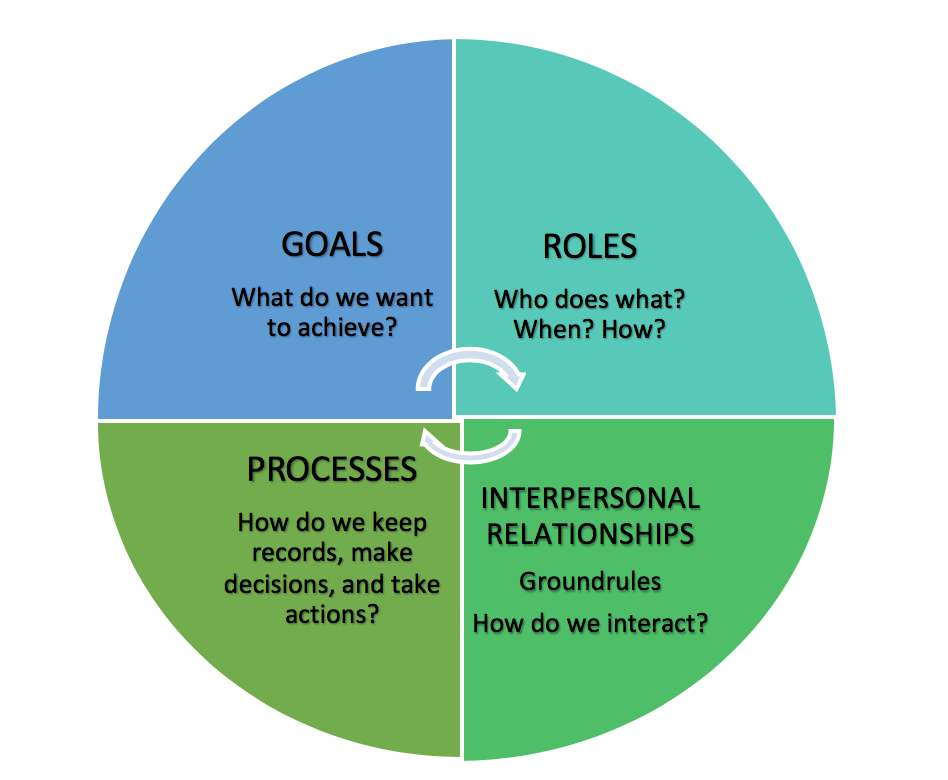
Roles and Responsibilities
Many team conflicts stem from ambiguity about who's doing what. Prevent this by:
- Clearly defining each person's role and responsibilities at the project's start
- Making sure everyone understands not just their own tasks but how they connect to others' work
- Using a RACI matrix (Responsible, Accountable, Consulted, Informed) to map out ownership for each project task
Establishing Team Norms and Guidelines
Team norms are agreed-upon expectations for how the group will work together. Develop these collaboratively at the start of a project:
- How will the team communicate (email, group chat, meetings)?
- What are the expectations for response times?
- How will the team give and receive feedback on each other's writing?
- What's the process for resolving disagreements?
Having these norms in writing gives the team a reference point when conflicts arise. Revisit and update them as the project evolves.
Fostering a Collaborative Culture
A strong team culture makes conflict resolution much easier. Build this by:
- Practicing active listening and empathy in every interaction
- Treating disagreements about content as opportunities to improve the document
- Starting meetings with brief check-ins so members can flag concerns early
- Viewing mistakes and "failed" drafts as learning opportunities rather than personal failures
Teams that trust each other can disagree productively. Teams that don't trust each other turn every disagreement into a personal conflict.
Ethical Considerations in Decisions
Team decisions carry ethical weight, especially in communication projects where the final product reaches an audience. Considering the moral dimensions of your choices leads to more responsible and sustainable outcomes.
Balancing Individual and Collective Interests
Ethical decisions often require weighing one person's needs against the group's. In a team writing project, this might mean deciding whether to credit a member who contributed minimally, or whether to override one person's strong preference for the good of the document.
Two common ethical frameworks can help:
- Utilitarianism asks: which choice produces the greatest overall benefit?
- Deontology asks: which choice follows the right moral rules or duties?
These frameworks sometimes point in different directions, which is why ethical decisions are rarely simple.
Assessing Short-Term vs. Long-Term Impacts
A quick fix now can create bigger problems later. Cutting corners on research to meet a deadline might save time today but undermine the document's credibility. Ethical decision-making means weighing immediate convenience against long-term consequences for the team, the project, and the audience.
Incorporating Values and Principles
Shared values like integrity, transparency, and accountability should guide team decisions. Practical ways to do this:
- Reference your team's stated values when evaluating options
- Use a values-based decision matrix to score alternatives against core principles
- Hold each other accountable for ethical conduct, not just task completion
When values are part of the conversation from the start, ethical decision-making becomes a habit rather than an afterthought.