10.4 Domestic politics and foreign policy

🫱🏼🫲🏾Theories of International Relations Unit 10 Review
10.4 Domestic politics and foreign policy
🫱🏼🫲🏾 Theories of International Relations
Domestic political systems
Domestic politics shape foreign policy in ways that go well beyond what leaders personally want. The institutions a leader operates within, the public they answer to, and the interest groups competing for influence all constrain and direct how a state behaves internationally. Understanding these domestic-level factors is central to Foreign Policy Analysis because they explain why states with similar power positions often make very different choices.
This section covers the major domestic factors: regime type, bureaucratic and decision-making models, individual leadership, economic pressures, security concerns, historical legacies, and comparative patterns across political systems.

Top images from around the web for Regime types and foreign policy
Political spectrum - Wikipedia View original
Is this image relevant?
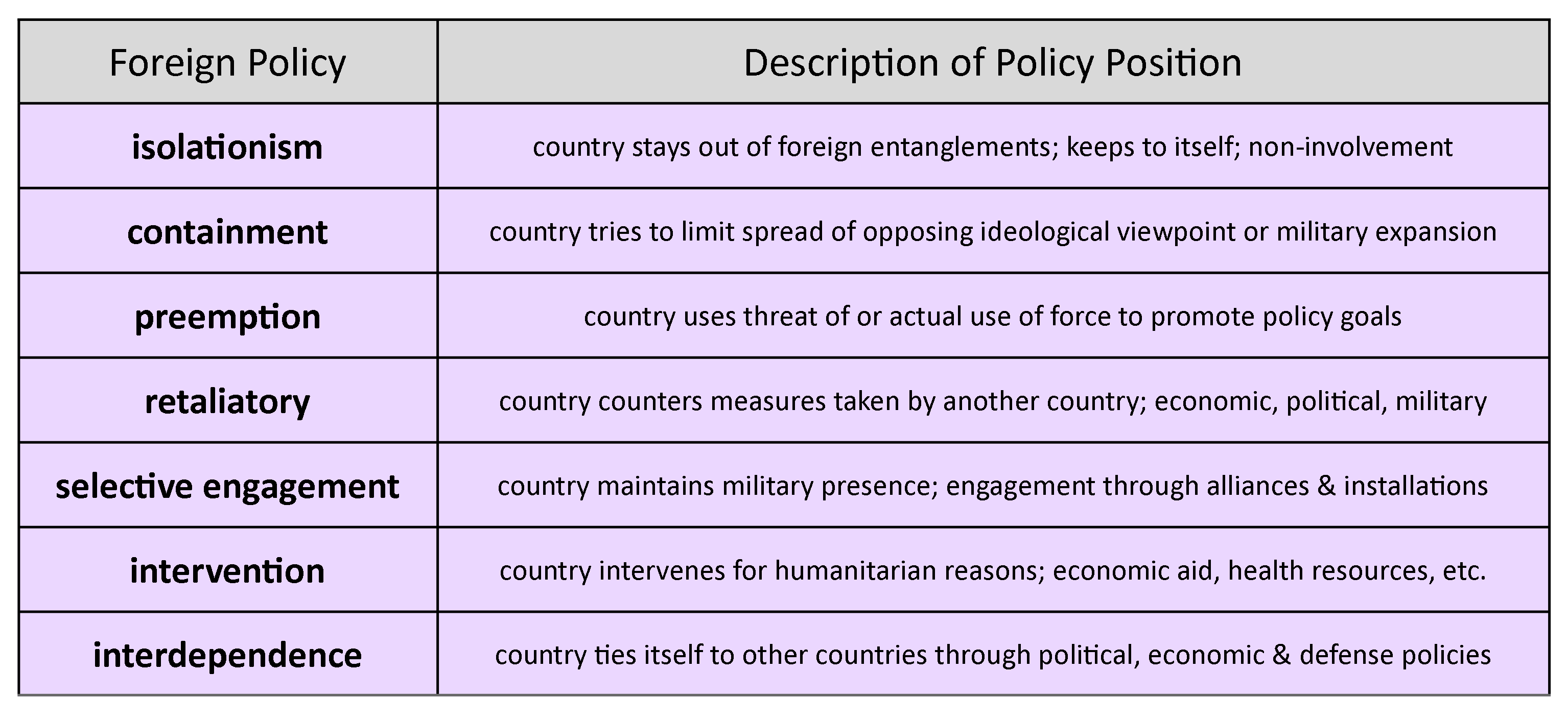
Foreign Policy: Approaches | United States Government View original
Is this image relevant?
United States Government: Why form a government? | United States Government View original
Is this image relevant?
Political spectrum - Wikipedia View original
Is this image relevant?
Foreign Policy: Approaches | United States Government View original
Is this image relevant?
Regime types and foreign policy
The type of political system a country has fundamentally shapes how foreign policy gets made.
- Democracies tend to be more transparent and constrained. Leaders face checks and balances, legislative oversight, and electoral accountability. These pressures often push democracies toward multilateral cooperation, alliance-building, and stated commitments to human rights and international law.
- Authoritarian regimes have fewer institutional constraints, giving leaders more flexibility and speed in foreign policy decisions. However, their core foreign policy goals often center on regime survival and sovereignty rather than broader normative commitments.
- These are tendencies, not absolutes. Democracies can act aggressively, and authoritarian states can cooperate internationally when it serves their interests.
Institutional constraints on leaders
Even powerful executives don't have a free hand in foreign policy. Institutional structures limit what leaders can do unilaterally:
- Separation of powers divides authority. In the U.S., for example, the president negotiates treaties, but the Senate must ratify them by a two-thirds vote.
- Legislative oversight includes war powers, budget approval for military operations, and confirmation of ambassadors. These processes force the executive to build support before acting.
- Judicial review can challenge the legality of foreign policy actions. Courts may rule on the constitutionality of executive orders related to immigration, sanctions, or military deployments.
The strength of these constraints varies by country. Presidential systems, parliamentary systems, and semi-presidential systems each distribute foreign policy authority differently.
Public opinion and mass media
In democracies, public opinion acts as both a constraint and a resource for leaders.
- Leaders who pursue unpopular foreign policies risk electoral punishment, so they tend to stay within the bounds of what the public will accept.
- Media framing matters enormously. How journalists cover a conflict or crisis shapes what the public thinks is at stake and what responses seem appropriate.
- Leaders can also actively shape opinion through public diplomacy, press conferences, and strategic messaging to build domestic support for their preferred policies.
In authoritarian systems, public opinion matters less as a direct constraint, but it doesn't disappear entirely. Even autocrats worry about mass unrest if foreign policy failures become visible.
State-society relations
Foreign policy doesn't emerge from government in a vacuum. Societal actors constantly push, pull, and lobby to shape international decisions in their favor.
Interest groups and lobbying
Interest groups are organized actors that try to influence foreign policy to serve their specific goals.
- Ethnic lobbies advocate for policies favorable to a particular diaspora community or homeland. The Israeli lobby (AIPAC) in the U.S. is a frequently cited example.
- Business associations push for trade agreements, investment protections, or sanctions relief that benefit their industries.
- NGOs advocate on issues like human rights, climate change, or arms control.
Their effectiveness depends on resources, organizational capacity, and access to decision-makers. A well-funded lobby with direct access to legislators will have more influence than a diffuse, poorly organized group.
Electoral politics and foreign policy
Elections create incentives that directly shape foreign policy choices.
- Leaders may adopt hawkish or dovish positions based on what they think will win votes, not just on strategic calculation.
- Partisan divisions mean that different parties often have genuinely different foreign policy preferences. In the U.S., debates over NATO commitments, trade deals, and military intervention frequently split along party lines.
- Foreign policy can also be weaponized electorally. The rally-around-the-flag effect describes the temporary boost in public approval leaders receive during international crises. Some scholars argue leaders may even initiate or escalate conflicts to distract from domestic problems, a concept known as diversionary war theory.
Bureaucratic politics model
Graham Allison's bureaucratic politics model challenges the idea that foreign policy reflects a single rational decision. Instead, it argues that policy emerges from bargaining among competing government agencies.
- The military, intelligence agencies, the foreign ministry, and economic departments each have distinct organizational cultures, budgets to protect, and preferred policy tools.
- A defense ministry might push for a military response to a crisis while the state department advocates diplomacy, not because one is "right" but because each agency sees the world through its own institutional lens.
- The final policy outcome is often a compromise that doesn't fully satisfy any single actor, rather than the optimal solution a purely rational process would produce.
Decision-making processes
Foreign Policy Analysis uses several models to explain how decisions actually get made. Each model highlights different factors and offers different predictions.
Rational actor model
The rational actor model (Allison's Model I) treats the state as a single, unified decision-maker that:
- Identifies the problem or threat
- Surveys all available policy options
- Evaluates each option's costs and benefits
- Selects the option that best maximizes national interests
This model is useful as a starting point, and it's the default assumption in much realist IR theory. But it has clear limitations: it ignores internal politics, assumes perfect information, and overlooks the cognitive limitations of real human decision-makers.
Organizational process model
The organizational process model (Allison's Model II) shifts focus to the routines and standard operating procedures (SOPs) of government agencies.
- Agencies develop habitual ways of responding to situations based on past experience and organizational culture.
- Decisions tend to be incremental rather than bold. Agencies adjust existing policies at the margins rather than starting from scratch.
- This model explains why foreign policy often shows path dependence: once a bureaucratic routine is established, it's hard to change even when circumstances shift. The U.S. nuclear posture during the Cold War, for instance, was heavily shaped by military SOPs that were difficult for presidents to override quickly.

Governmental politics model
The governmental politics model (Allison's Model III) focuses on the individuals within government and how they compete for influence.
- Foreign policy results from political bargaining among key players: cabinet members, military leaders, intelligence chiefs, and senior advisors.
- Each player brings their own interests, worldview, and bureaucratic position to the table. As Allison famously put it: "Where you stand depends on where you sit."
- Personal relationships, coalition-building, and persuasion matter as much as formal authority. A politically skilled advisor with the president's ear may have more influence than a cabinet secretary who lacks that access.
Leadership and individuals
Individual leaders are not interchangeable. Their beliefs, personalities, and psychological tendencies shape foreign policy in ways that structural models alone can't explain.
Beliefs, perceptions, and images
Leaders carry mental frameworks that filter how they interpret international events.
- A leader who believes the international system is fundamentally hostile will interpret ambiguous actions by other states as threatening. A leader with a more cooperative worldview may see the same actions as opportunities for engagement.
- Threat perception is subjective. Two leaders facing the same intelligence briefing may reach very different conclusions about how dangerous a situation is.
- Enemy images and national stereotypes can lead to misperceptions. During the Cold War, rigid images of the Soviet Union as an implacable enemy sometimes prevented U.S. leaders from recognizing genuine Soviet overtures.
Personality traits and styles
Personality research in Foreign Policy Analysis examines how individual characteristics affect decision-making.
- Traits like openness to new information, need for power, and tolerance for ambiguity influence whether a leader seeks diverse advice or relies on a small inner circle.
- Leadership style matters for how decisions get made. Some leaders centralize authority and make decisions personally; others delegate extensively and rely on formal advisory systems.
- Background factors like military service, education, and formative political experiences shape how leaders understand the world and what policy tools they instinctively reach for.
Cognitive biases and heuristics
Even well-intentioned leaders are subject to systematic psychological errors.
- Confirmation bias: seeking out information that supports existing beliefs while ignoring contradictory evidence.
- Availability heuristic: overweighting recent or vivid events when assessing risk. A leader who just witnessed a successful military intervention may overestimate the likelihood of success in a different context.
- Groupthink: when a cohesive decision-making group suppresses dissent and converges on a consensus without critically evaluating alternatives. The Bay of Pigs invasion (1961) is a classic case study.
- Analogical reasoning: leaders often draw on historical analogies (e.g., "this is another Munich" or "this is another Vietnam") that may not fit the current situation, leading to flawed policy choices.
Domestic economic factors
Economic conditions and interests are among the most powerful domestic drivers of foreign policy. They shape both the resources available for international engagement and the political incentives leaders face.
Economic interest groups
Domestic industries, trade unions, and business associations actively lobby for foreign policies that serve their economic interests.
- The U.S. agricultural sector, for example, lobbies heavily for trade agreements that open foreign markets to American farm exports.
- Defense contractors push for arms sales and military spending that sustain their business.
- The influence of these groups depends on their size, financial resources, organizational strength, and political connections. In some countries, a single dominant industry (like oil in Saudi Arabia) can heavily shape the entire foreign policy orientation.
Trade policies and protectionism
Trade policy sits at the intersection of domestic economics and foreign policy.
- Tariffs, subsidies, and non-tariff barriers (like quotas or regulatory standards) are tools governments use to protect domestic industries from foreign competition.
- Protectionist measures can trigger trade disputes and retaliation. The U.S.-China tariff escalations beginning in 2018 illustrate how domestic economic pressures can reshape bilateral relations.
- The balance between free trade and protectionism reflects domestic economic conditions, the lobbying power of affected industries, and the ideological orientation of the government in power.
Economic crises and foreign policy
Economic downturns reshape foreign policy priorities, often dramatically.
- During recessions or financial crises, leaders face intense domestic pressure to focus on economic recovery. International commitments may be scaled back as a result.
- Crises can lead to increased protectionism, reduced foreign aid budgets, and a more inward-looking posture.
- Conversely, economic crises can sometimes drive greater international cooperation if leaders believe multilateral solutions (like coordinated stimulus or financial regulation) are necessary. The 2008 global financial crisis, for instance, elevated the G20 as a forum for economic coordination.
Domestic security concerns
Internal security threats don't stay neatly separated from foreign policy. They spill over into international relations in multiple ways.

Threat perception and securitization
How a threat is framed domestically determines the foreign policy response.
- Securitization theory (developed by the Copenhagen School) describes the process by which political actors frame an issue as an existential threat requiring emergency measures that go beyond normal politics.
- Once an issue is successfully securitized, it can justify extraordinary foreign policy actions: military interventions, surveillance programs, or suspension of certain international commitments.
- The framing matters as much as the objective threat level. Different political actors may securitize the same issue differently, leading to competing policy prescriptions.
Internal conflicts and civil wars
Domestic instability has significant international consequences.
- Civil wars often produce refugee flows, arms trafficking, and regional destabilization that draw in neighboring states and international organizations.
- Governments facing internal conflicts may seek external military assistance, diplomatic mediation, or UN peacekeeping support.
- A state consumed by internal conflict typically has reduced capacity to project power or pursue an active foreign policy agenda. Syria's civil war, for example, fundamentally altered its regional role and drew in multiple external powers.
Terrorism and counterterrorism policies
Domestic terrorism threats reshape foreign policy priorities and international relationships.
- After the September 11 attacks, U.S. foreign policy underwent a massive reorientation toward counterterrorism, including military interventions in Afghanistan and Iraq, expanded intelligence cooperation, and new security alliances.
- Counterterrorism cooperation involves intelligence sharing, law enforcement coordination, financial tracking, and sometimes joint military operations.
- Domestically, the tension between security measures and civil liberties generates political debate that can affect international relationships. Allies may disagree over surveillance practices, detention policies, or the use of drone strikes.
Historical legacies
Foreign policy doesn't start from a blank slate. A country's history shapes its identity, its institutions, and the range of choices its leaders consider realistic.
Colonial experiences and foreign policy
Colonial history leaves deep imprints on post-independence foreign policy.
- Former colonies often maintain complex relationships with their former colonial powers, including economic ties, linguistic connections, and institutional legacies. France's continued involvement in Francophone Africa is a prominent example.
- Many post-colonial states have prioritized sovereignty and non-intervention as core foreign policy principles, partly as a reaction to their colonial experience.
- Solidarity among post-colonial states has historically driven movements like the Non-Aligned Movement and shaped voting patterns in the UN General Assembly.
Ideology and national identity
A state's ideological orientation and sense of national identity provide a framework for foreign policy.
- Ideological commitments shape which states are seen as natural allies or adversaries. During the Cold War, ideological alignment with capitalism or communism was a primary driver of alliance formation.
- National identity factors like religion, ethnicity, and cultural heritage influence foreign policy priorities. Turkey's foreign policy, for instance, has been shaped by ongoing debates about whether its identity is primarily European, Middle Eastern, or uniquely Turkish.
- Identity-based conflicts can generate foreign policy tensions, as when a state feels compelled to protect co-ethnic or co-religious populations abroad.
Path dependence in foreign policy
Past decisions constrain future options, sometimes for decades.
- Alliances created in one era persist into another, even when the original rationale has changed. NATO was created to counter the Soviet Union but has continued and expanded well beyond the Cold War.
- Institutional frameworks and policy precedents create inertia. Reversing a long-standing policy requires significant political capital, so leaders often work within inherited frameworks rather than overturning them.
- Path dependence helps explain why foreign policy change is usually gradual rather than sudden, and why dramatic shifts (like Nixon's opening to China in 1972) are rare and noteworthy.
Domestic politics in comparative perspective
The domestic factors discussed above don't operate the same way everywhere. Comparing across different types of states reveals important patterns.
Developed vs. developing countries
- Developed countries generally have stronger institutions, more resources for diplomacy and defense, and more stable political systems. Their foreign policy apparatus tends to be professionalized and well-funded.
- Developing countries often face constraints like political instability, limited diplomatic capacity, and economic vulnerability that narrow their foreign policy options.
- Priorities differ as well. Developed states may focus on maintaining the international order, while developing states may prioritize economic development, sovereignty, and attracting foreign investment.
Democratic vs. authoritarian regimes
- Democracies face more domestic constraints on foreign policy but benefit from greater international legitimacy and credibility in making commitments (since agreements are harder to reverse when multiple institutions are involved).
- Authoritarian regimes can act more quickly and decisively but may face challenges of international isolation, reduced credibility, and the risk that foreign policy serves regime survival rather than broader national interests.
- The democratic peace theory suggests that democracies rarely go to war with each other, partly because of these domestic institutional constraints. This remains one of the most debated findings in IR.
Coalition governments and divided societies
- Coalition governments must balance the foreign policy preferences of multiple parties, which can lead to compromises, inconsistencies, or policy paralysis. Israel's frequent coalition governments, for example, often produce foreign policy shaped by the demands of smaller coalition partners.
- In deeply divided societies, ethnic, religious, or regional cleavages can spill into foreign policy. Lebanon's sectarian power-sharing system, for instance, has historically constrained its ability to adopt a coherent foreign policy stance.
- Building domestic consensus on foreign policy is harder in these contexts, making sustained international commitments more difficult to maintain.
See Fiveable more often in Google
Mark Fiveable as a preferred source and Google is more likely to show you our guides in Top Stories, with a "preferred" badge in AI Mode and AI Overviews.