
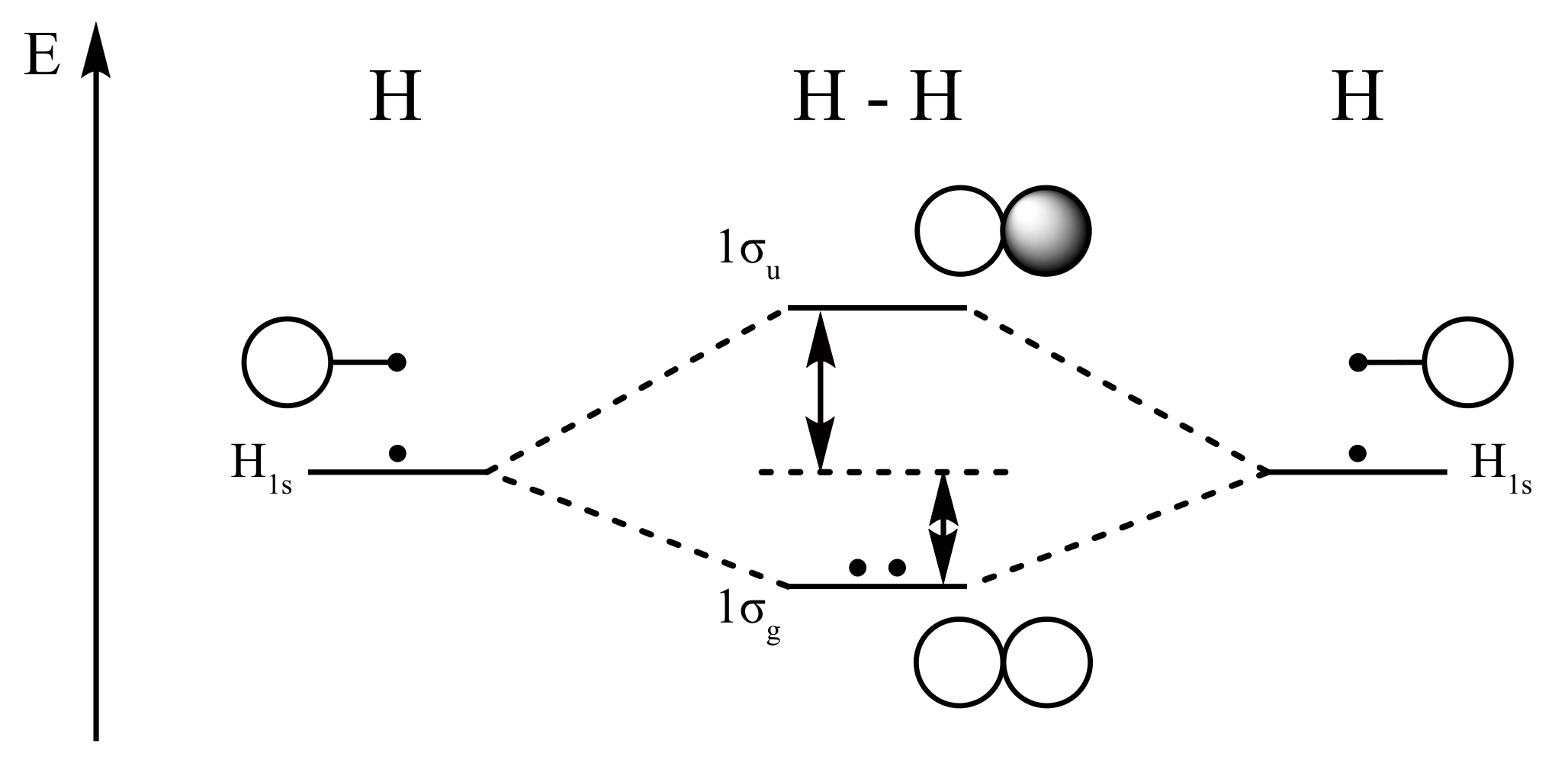
Molecular orbitals form when atomic orbitals combine. This process, called Linear Combination of Atomic Orbitals (LCAO), involves adding or subtracting atomic orbital wave functions to create new molecular orbital wave functions.
LCAO results in bonding and antibonding molecular orbitals. Bonding orbitals have lower energy and greater stability, while antibonding orbitals have higher energy and less stability compared to the original atomic orbitals.
Molecular Orbital Formation
Linear Combination of Atomic Orbitals (LCAO)
- Molecular orbitals form through the linear combination of atomic orbitals (LCAO) approach
- LCAO involves adding or subtracting atomic orbital wave functions to create new molecular orbital wave functions
- Bonding molecular orbitals result from the constructive interference of atomic orbitals (s + s, p + p)
- Antibonding molecular orbitals result from the destructive interference of atomic orbitals (s - s, p - p)
- Bonding orbitals have lower energy and greater stability compared to the original atomic orbitals
- Antibonding orbitals have higher energy and less stability compared to the original atomic orbitals
- The number of molecular orbitals formed equals the number of atomic orbitals combined
Constructive and Destructive Interference
- Constructive interference occurs when atomic orbital wave functions combine in-phase
- Leads to increased electron density between the nuclei
- Results in the formation of bonding molecular orbitals (σ and π)
- Destructive interference occurs when atomic orbital wave functions combine out-of-phase
- Leads to decreased electron density between the nuclei
- Results in the formation of antibonding molecular orbitals (σ* and π*)
- The degree of constructive or destructive interference depends on the overlap of the atomic orbitals
Mathematical Aspects of LCAO
Overlap Integral and Normalization
- The overlap integral (S) quantifies the degree of overlap between two atomic orbitals
- Ranges from 0 (no overlap) to 1 (complete overlap)
- Determines the strength of the interaction between atomic orbitals
- Normalization ensures that the probability of finding an electron in a molecular orbital is equal to 1
- Achieved by adjusting the coefficients of the atomic orbital wave functions
- Ensures that the molecular orbital wave function is properly scaled

Molecular Orbital Coefficients
- Molecular orbital coefficients (c) determine the contribution of each atomic orbital to the molecular orbital
- The coefficients are determined by solving the secular determinant
- Involves the overlap integral (S) and the Coulomb and exchange integrals (H)
- The magnitude of the coefficients indicates the relative contribution of each atomic orbital
- Larger coefficients signify greater contribution from the corresponding atomic orbital
- The sign of the coefficients (positive or negative) reflects the phase relationship between the atomic orbitals
Orbital Symmetry
Symmetry Considerations
- Orbital symmetry plays a crucial role in determining the formation and properties of molecular orbitals
- Molecular orbitals must have the same symmetry as the overall molecule
- Symmetric atomic orbitals combine to form symmetric molecular orbitals (σ and σ*)
- Asymmetric atomic orbitals combine to form asymmetric molecular orbitals (π and π*)
- Orbital overlap is maximized when the atomic orbitals have the same symmetry
- s orbitals can combine with s orbitals (s + s) or p orbitals (s + p)
- p orbitals can combine with p orbitals (p + p) or d orbitals (p + d)
- Orbitals with different symmetry (e.g., s and p) cannot combine effectively due to limited overlap
- Symmetry-allowed combinations lead to the formation of stable molecular orbitals
- Symmetry-forbidden combinations result in unstable or non-bonding molecular orbitals