8.1 Origins and motivations for the Crusades

🏰The Middle Ages Unit 8 Review
8.1 Origins and motivations for the Crusades
🏰 The Middle Ages
Factors Leading to the Crusades
The Crusades were a series of religious wars launched by Western European Christians, primarily aimed at recapturing Jerusalem and the Holy Land from Muslim control. They grew out of a tangled mix of religious conviction, political calculation, and economic ambition, with the Catholic Church serving as the driving force behind their launch. Understanding these origins helps explain why tens of thousands of people left their homes for a dangerous journey across the known world.

Top images from around the web for Factors behind the Crusades
The Crusades | Western Civilization View original
Is this image relevant?
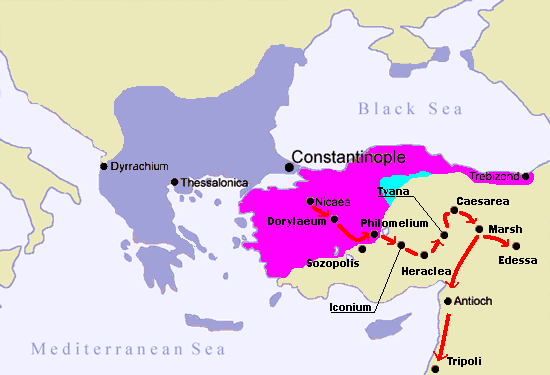
March from Antioch to Jerusalem during the First Crusade - Wikipedia View original
Is this image relevant?
WorldHistoryPPG - The Crusades View original
Is this image relevant?
The Crusades | Western Civilization View original
Is this image relevant?
March from Antioch to Jerusalem during the First Crusade - Wikipedia View original
Is this image relevant?
Religious Factors
Jerusalem held deep significance for Christians as the site of Christ's crucifixion and resurrection. By the late 11th century, the Seljuk Turks (a Muslim dynasty expanding across the Middle East) controlled the Holy Land, and reports circulated in Europe that Christian pilgrims traveling to sacred sites faced harassment, robbery, and violence. Whether or not these reports were exaggerated, they created genuine outrage among European Christians.
The Church taught that fighting to reclaim the Holy Land was not just acceptable but spiritually rewarding. Participants were promised remission of sins, meaning their service in the Crusade would count as penance. For a deeply religious society that feared eternal damnation, this was an extraordinarily powerful motivator.
Political Factors
- In 1071, the Seljuk Turks defeated the Byzantine Empire at the Battle of Manzikert and conquered much of Anatolia (modern-day Turkey). Byzantine Emperor Alexios I sent an appeal to Pope Urban II requesting military assistance, giving the Pope both a reason and an opening to act.
- European rulers saw the Crusades as a chance to expand their influence by establishing footholds in the East.
- Launching a common external campaign also served to redirect the constant warfare among European nobles. Uniting feuding lords against a shared enemy reduced internal conflicts, at least temporarily.
Economic Factors
The Crusades offered real material incentives, especially for those with limited prospects at home. Under the feudal system of primogeniture, only the eldest son inherited land. Younger sons and landless knights had few options for gaining wealth or status in Europe.
- Conquering territory in the East meant the chance to establish their own estates and fiefs.
- The Eastern Mediterranean was a gateway to luxury goods like spices, silk, and precious metals. Merchants and nobles alike recognized the potential for profitable new trade routes.
- Even for common soldiers, the prospect of plunder provided a concrete, worldly reason to take up the cross.

The Catholic Church's Role
Pope Urban II and the Council of Clermont (1095)
The single most important event in launching the Crusades was Pope Urban II's speech at the Council of Clermont in November 1095. Urban called on Christian knights to march east, aid the Byzantine Empire, and reclaim the Holy Land from Muslim control.
The speech was remarkably effective. Urban framed the campaign as a sacred duty and promised indulgences (reductions in the punishment for sins, including time in purgatory) to anyone who participated. According to chroniclers, the crowd responded with shouts of "Deus vult!" ("God wills it!"), which became the rallying cry of the First Crusade.
Religious Propaganda and Church Support
The Church didn't just launch the Crusades; it actively sustained enthusiasm for them.
- Propaganda: Church leaders portrayed Muslims as enemies of the faith who had desecrated Christian holy sites. This framing cast the Crusades as a defensive, righteous cause rather than an aggressive invasion.
- Financial support: The Church raised funds through special tithes and directed church resources toward outfitting and supplying expeditions.
- Papal endorsement: The Pope's personal backing gave the Crusades a legitimacy that no secular ruler alone could provide. Crusaders wore the cross as a symbol of their mission, and the Church granted them legal protections (such as safeguarding their property while they were away).

Motivations and the Concept of Holy War
Why People Joined the Crusades
No single motivation explains why so many Europeans took up the cross. Most crusaders were driven by some combination of the following:
- Religious devotion: A genuine belief that defending the faith and liberating Jerusalem was their Christian duty. For many ordinary people, this was the primary reason.
- Spiritual reward: The promise of indulgences and salvation carried enormous weight in a society where fear of hell was very real.
- Land and wealth: Younger sons, landless knights, and ambitious nobles saw a path to territory and riches unavailable to them in Europe.
- Prestige and glory: Military victories in the Holy Land brought social status and reputation back home.
- Escape: Some crusaders sought to leave behind debts, legal troubles, political rivalries, or simply the limited horizons of their local communities.
The Concept of Holy War
A holy war is a conflict that religious authorities declare to be sanctioned by God and fought for a religious purpose. It differs from ordinary warfare in a few key ways:
- It carries supposed divine approval, elevating the conflict beyond a political or territorial dispute.
- Participants are promised spiritual rewards (salvation, indulgences) for their service, making the act of fighting itself a form of religious devotion.
- Religious leaders, not just secular rulers, authorize and promote the campaign.
In the context of the Crusades, the concept of holy war served several functions: it provided moral justification for violence, it motivated participation by appealing to faith, and it helped unite the fractured kingdoms of Western Europe under a shared religious banner. It also deepened the sense of a fundamental divide between Christianity and Islam, a legacy that shaped relations between the two civilizations for centuries afterward.
See Fiveable more often in Google
Mark Fiveable as a preferred source and Google is more likely to show you our guides in Top Stories, with a "preferred" badge in AI Mode and AI Overviews.