
Designing engaging and effective lesson plans is crucial for successful science education. This topic explores key elements like inquiry-based learning, measurable objectives, and differentiated instruction. These strategies help teachers create dynamic lessons that cater to diverse learners and promote critical thinking.
Effective lesson plans incorporate hands-on activities, safety considerations, and clear learning objectives. They also use varied instructional methods to accommodate different learning styles. By focusing on these elements, teachers can create lessons that captivate students and foster deep understanding of scientific concepts.
Inquiry-Based Learning Design
Incorporating Inquiry-Based Learning and Hands-On Activities
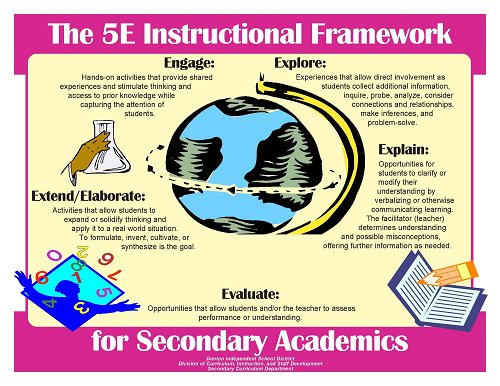
- Inquiry-based learning emphasizes the process of discovery and investigation, allowing students to construct their own understanding of scientific concepts (5E model: Engage, Explore, Explain, Elaborate, and Evaluate)
- Hands-on activities actively engage students in manipulating materials, conducting experiments, or participating in simulations to reinforce scientific concepts and skills (dissections, lab experiments, simulations)
- Lesson plans should include a balance of direct instruction, guided inquiry, and open-ended exploration to scaffold student learning and maintain engagement
- Hands-on activities should be purposeful, aligned with learning objectives, and designed to promote critical thinking, problem-solving, and scientific reasoning skills
Safety and Logistics for Inquiry-Based Learning
- Inquiry-based lessons should follow a structured sequence to guide students through the learning process
- Lesson plans should incorporate safety considerations, necessary materials, and clear instructions for inquiry-based learning and hands-on activities
- Teachers should provide appropriate safety equipment and training for students when conducting hands-on activities (goggles, gloves, lab coats)
- Lesson plans should include contingency plans for unexpected situations or challenges that may arise during inquiry-based learning (power outages, equipment malfunctions)
Measurable Learning Objectives
Writing Effective Learning Objectives
- Learning objectives are specific, observable, and measurable statements that describe what students should know or be able to do by the end of a lesson or unit
- Objectives should be written using action verbs that describe observable behaviors to ensure they are measurable (identify, explain, analyze, design)
- Learning objectives should be achievable within the given timeframe and resources available, considering students' prior knowledge and skills
- Objectives should be aligned with national, state, or local curriculum standards to ensure that lessons cover required content and skills (Next Generation Science Standards, state science standards)
Communicating Learning Objectives to Students
- Learning objectives should be communicated to students at the beginning of the lesson to provide a clear focus and direction for their learning
- Teachers should explain the relevance and importance of learning objectives to students, connecting them to real-world applications and future learning (career connections, scientific literacy)
- Students should be encouraged to self-assess their progress towards learning objectives and set personal learning goals (reflection journals, goal-setting activities)
- Teachers should refer back to learning objectives throughout the lesson and use them to guide formative and summative assessments (exit tickets, rubrics)
Differentiated Instruction Strategies
Accommodating Diverse Learning Needs
- Differentiated instruction tailors teaching methods, materials, and assessments to meet the diverse learning needs, interests, and abilities of individual students
- Lesson plans should include a variety of instructional strategies to accommodate different learning styles and preferences (visual aids, cooperative learning, hands-on activities, technology integration)
- Teachers should use pre-assessments and formative assessments to identify students' prior knowledge, skills, and misconceptions, and adjust instruction accordingly (KWL charts, concept maps, quizzes)
- Lesson plans should provide multiple ways for students to access content and allow for different modes of expression (reading, listening, watching videos, writing, speaking, creating visual representations)
Providing Support and Challenge
- Teachers should offer varying levels of support and challenge to ensure that all students are appropriately engaged and making progress towards learning objectives
- Tiered assignments provide students with different levels of complexity or depth based on their readiness or ability level (basic, intermediate, advanced)
- Flexible grouping allows students to work with peers of similar or different ability levels, depending on the purpose of the activity (homogeneous groups, heterogeneous groups)
- Teachers should provide scaffolding and support as needed, gradually releasing responsibility to students as they develop skills and understanding (graphic organizers, sentence starters, peer tutoring)
- Extension activities and enrichment opportunities should be available for students who have mastered the learning objectives and are ready for additional challenges (independent research projects, design challenges)

Critical Thinking Lesson Design
Promoting Critical Thinking and Problem-Solving Skills
- Critical thinking involves analyzing information, evaluating evidence, and making reasoned judgments or decisions
- Problem-solving is the process of identifying a problem, generating and testing possible solutions, and evaluating the effectiveness of the chosen solution
- Lesson plans should include open-ended questions, real-world scenarios, and complex tasks that require students to apply critical thinking and problem-solving skills (case studies, design challenges, debates)
- Teachers should model and explicitly teach critical thinking and problem-solving strategies, providing scaffolding and support as needed (think-alouds, graphic organizers, problem-solving frameworks)
Developing Scientific Reasoning Abilities
- Scientific reasoning involves using logical thinking and evidence-based arguments to draw conclusions, make predictions, and explain phenomena
- Lessons should encourage students to ask questions, formulate hypotheses, design experiments, analyze data, and communicate their findings to develop their scientific reasoning abilities
- Teachers should provide opportunities for students to engage in scientific practices, such as observing, measuring, classifying, inferring, and predicting (lab investigations, field studies, data analysis activities)
- Students should be encouraged to use scientific language and reasoning when discussing and writing about their findings (lab reports, scientific arguments, presentations)
Lesson Plan Evaluation
Assessing Student Engagement and Understanding
- Effective lesson plans should result in high levels of student engagement, characterized by active participation, focused attention, and sustained interest in learning activities
- Teachers should use formative assessment strategies to monitor student engagement and understanding throughout the lesson (questioning, observation, student work samples)
- Summative assessments should be aligned with learning objectives and used to measure student mastery of key concepts and skills (quizzes, tests, projects, presentations)
- Assessment data should be analyzed to identify strengths and weaknesses in student learning, inform future instructional decisions, and provide feedback to students on their progress (data-driven instruction, student conferences)
Reflecting on and Refining Lesson Plans
- Teachers should reflect on the effectiveness of their lesson plans, considering factors such as pacing, clarity of instructions, and student outcomes
- Lesson plans should be continuously refined based on student feedback, assessment results, and best practices in science education to ensure that they are engaging, effective, and responsive to student needs
- Teachers should collaborate with colleagues and seek professional development opportunities to improve their lesson planning and instructional practices (professional learning communities, workshops, conferences)
- Lesson plans should be adapted and modified as needed to address changing student needs, curricular requirements, or logistical constraints (differentiation, alignment with new standards)