
Actinides, elements 89 to 103, are f-block elements with unique electronic structures. They're mostly radioactive and synthetic, except for thorium and uranium. Their electron configurations follow [Rn] 5f¹⁻¹⁴ 6d⁰⁻² 7s², leading to interesting periodic trends.
These elements show a wide range of oxidation states and high reactivity. Actinide contraction and relativistic effects play crucial roles in their behavior, causing decreased atomic radii and influencing their chemical properties.
Electronic Configuration and Periodic Trends
Actinide Series and f-Block Elements
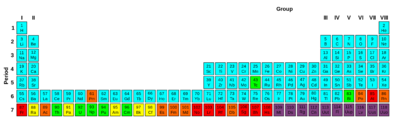
- Actinide series consists of elements with atomic numbers 89 to 103 (actinium to lawrencium)
- Belong to the f-block elements in the periodic table
- f-block elements have valence electrons in the f-subshell
- Includes lanthanides (atomic numbers 57-71) and actinides
- Most actinides are radioactive and undergo radioactive decay
- Emit alpha particles, beta particles, or gamma rays
- Only thorium and uranium occur naturally in significant quantities (other actinides are synthetically produced)
Electron Configuration and Periodic Trends
- Electron configuration of actinides follows the general pattern
- represents the electron configuration of the preceding noble gas, radon
- Electrons fill the 5f, 6d, and 7s subshells
- Actinides exhibit unique periodic trends compared to other elements
- Atomic and ionic radii decrease across the series (actinide contraction)
- Ionization energies generally increase across the series
- Electronegativity values are relatively low and do not vary significantly

Chemical Properties
Oxidation States and Reactivity
- Actinides exhibit a wide range of oxidation states, from +2 to +7
- Most common oxidation states are +3, +4, +5, and +6
- Higher oxidation states become more stable for heavier actinides
- Actinides are highly reactive due to their large atomic radii and low ionization energies
- React readily with non-metals like oxygen, halogens, and sulfur
- Form compounds with a variety of anions (oxides, halides, sulfides)
- Early actinides (thorium and uranium) are less reactive than later actinides
- Thorium and uranium are more stable in aqueous solutions
Actinide Contraction and Relativistic Effects
- Actinide contraction refers to the decrease in atomic and ionic radii across the actinide series
- Caused by poor shielding of the 5f electrons and increasing effective nuclear charge
- Results in similarities between the later actinides and their corresponding lanthanides
- Relativistic effects become significant for heavy elements like actinides
- Electrons near the nucleus move at relativistic speeds, causing orbital contraction and stabilization
- Affects the electronic structure, bonding, and chemical properties of actinides
- Contributes to the unique behavior of actinides compared to lighter elements