
Special relativity revolutionizes our understanding of space and time. It introduces mind-bending concepts like time dilation and length contraction, reshaping how we view the universe. These ideas are crucial for grasping particle behavior at high speeds.
Four-vectors are the mathematical tools that make special relativity work. They combine space and time coordinates, allowing us to describe particle motion and energy in a way that's consistent across all reference frames. This framework is essential for analyzing particle interactions and decays.
Principles of Special Relativity
Fundamental Postulates and Spacetime
- Special relativity builds on two fundamental postulates
- Principle of relativity maintains physical laws remain consistent across all inertial reference frames
- Speed of light stays constant in vacuum for all observers, regardless of their motion
- Spacetime concept emerges from special relativity
- Unifies space and time into a four-dimensional continuum
- Events described by four coordinates (three spatial, one temporal)
- Proper time represents time measured in a particle's rest frame
- Invariant under Lorentz transformations
- Calculated using spacetime interval
Relativistic Effects and Universal Speed Limit
- Time dilation occurs for fast-moving objects
- Clocks tick slower for observers in motion relative to stationary observers
- Becomes significant as velocities approach speed of light
- Length contraction affects objects moving at high speeds
- Objects appear shorter in the direction of motion
- Noticeable for particles in accelerators (proton bunches)
- Speed of light (c) serves as universal speed limit
- No massive particle can reach or exceed c
- Impacts particle interactions and energy conservation in colliders
Mass-Energy Equivalence
- Einstein's famous equation expresses mass-energy equivalence
- Mass can be converted to energy and vice versa
- Explains energy release in nuclear reactions (fission, fusion)
- Rest energy represents energy content of a particle at rest
- Given by , where is rest mass
- Provides baseline for total energy calculations in particle physics
Four-vectors for Particle Motion
Four-vector Basics and Transformations
- Four-vectors describe physical quantities in relativistic physics
- Transform correctly under Lorentz transformations
- Ensure consistency of physical laws across reference frames
- Position four-vector combines space and time coordinates
- Represented as
- Unifies spatial and temporal information of an event
- Energy-momentum four-vector encapsulates particle's energy and momentum
- Expressed as
- Conserved in particle interactions (collisions, decays)
- Metric tensor raises and lowers four-vector indices
- Facilitates calculations in different coordinate representations
- Minkowski metric in flat spacetime:
Four-vector Algebra and Invariants
- Scalar product of four-vectors remains Lorentz invariant
- Allows calculation of invariant quantities (spacetime interval, rest mass)
- For position four-vectors:
- Four-vector algebra analyzes particle collisions and decays
- Ensures conservation laws satisfied in all reference frames
- Example: total four-momentum conserved in particle decay
- Proper time calculated using invariant spacetime interval
- Represents time experienced by particle in its rest frame
Relativistic Effects on Particles
Relativistic Mass and Momentum
- Relativistic mass describes effective mass increase with velocity
- , where is Lorentz factor
- Approaches infinity as particle speed nears c
- Relativistic momentum accounts for velocity-dependent mass
- Explains why particles cannot reach speed of light (infinite momentum required)
- Lorentz factor quantifies relativistic effects
- Approaches infinity as v approaches c

Energy and Mass Relations
- Total energy of a particle includes rest energy and kinetic energy
- Reduces to for particle at rest
- Rest mass remains invariant across reference frames
- Defined as
- Fundamental property of particles (electron rest mass, proton rest mass)
- Energy-momentum relation for free particles
- Applies to both massive and massless particles
Massless Particles and Rapidity
- Massless particles always travel at speed of light
- Photons, gluons in quantum field theory
- Energy-momentum relation simplifies to
- Rapidity describes relativistic velocities as hyperbolic angle
- Defined as
- Provides additive property for successive boosts
Lorentz Transformations for Reference Frames
Lorentz Transformation Equations
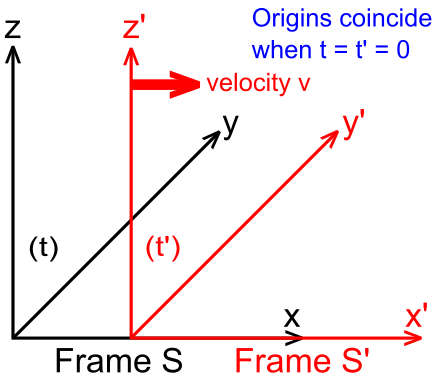
- Lorentz transformations relate event coordinates between inertial frames
- For relative motion along x-axis:
- y and z coordinates remain unchanged
- Lorentz factor appears in all transformation equations
- Quantifies time dilation and length contraction effects
Velocity Transformations and Invariance
- Relativistic velocity addition formula ensures c is never exceeded
- For parallel velocities:
- Explains why adding velocities doesn't allow surpassing c
- Four-vectors maintain Lorentz invariant scalar products under transformations
- Spacetime interval remains constant:
- Ensures consistency of physical laws across reference frames
Time Dilation and Length Contraction
- Time dilation emerges from Lorentz transformations
- Moving clocks tick slower:
- Observed in particle decay experiments (muon lifetime)
- Length contraction affects objects in direction of motion
- , where L is proper length
- Relevant for particle beams in accelerators
- Proper time and proper length represent invariant quantities
- Measured in rest frame of object or particle
- Connect relativistic effects to classical measurements