
Diagonalizable matrices are a key concept in linear transformations. They have a full set of linearly independent eigenvectors, allowing us to represent them as a product of simpler matrices. This property simplifies calculations and provides insights into the matrix's behavior.
Understanding diagonalizability helps us analyze linear transformations more effectively. By decomposing a matrix into its eigenvalues and eigenvectors, we can easily compute matrix powers, solve systems of differential equations, and gain geometric intuition about the transformation's effects on vectors.
Eigenvalues and eigenvectors
Definition and properties
- An eigenvector of a square matrix A is a nonzero vector v such that for some scalar .
- The scalar is called the eigenvalue corresponding to the eigenvector v.
- Eigenvectors are unique up to scalar multiplication, meaning if v is an eigenvector, then any nonzero multiple of v is also an eigenvector with the same eigenvalue (e.g., 2v, -3v).
- The set of all eigenvectors corresponding to a particular eigenvalue, along with the zero vector, forms a subspace called the eigenspace of that eigenvalue.
- The eigenvalues of a matrix A are the roots of the characteristic polynomial , where I is the identity matrix.
- The algebraic multiplicity of an eigenvalue is its multiplicity as a root of the characteristic polynomial, while the geometric multiplicity is the dimension of its eigenspace.
Examples
- For the matrix , the eigenvectors are and , with corresponding eigenvalues 3 and 2, respectively.
- The matrix has a single eigenvalue 2 with algebraic multiplicity 2, and any nonzero vector in is an eigenvector of B.
Finding eigenvalues and eigenvectors
Solving the characteristic equation
- To find the eigenvalues of a matrix A, solve the characteristic equation for .
- For each eigenvalue , find the corresponding eigenvectors by solving the equation for nonzero vectors v.
- The solutions to form the eigenspace corresponding to the eigenvalue .

Row reduction and nullspace
- The eigenvectors can be found by row reducing the matrix to echelon form and finding the basis vectors for the nullspace.
- Eigenvectors corresponding to distinct eigenvalues are linearly independent.
Examples
- For the matrix , the characteristic equation is , yielding eigenvalues 3 and -1.
- To find the eigenvectors for , solve , which gives the eigenvector . For , solve , yielding the eigenvector .
Diagonalizability of matrices
Conditions for diagonalizability
- A square matrix A is diagonalizable if and only if it has a full set of linearly independent eigenvectors, meaning the sum of the geometric multiplicities of its eigenvalues equals the size of the matrix.
- If a matrix A is diagonalizable, then there exists an invertible matrix P and a diagonal matrix D such that , where the columns of P are the eigenvectors of A, and the diagonal entries of D are the corresponding eigenvalues.
- A matrix is diagonalizable if and only if its minimal polynomial factors completely into distinct linear factors.
- If a matrix has distinct eigenvalues, it is guaranteed to be diagonalizable.
- A matrix with repeated eigenvalues may or may not be diagonalizable, depending on the geometric multiplicities of the repeated eigenvalues.
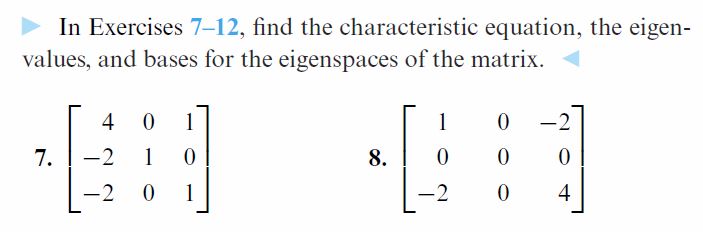
Examples
- The matrix is diagonalizable, as it has distinct eigenvalues 3 and 2 with corresponding linearly independent eigenvectors and .
- The matrix is not diagonalizable, as it has a single eigenvalue 2 with algebraic multiplicity 2 but geometric multiplicity 1, since the eigenspace is spanned by .
Geometric interpretation of diagonalization
Change of basis
- Diagonalization of a matrix A geometrically represents a change of basis to a coordinate system aligned with the eigenvectors of A.
- The eigenvectors of A form the columns of the change-of-basis matrix P, and the eigenvalues of A are the scaling factors along the eigenvector directions.
- In the new coordinate system defined by the eigenvectors, the matrix A is represented by a diagonal matrix D, where the diagonal entries are the eigenvalues.
Scaling and matrix powers
- The action of A on a vector x can be interpreted as scaling the components of x along the eigenvector directions by the corresponding eigenvalues.
- Diagonalization simplifies the computation of matrix powers, as , where is obtained by raising the diagonal entries of D to the power n.
Examples
- For the matrix , the eigenvectors and define a new coordinate system in which A is represented by the diagonal matrix .
- The matrix can be easily computed as .