9.7 The Fall of Communism

🇪🇺AP European History Unit 9 Review
9.7 The Fall of Communism
🇪🇺 AP European History
9.1
Context of the Cold War and Contemporary Europe
9.2
Rebuilding Europe After World War II
9.3
The Cold War
9.4
Two Super Powers Emerge
9.5
Postwar Nationalism, Ethnic Conflict, and Atrocities
9.6
Contemporary Western Democracies
9.7
The Fall of Communism
9.8
20th-Century Feminism
9.9
Decolonization
9.10
The European Union
9.11
Migrations within and to Europe Since 1945
9.12
Technological Developments Since 1914
9.13
Globalization
9.14
20th- and 21st-Century Culture, Arts, and Demographic Trends
9.15
Continuity and Change in the 20th and 21st Centuries
The fall of communism happened because the Soviet Union's economy stagnated for years and Mikhail Gorbachev's reforms, perestroika and glasnost, failed to fix the system and instead loosened Soviet control. By 1991 the USSR collapsed, ending the Cold War, reunifying Germany, breaking apart Czechoslovakia and Yugoslavia, and pushing former Eastern bloc countries toward capitalism and EU membership.
Why This Matters for the AP European History Exam
This topic is about causation and effects: explain why the Cold War ended and what changed across Europe afterward. It connects directly to bigger Unit 9 themes, like the polarized Cold War order giving way to transnational union (the growing European Union) and the shift from communist central planning to capitalist economies.
When you write or analyze sources about this period, you will often be asked to explain causes and effects or to track continuity and change over time. The reforms-that-backfired story is a strong example of unintended consequences, which makes it useful evidence in arguments about the end of the Cold War.
Key Takeaways
- A long period of economic stagnation set up the collapse; the centrally planned Soviet economy fell behind the West in productivity, innovation, and consumer goods.
- Gorbachev's perestroika (restructuring) and glasnost (openness) were meant to make the Soviet system more flexible but failed to prevent the collapse and weakened Soviet control over its satellites.
- The USSR collapsed in 1991, ending the Cold War and leading to capitalist economies across Eastern Europe.
- Major results: Germany was reunited, the Czechs and Slovaks parted, Yugoslavia dissolved, and the European Union expanded by admitting former Eastern bloc countries.
- The fall of the Berlin Wall and Poland's 1989 elections are key examples of communism collapsing across the Soviet bloc.
How Communism Fell
From Stagnation to Reform
Before Gorbachev, the Soviet economy had slowed badly. Central planning struggled to keep up with Western advances in technology and consumer goods, and inefficiency built up over time. This stagnation is the background cause for everything that follows: a system that could not deliver was harder and harder to defend.
When Mikhail Gorbachev came to power in the 1980s, he tried to save the system rather than end it. His two big reforms were:
- Perestroika (restructuring): loosened tight central control over the economy to make it more flexible.
- Glasnost (openness): allowed more freedom of speech and public debate.
The goal was a more flexible, workable Soviet system. Instead, the reforms exposed decades of problems and gave people room to criticize the government openly. Soviet control over Eastern and Central European satellite states slipped, and Gorbachev did not send in the military to hold the bloc together the way earlier Soviet leaders had.
The Collapse and Its Effects
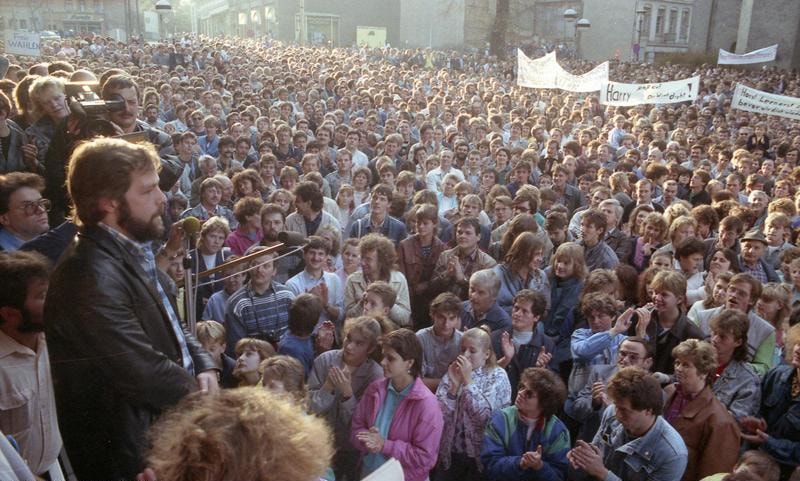
The Soviet Union collapsed in 1991, and that collapse ended the Cold War. The map and politics of Europe changed fast:
- Germany was reunited, with the fall of the Berlin Wall in 1989 marking the end of communist control in the East.
- The Czechs and Slovaks parted, splitting into two separate countries.
- Yugoslavia dissolved, breaking apart into separate nations, some of which faced violent conflict.
- Eastern Europe shifted to capitalist economies, and the European Union grew by admitting former Eastern bloc countries.
Two examples are worth knowing as evidence of the bloc breaking apart: the fall of the Berlin Wall and the Polish elections in 1989, where opposition to communist rule made real gains.
| Country/Region | Result After USSR Collapse |
|---|---|
| Germany | Reunited |
| Czechoslovakia | Parted into separate Czech and Slovak states |
| Yugoslavia | Dissolved; led to conflict and ethnic violence |
| Poland, Hungary, etc. | Moved to capitalism; later joined the EU |
| Russia | Economic difficulty and weakened global influence |
How to Use This on the AP European History Exam
Causation
The clearest way to use this topic is cause and effect. Be ready to explain that the end of the Cold War had a long-term cause (economic stagnation) and a more immediate trigger (Gorbachev's reforms that failed to stabilize the system). Then connect to effects: the USSR's collapse, the spread of capitalism, German reunification, and the breakup of Czechoslovakia and Yugoslavia.
Continuity and Change
Use this period to show change over time. The Cold War split Europe into a communist East and a democratic West for nearly half a century. Its end reversed that division and opened the way for EU expansion eastward, a major shift toward integration after decades of a polarized order.
Using Sources Effectively
If you get a document or image from this era (for example, about glasnost, the Berlin Wall, or Polish opposition movements), focus on point of view and purpose. Ask whether the source is defending reform, criticizing the regime, or celebrating the end of communist control, and use that to support a claim about why the system fell.
Common Trap
Do not argue that Gorbachev was trying to end communism. He was trying to save it. The reforms backfired, and that gap between intention and result is exactly the kind of nuance that strengthens an argument.
Common Misconceptions
- Misconception: Gorbachev wanted to dismantle the Soviet Union.Actually: No. Perestroika and glasnost were meant to make the Soviet system more flexible and keep it alive. The collapse was an unintended result.
- Misconception: The fall of communism happened suddenly out of nowhere.Actually: It followed a long period of economic stagnation. The 1991 collapse was the breaking point, not the whole story.
- Misconception: The Cold War ended with a war or a single dramatic battle.Actually: The Soviet collapse and the loss of control over its satellites ended it, not a military defeat of the USSR.
- Misconception: Every former communist country transitioned peacefully.Actually: Many shifts were peaceful, but the dissolution of Yugoslavia led to war and ethnic violence in the Balkans.
- Misconception: Germany reunified before the Berlin Wall fell.Actually: The Wall's fall in 1989 came first and symbolized the end of communist control; reunification followed.
Related AP European History Guides
Practice Questions for 9.7
1 of 10
In his 1987 book Perestroika, Soviet leader Mikhail Gorbachev wrote: "We are looking within socialism, rather than outside it, for the answers to all the questions that arise... Every part of our program of perestroika is fully based on the principle of more socialism and more democracy." Which of the following best describes Gorbachev's central claim in this passage?
A.
Strict authoritarian controls were necessary to strengthen and preserve the communist system.
B.
Internal structural reforms were necessary to strengthen and preserve the communist system.
C.
Democratic capitalist institutions were necessary to replace the failing communist system.
D.
Western financial investments were necessary to strengthen and preserve the communist system.
Vocabulary
The following words are mentioned explicitly in the AP® course framework for this topic.Term | Definition |
|---|---|
Berlin Wall | The barrier constructed by East Germany in 1961 that divided Berlin and symbolized the division between communist Eastern Europe and the capitalist West; its fall in 1989 marked a symbolic end to the Cold War. |
capitalist economies | Economic systems based on private ownership, free markets, and profit motive, as opposed to communist command economies. |
Cold War | The ideological and geopolitical conflict between the Soviet Union and the United States and their respective allies that lasted from the end of World War II until 1991, characterized by tension, proxy wars, and nuclear threat rather than direct military confrontation. |
Eastern bloc | The communist countries of Eastern Europe under Soviet political and military control during the Cold War. |
European Union | A political and economic union of European countries that expanded to include former Eastern bloc nations after the Cold War. |
glasnost | Mikhail Gorbachev's policy of openness and transparency that allowed greater freedom of speech and press in the Soviet Union. |
hegemonic control | The dominance and influence of one power over others, particularly the Soviet Union's political and military control over Eastern and Central European satellite states. |
perestroika | Mikhail Gorbachev's policy of restructuring the Soviet economic and political system to make it more efficient and flexible. |
Soviet Union | The Union of Soviet Socialist Republics (USSR), the communist superpower that existed from 1922 to 1991. |
Frequently Asked Questions
Why did the Soviet Union collapse?
The Soviet Union collapsed because long-term economic stagnation weakened the system, while Gorbachev's reforms of perestroika and glasnost loosened control without fixing the economy or preserving political authority.
What were perestroika and glasnost?
Perestroika means restructuring and refers to Gorbachev's attempt to make the Soviet economy more flexible. Glasnost means openness and allowed more public debate and criticism of the government.
How did Gorbachev's reforms contribute to the fall of communism?
Gorbachev meant to save communism, but the reforms exposed deep problems and gave people more room to criticize Soviet rule. He also refused to use force to keep Eastern Europe under Soviet control.
What happened in Eastern Europe in 1989?
In 1989, communist control weakened across Eastern Europe. Key examples include Poland's elections and the fall of the Berlin Wall, which symbolized the collapse of Soviet-backed rule in the region.
What were the effects of the fall of communism in Europe?
The fall of communism ended the Cold War, reunified Germany, shifted many Eastern European countries toward capitalism, expanded the European Union eastward, and contributed to the breakup of Czechoslovakia and Yugoslavia.
How is the fall of communism tested on AP European History?
AP Euro questions often use this topic for causation, continuity and change, and source analysis about the Cold War, Soviet reform, Eastern Europe, and the transition from communism to capitalism.