8.2 Classical architecture

🎻Intro to Humanities Unit 8 Review
8.2 Classical architecture
🎻 Intro to Humanities
Origins of Classical Architecture
Classical architecture emerged in ancient Greece and Rome, establishing a design language built on proportion, harmony, and rational order. These buildings weren't just functional; they expressed humanistic values about beauty and the relationship between humans and the cosmos. Those same principles still show up in courthouses, museums, and government buildings today.
Ancient Greek Foundations
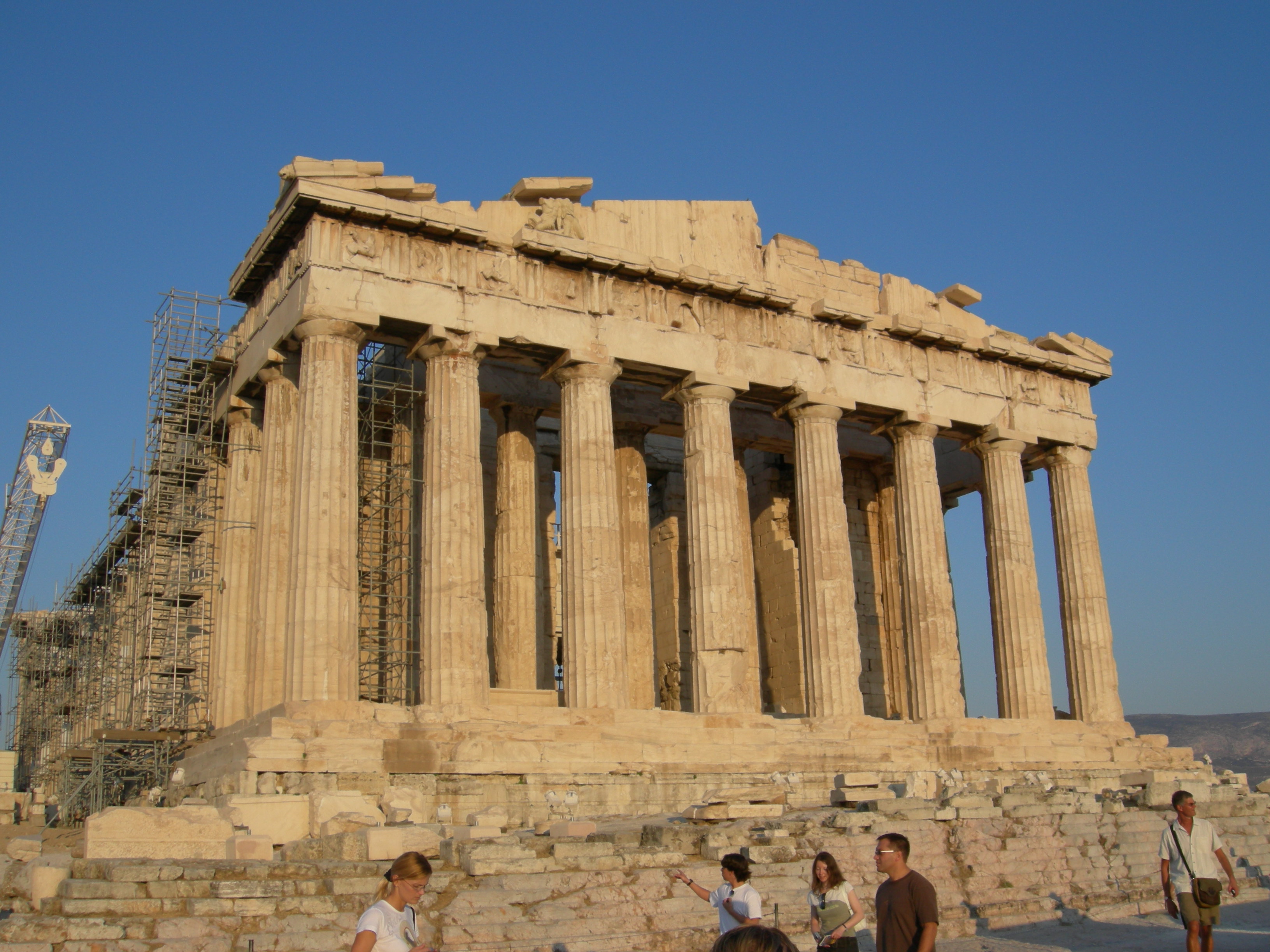
Greek architects developed the classical style between roughly the 7th and 4th centuries BCE. Their buildings emphasized simplicity and precise proportional relationships, and they introduced the three primary column orders (Doric, Ionic, and Corinthian) that became the vocabulary of Western architecture. The Parthenon in Athens, completed around 432 BCE, remains the most famous example of these principles in action.
Roman Adaptations
Rome inherited Greek architectural ideas but pushed them further, roughly from the 1st century BCE through the 5th century CE. Roman builders added arches, vaults, and domes to the classical toolkit, which allowed them to create much larger and more complex interior spaces. They also scaled up dramatically for practical and imperial purposes. The Colosseum and the Pantheon both show how Romans combined Greek aesthetics with bold engineering.
Revival in the Renaissance
In the 15th and 16th centuries, Italian architects rediscovered classical forms by studying ancient ruins and texts. Figures like Filippo Brunelleschi and Andrea Palladio didn't just copy Greek and Roman buildings; they reinterpreted classical principles for their own time. Their work spread across Europe through published treatises and travel, sparking a revival that would echo for centuries.
Key Elements of Classical Style
A handful of distinct visual and structural elements define classical architecture. Together, they reflect the style's core commitment to order, proportion, and balance.
Column Orders
The column orders are the most recognizable feature of classical architecture. Each order has its own proportions, capital (top) design, and level of ornamentation:
- Doric: The simplest and sturdiest. Plain, cushion-shaped capitals. Used for temples to powerful gods like Zeus.
- Ionic: More slender, with distinctive scroll-shaped capitals called volutes.
- Corinthian: The most ornate, featuring capitals carved with acanthus leaves.
The Romans added two more: Tuscan (a stripped-down version of Doric) and Composite (blending Ionic scrolls with Corinthian leaves). Architects used these orders to create visual hierarchy, with simpler orders on lower levels and more decorative ones above.
Symmetry and Proportion
Classical buildings are designed with bilateral symmetry around a central axis, meaning the left side mirrors the right. Architects used mathematical ratios to determine the spacing and dimensions of every element. The Golden Ratio (approximately 1:1.618) was considered especially pleasing to the eye and appears throughout classical design. The goal was always harmonious relationships between individual parts and the building as a whole.
Decorative Motifs
Ornamentation in classical architecture draws from nature and geometry. Common motifs include:
- Acanthus leaves (especially on Corinthian capitals)
- Egg-and-dart patterns (alternating oval and pointed shapes along moldings)
- Meanders (repeating geometric key patterns, sometimes called Greek keys)
Friezes (horizontal bands running along a building's upper walls) and metopes (rectangular panels between structural elements) often depicted mythological scenes or historical events. Sculptural elements like pediments (the triangular gable above a portico) frequently housed elaborate figure groups.
Iconic Classical Structures
Classical architecture produced buildings that have become enduring symbols of Western cultural heritage. These structures served civic, religious, and political functions while demonstrating classical design at its finest.
Greek Temples
- The Parthenon in Athens, dedicated to the goddess Athena, is considered the perfection of the Doric order.
- The Temple of Apollo at Delphi showcases the Ionic order in a sacred setting.
- The Temple of Olympian Zeus in Athens demonstrates the grandeur of the Corinthian style.
Greek temples were designed primarily to house statues of deities rather than to hold large congregations. They served as focal points for outdoor religious rituals and civic identity.
Roman Public Buildings
- The Pantheon in Rome features a massive unreinforced concrete dome with a 43-meter (142-foot) span, a feat of engineering unmatched for over a thousand years.
- The Colosseum uses a system of arches and vaults to seat roughly 50,000 spectators.
- The Basilica of Maxentius and Constantine adapted Greek forms for large civic gathering spaces.
- Aqueducts like the Pont du Gard in southern France applied classical arch principles to practical infrastructure.
Neoclassical Monuments
Classical forms have been adopted worldwide to convey authority and democratic ideals:
- The United States Capitol in Washington, D.C. uses a Roman-inspired dome and Corinthian columns.
- The British Museum in London showcases Greek Revival style with its massive Ionic colonnade.
- The Brandenburg Gate in Berlin uses a Greek-style gateway as a symbol of national identity.
- The Arc de Triomphe in Paris adapts the Roman triumphal arch for modern commemoration.
Influence on Western Architecture
Classical architecture's principles and forms have been revived and reinterpreted repeatedly over the centuries, each time reflecting the cultural values of a new era.
Renaissance Rediscovery
Italian architects like Brunelleschi and Leon Battista Alberti studied ancient ruins firsthand to recover classical principles. A key resource was Vitruvius' Ten Books on Architecture, a Roman-era treatise that became the foundation for Renaissance architectural theory. Buildings like the Palazzo Rucellai in Florence show how early Renaissance architects applied classical column orders and proportions to contemporary building types. As architectural publications circulated, the classical revival spread throughout Europe.

Neoclassicism in Europe
The 18th and 19th centuries saw a deliberate return to Greek and Roman models, partly inspired by archaeological discoveries at Pompeii and Herculaneum (buried by the eruption of Vesuvius in 79 CE and rediscovered in the 1700s). These excavations gave architects direct access to ancient designs. British architect Robert Adam popularized neoclassical interiors, while major public buildings like the Panthéon in Paris and the Altes Museum in Berlin embraced the style's clean lines and monumental columns.
American Federal Style
The young United States adopted classical forms to express democratic ideals, drawing a deliberate connection between American democracy and the ancient republics. Thomas Jefferson was a major champion of this approach. His designs for Monticello and the University of Virginia directly reference Roman temple architecture. The broader Federal style adapted classical elements to local materials and building traditions across the country.
Principles of Classical Design
Classical architecture follows a set of design principles meant to ensure harmony, proportion, and visual coherence. These guidelines reflect the humanistic belief that beauty arises from rational order.
Golden Ratio
The Golden Ratio is a mathematical proportion approximately equal to , often denoted by the Greek letter phi (). Architects and artists believed this ratio produced naturally pleasing compositions. It was applied to determine the dimensions of building elements and overall proportions. Renaissance thinkers saw the Golden Ratio as evidence of divine harmony in the natural world.
Vitruvian Principles
The Roman architect Vitruvius (1st century BCE) argued that good architecture requires three qualities:
- Firmitas (strength): The building must be structurally sound.
- Utilitas (functionality): It must serve its intended purpose well.
- Venustas (beauty): It must be aesthetically pleasing.
Vitruvius also prescribed ideal building proportions based on the proportions of the human body. This idea deeply influenced Renaissance architects like Palladio and continues to shape architectural theory.
Harmony and Balance
Classical designers achieved visual equilibrium through symmetrical composition and proportional relationships. Rhythm and repetition of elements (columns, windows, moldings) create coherence across a building's facade. The aim is a careful balance between ornament and structure, avoiding both excess and austerity, so the finished building feels complete and resolved.
Materials and Construction Techniques
Classical architecture developed increasingly sophisticated building methods, allowing for ever more ambitious and durable structures.
Stone Masonry
Stone was the primary building material for Greek and early Roman architecture. Greek builders achieved remarkable precision, cutting and fitting stone blocks so tightly that many joints needed no mortar at all (dry stone construction). Iron clamps and lead dowels reinforced critical joints. Quarrying, transporting, and lifting massive stone blocks required elaborate systems of ramps, rollers, and cranes.
Arches and Vaults
The arch was a Roman innovation that transformed what buildings could do. A semicircular arch distributes weight outward to its supporting columns or walls, allowing for much wider spans than a flat stone beam (called a lintel) could achieve.
- A barrel vault extends an arch along a linear axis, creating a tunnel-like ceiling.
- A groin vault forms where two barrel vaults intersect at right angles, opening up more complex interior spaces and allowing windows in the upper walls.
Concrete in Roman Architecture
Roman concrete was a revolutionary material. Made from lime mortar, volcanic ash (pozzolana), and aggregate (broken stone or brick), it could be poured into molds to create forms impossible with cut stone. The Pantheon's dome, still the world's largest unreinforced concrete dome, is the most dramatic example. Concrete also enabled rapid, economical construction of large-scale public works like aqueducts and harbors.
Symbolism and Cultural Significance
Classical architecture was never just about shelter or engineering. Its forms and decorations conveyed complex cultural, religious, and political messages.
Religious Symbolism
Greek temples were typically oriented on an east-west axis so the entrance faced the rising sun, symbolizing divine order. Specific column orders carried associations with particular deities: Doric was linked to male gods, while Ionic was associated with goddesses. Romans adapted temple forms for imperial cult worship, blurring the line between religion and political power. Early Christian churches later incorporated classical elements to convey authority and continuity with the ancient world.
Political Power
Monumental scale and ornate decoration projected the strength and legitimacy of rulers. Roman imperial fora combined classical architecture with propagandistic sculpture and inscriptions. During the Renaissance, wealthy patrons built palaces with classical facades to associate themselves with ancient Roman virtues. Modern democracies continue this tradition: government buildings worldwide use classical styles to evoke ideals of justice, stability, and civic duty.
Ideals of Beauty and Order
At a philosophical level, classical architecture embodied the belief that the universe is rationally ordered and governed by mathematical principles. Visual balance and symmetry were interpreted as expressions of cosmic harmony. This is why classical forms have maintained their association with timeless beauty and cultural refinement across so many centuries and cultures.
Evolution of Classical Forms
Classical architecture transformed significantly as it spread across regions and time periods. These adaptations show how a living architectural tradition responds to new cultural contexts.
Hellenistic Variations
After Alexander the Great's conquests (late 4th century BCE), Greek architecture expanded in scale and complexity. Buildings became more theatrical, with elaborate ornamentation and dramatic spatial effects. New building types emerged, including the stoa (a covered walkway for public gathering) and the gymnasium. The Pergamon Altar and the Lighthouse of Alexandria represent the ambition of this period.
Byzantine Adaptations
The Eastern Roman (Byzantine) Empire fused Roman architectural forms with Eastern influences. The most significant development was the centrally planned church topped with a dome, replacing the rectangular Roman basilica plan. Interiors were covered in rich mosaics and marble veneers. Hagia Sophia in Constantinople (completed 537 CE) represents the culmination of this tradition, with its massive dome appearing to float on a ring of windows.
Baroque Interpretations
In the 17th and 18th centuries, Baroque architects dramatically reinterpreted classical elements. Where classical design valued restraint and clarity, Baroque emphasized movement, contrast, and emotional impact. Curved walls, trompe l'oeil ceiling paintings, and elaborate sculptural decoration transformed classical vocabulary into something dynamic and theatrical. St. Peter's Basilica in Rome and the Palace of Versailles are defining examples.
Classical Architecture vs. Other Styles
Comparing classical architecture with other traditions highlights what makes it distinctive and shows how different eras have responded to its influence.
Gothic vs. Classical
Gothic architecture (12th-16th centuries) emphasized verticality and light, contrasting with classical architecture's preference for horizontal lines and solid proportions. Gothic builders used pointed arches and ribbed vaults to create taller, more open interiors flooded with stained-glass light. Renaissance architects saw the classical revival partly as a reaction against what they considered the disorder of Gothic design, though later movements like the Gothic Revival sometimes blended elements of both.
Modernism vs. Classical Revival
The Modernist movement of the early 20th century rejected historical styles, including classical forms, in favor of functionalism. Modernists championed new materials (steel, glass, reinforced concrete) and the honest expression of structure, stripping away ornament. Le Corbusier's "Five Points of Architecture" served as a direct counterpoint to classical principles. Yet some Modernists, like Mies van der Rohe, retained classical ideas of proportion and spatial clarity even while abandoning classical decoration.
Postmodern Reinterpretations
By the 1970s and 1980s, Postmodern architects began playfully referencing and subverting classical forms as a challenge to Modernist orthodoxy. Michael Graves' Portland Building (1982) combines classical motifs with bold, non-traditional colors. Philip Johnson's AT&T Building (now 550 Madison Avenue) in New York placed a Chippendale-inspired broken pediment atop a skyscraper. These buildings used classical elements with irony and humor rather than reverence.
Legacy and Contemporary Applications
Classical architecture's influence extends well beyond historical monuments. Its principles continue to shape how we build and think about design today.
Preservation of Ancient Structures
Major conservation efforts are underway worldwide to protect classical monuments. The Acropolis Restoration Project in Athens, ongoing since 1975, uses advanced techniques to stabilize and repair the Parthenon and surrounding structures. Digital technologies now allow detailed documentation and virtual reconstruction of ancient buildings, aiding both scholarship and public engagement. Debates continue over how much restoration is appropriate versus preserving ruins in their current state.
Neo-Classical Movements
Classical forms periodically resurface in response to changing cultural and political climates. The New Classical architecture movement promotes traditional design principles in contemporary contexts. Architects like Quinlan Terry and Robert A.M. Stern continue to design buildings in classical idioms. Whether classical styles are appropriate for modern institutions remains a lively debate in architecture.
Classical Elements in Modern Design
Even buildings that don't look overtly classical often incorporate classical principles. Minimalist architecture frequently relies on classical proportions and symmetry. Columns, pediments, and other classical motifs appear as decorative elements in contemporary buildings. Classical ideas about harmony and balance also influence landscape and urban design, and the classical emphasis on durable, timeless quality resonates with current interests in sustainable architecture.
See Fiveable more often in Google
Mark Fiveable as a preferred source and Google is more likely to show you our guides in Top Stories, with a "preferred" badge in AI Mode and AI Overviews.