
Origins and Evolution of the Book of the Dead
Evolution of funerary texts
Egyptian funerary texts developed over roughly two thousand years, gradually shifting from exclusive royal use to broader accessibility. Each stage built on the last, expanding who could access afterlife guidance and what that guidance covered.
Pyramid Texts (Old Kingdom, 2686–2181 BCE)
These are the earliest known religious texts in ancient Egypt, carved directly into the interior walls of royal pyramids. They contained spells, hymns, and prayers designed to ensure the pharaoh's successful passage into the afterlife. The central theme was the pharaoh's ascension to the sky to join the gods, particularly the sun god Ra.
Only pharaohs had access to these texts. No one outside the royal family was considered eligible for this kind of divine protection.
Coffin Texts (Middle Kingdom, 2055–1650 BCE)
The Coffin Texts evolved from the Pyramid Texts but represented a major shift: non-royal individuals, particularly nobles and high officials, could now use afterlife texts. This is sometimes called the "democratization of the afterlife."
- Written on the inside surfaces of coffins and on tomb walls, making them more portable than pyramid inscriptions
- Introduced the idea that the deceased could be identified with Osiris, god of the underworld, rather than ascending to the sky with Ra
- Added new categories of spells covering protection, bodily transformation, and material provisions for the dead
Book of the Dead (New Kingdom onward, 1550–332 BCE)
The Book of the Dead grew out of the Coffin Texts but took a different physical form: spells and illustrations written on papyrus scrolls, placed inside the coffin or burial chamber.
- Offered a more structured narrative of the afterlife journey, with particular emphasis on the judgment of the deceased and their vindication before the gods
- Included a wider range of spells for protection, transformation, and navigation of the underworld landscape
- Was available to anyone who could afford a copy, not just royalty or the elite

Key periods of prevalence
New Kingdom (1550–1069 BCE)
This was the golden age of the Book of the Dead. During the 18th Dynasty (1550–1292 BCE), the texts became more standardized and widespread. Some of the most famous surviving examples date to this period, including the papyri of Ani and Hunefer. The 19th and 20th Dynasties continued this tradition with a high degree of consistency in spell selection and ordering.
Third Intermediate Period (1069–664 BCE)
The Book of the Dead remained in use, though regional variations increased and versions tended to become shorter and more personalized. This period also saw the emergence of new afterlife texts, such as the Books of Breathing, which focused specifically on reviving the deceased.
Late Period (664–332 BCE)
Production continued, but quality and standardization declined as the funerary industry became more commercialized. Abbreviated versions and selected extracts from the Book of the Dead were common, often combined with other afterlife texts.
Purpose and Physical Characteristics of the Book of the Dead
Purpose in Egyptian burial practices
The Book of the Dead served three interconnected functions:
1. A guidebook for navigating the underworld. The spells provided instructions and magical tools for overcoming specific obstacles: gates, guardian beings, and demons that the deceased would encounter. The texts also mapped key locations, including the Hall of Judgment (where the heart was weighed) and the Field of Reeds (the Egyptian paradise).
2. Ensuring eternal life and regeneration. Spells addressed the preservation of the physical body, the sustenance of the ka (life force), and the reunion of the deceased with their ba (personality or soul) and shadow. Other spells allowed the deceased to transform into divine beings such as a falcon, a lotus, or a god, granting power and freedom in the afterlife. Practical provisions were also covered, with spells for food, drink, and clothing.
3. Facilitating judgment before the gods. The most critical moment in the afterlife journey was the weighing of the heart ceremony, where the deceased's moral character was assessed. The Book of the Dead included:
- Protective spells for surviving this judgment
- The Negative Confessions (Spell 125), a series of declarations of innocence recited to demonstrate the deceased's adherence to maat (cosmic order and truth)
- Spells aimed at securing vindication so the deceased could enter the afterlife as a blessed spirit, known as an akh
Characteristics of manuscripts
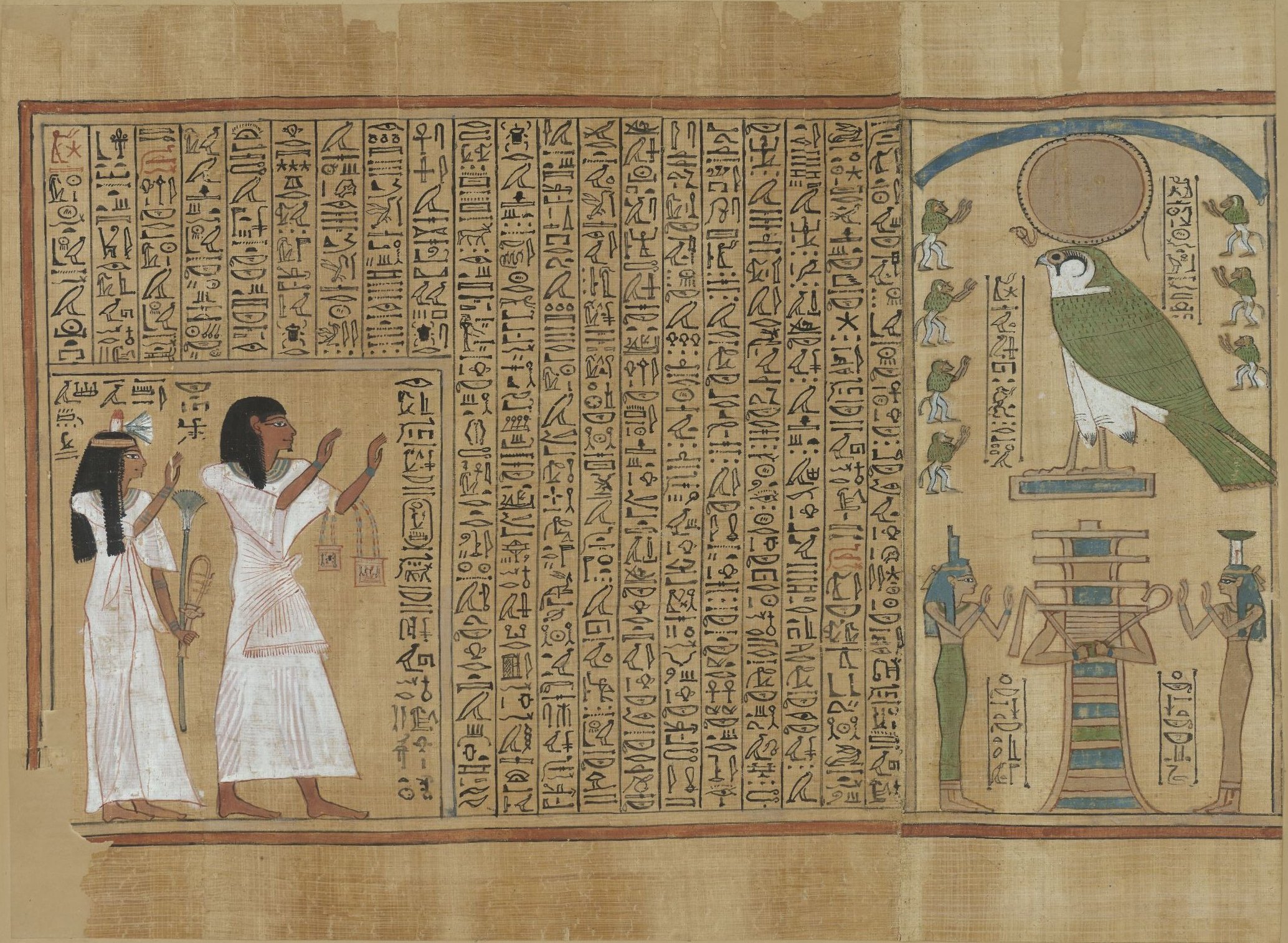
Materials. Papyrus scrolls were the most common medium. Papyrus was made from the pith of the papyrus plant, pressed and dried into sheets that were joined end-to-end to form long scrolls. Some texts were instead inscribed on linen mummy wrappings or tomb walls. The quality of both the papyrus and the scribal work depended on the wealth and status of the deceased.
Length and composition. Manuscripts varied enormously, from just a few sheets to scrolls over 40 meters long. Scribes drew from a pool of nearly 200 known spells, selecting and arranging them based on personal preference, the buyer's budget, and local traditions. Wealthier individuals could commission longer, more comprehensive versions, while shorter, more standardized copies became increasingly common over time.
Illustrations and vignettes. Visual elements were not merely decorative. They served as both a guide and a magical aid for the deceased.
- Scenes depicted the dead person interacting with gods, performing rituals, and moving through the underworld
- Artists used vivid colors and symbolic imagery to reinforce the power of the accompanying spells
- The skill and detail of the illustrations varied widely based on the resources available
Standardization. During the New Kingdom, the ordering of spells became more consistent. Certain key spells appeared in most manuscripts, including Chapters 17, 30B, 64, and 125. Yet regional variations and personal adaptations persisted throughout the tradition, reflecting the diverse religious landscape of ancient Egypt. In later periods, as mass production increased, both consistency and quality tended to decline.