
Sub-Riemannian manifolds blend smooth geometry with restricted motion, creating unique spaces where distance is measured along special paths. These structures challenge our usual notions of dimension and distance, offering a fresh perspective on geometric relationships.
Carnot groups are key players in this field, serving as local models for sub-Riemannian spaces. They help us understand the intricate geometry of these manifolds, much like how flat spaces help us grasp curved surfaces in everyday life.
Sub-Riemannian Manifolds
Definition and Key Properties
- A sub-Riemannian manifold is a smooth manifold M equipped with a smooth distribution H ⊂ TM of subspaces of the tangent spaces, called a horizontal distribution, and a smoothly varying inner product g defined only on H
- The dimension of the horizontal distribution H is strictly less than the dimension of the manifold M
- The horizontal distribution H is required to satisfy the Hörmander condition
- States that the horizontal vector fields, along with their Lie brackets, should span the entire tangent space at each point of the manifold
- The distance between two points on a sub-Riemannian manifold is defined as the infimum of the lengths of all horizontal curves connecting the points
- The length is measured using the sub-Riemannian metric g
- Geodesics in sub-Riemannian geometry are horizontal curves that locally minimize the sub-Riemannian distance between points
Hausdorff Dimension
- The Hausdorff dimension of a sub-Riemannian manifold is typically greater than its topological dimension
- This is due to the presence of the horizontal distribution and the Hörmander condition
- Example: The Heisenberg group, a basic example of a sub-Riemannian manifold, has topological dimension 3 but Hausdorff dimension 4
- The increased Hausdorff dimension reflects the intricate geometry and the presence of non-smooth horizontal curves in sub-Riemannian manifolds
Horizontal Distributions in Geometry
Definition and Role
- A horizontal distribution H on a smooth manifold M is a smooth assignment of a subspace Hp ⊂ TpM of the tangent space at each point p ∈ M
- The horizontal distribution determines the set of admissible curves, called horizontal curves, along which motion is allowed in sub-Riemannian geometry
- A curve γ : [0, 1] → M is said to be horizontal if its tangent vector γ'(t) belongs to the horizontal distribution Hγ(t) for almost every t ∈ [0, 1]
- The choice of the horizontal distribution significantly influences the geometry and properties of the sub-Riemannian manifold
- Affects the distance function, geodesics, and the Hausdorff dimension

Hörmander Condition
- The Hörmander condition requires the horizontal vector fields and their Lie brackets to span the entire tangent space at each point
- Ensures that any two points on the manifold can be connected by a horizontal curve
- Crucial for the controllability and connectivity of the sub-Riemannian manifold
- Example: In the Heisenberg group, the horizontal distribution is spanned by two vector fields X and Y, and their Lie bracket [X, Y] spans the vertical direction, satisfying the Hörmander condition
Carnot Groups and Sub-Riemannian Manifolds
Definition and Properties
- A Carnot group G is a connected, simply connected Lie group whose Lie algebra 𝔤 admits a stratification
- Stratification: a direct sum decomposition 𝔤 = V1 ⊕ V2 ⊕ ... ⊕ Vr such that [V1, Vj] = Vj+1 for 1 ≤ j < r and [V1, Vr] = {0}
- The subspace V1 is called the horizontal layer, and it generates the entire Lie algebra 𝔤 through the Lie bracket operation
- A Carnot group G can be equipped with a natural sub-Riemannian structure
- Considers the left-invariant distribution H corresponding to the horizontal layer V1 and a left-invariant metric g on H
Relationship to Sub-Riemannian Manifolds
- Carnot groups serve as local models for sub-Riemannian manifolds
- Similar to how Euclidean spaces serve as local models for Riemannian manifolds
- The Gromov-Hausdorff tangent space at almost every point of a sub-Riemannian manifold is isometric to a Carnot group
- Known as the Mitchell-Bellaïche theorem
- Carnot groups provide a rich class of examples of sub-Riemannian manifolds with a high degree of symmetry and a well-understood structure
- Example: The Heisenberg group is the simplest non-trivial example of a Carnot group and plays a fundamental role in sub-Riemannian geometry
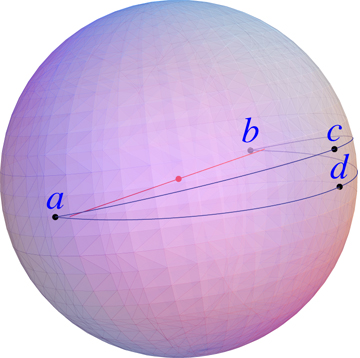
Riemannian vs Sub-Riemannian Geometries
Metric Structure
- Riemannian geometry: based on a smoothly varying inner product (Riemannian metric) defined on the entire tangent space at each point of the manifold
- Sub-Riemannian geometry: relies on a smoothly varying inner product defined only on a subspace (horizontal distribution) of the tangent space
Distance and Geodesics
- Riemannian geometry: distance between two points is the infimum of the lengths of all smooth curves connecting them
- Geodesics are curves that locally minimize the Riemannian distance and are characterized by the vanishing of their covariant derivative
- Sub-Riemannian geometry: distance is the infimum of the lengths of only the horizontal curves connecting the points
- Geodesics are horizontal curves that locally minimize the sub-Riemannian distance and are characterized by the Pontryagin maximum principle
Dimension and Curvature
- Riemannian manifolds: Hausdorff dimension coincides with its topological dimension
- Well-developed theory of curvature plays a crucial role in understanding the geometry and topology
- Sub-Riemannian manifolds: Hausdorff dimension is typically greater than its topological dimension
- Notion of curvature is more intricate and is an active area of research
Classical Results
- Many classical results in Riemannian geometry, such as the Hopf-Rinow theorem and the Bishop-Gromov volume comparison theorem, do not hold or require significant modifications in the sub-Riemannian setting
- Example: The Hopf-Rinow theorem, which guarantees the completeness of Riemannian manifolds under certain conditions, does not hold in general for sub-Riemannian manifolds