
Residues are powerful tools in complex analysis, helping us evaluate tricky integrals. They're the secret sauce in the Laurent series expansion of functions with singularities. By finding residues, we can tackle complex contour integrals that seemed impossible before.
The residue theorem connects the dots between singularities and contour integrals. It's like a cheat code for solving real-world problems in physics and engineering. Mastering residues opens up a whole new world of problem-solving techniques in complex analysis.
Residues of functions
Definition and properties of residues
- The residue of a function at an isolated singular point is the coefficient of the term in the Laurent series expansion of about
- Residues are only defined for isolated singular points, which can be poles (of any order) or essential singularities
- Poles are characterized by a finite number of negative power terms in the Laurent series expansion
- Essential singularities have an infinite number of negative power terms in the Laurent series expansion
- The residue is independent of the choice of contour around the singular point, as long as the contour encloses no other singularities
- This property allows for flexibility in choosing contours when applying the residue theorem
- Residues can be used to evaluate complex contour integrals and real integrals using the residue theorem
- The residue theorem relates the sum of residues within a contour to the value of the contour integral
Types of isolated singular points
- Simple poles (poles of order 1)
- A simple pole occurs when the Laurent series expansion has only one negative power term,
- The residue at a simple pole can be calculated using the limit:
- Poles of order
- A pole of order occurs when the Laurent series expansion has negative power terms, up to
- The residue at a pole of order can be calculated using the formula:
- Essential singularities
- An essential singularity occurs when the Laurent series expansion has an infinite number of negative power terms
- The residue at an essential singularity must be determined from the Laurent series expansion by identifying the coefficient
Calculating residues with Laurent series
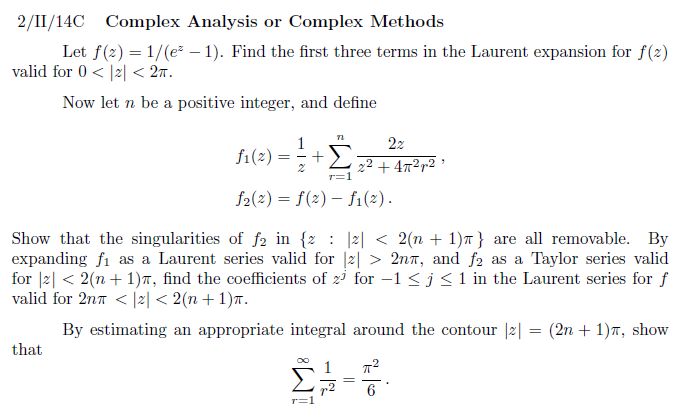
Expanding functions as Laurent series
- To find the residue at a singular point , expand the function as a Laurent series centered at
- The Laurent series expansion is of the form:
- The coefficients can be determined using the formula: , where is a contour enclosing
- Identify the coefficient of the term in the Laurent series expansion
- The coefficient is the residue of at
- For a simple pole, can be found using the limit formula:
Calculating residues at poles and essential singularities
- For a pole of order , use the formula:
- This formula involves taking the -th derivative of and evaluating the limit as approaches
- Example: For at ,
- For an essential singularity, determine the residue from the Laurent series expansion by identifying the coefficient
- Example: For at , the Laurent series expansion is , so the residue is
Evaluating integrals with the residue theorem

Statement and conditions of the residue theorem
- The residue theorem states that for a meromorphic function and a simple closed contour enclosing isolated singular points , the contour integral equals times the sum of the residues of at those singular points
- In mathematical notation:
- The contour must be simple (non-self-intersecting) and closed
- The contour can be a circle, a rectangle, or any other simple closed curve
- The function must be meromorphic (analytic except for isolated poles) within and on the contour
- The residue theorem does not apply to functions with branch cuts or other non-isolated singularities within the contour
Applying the residue theorem to contour integrals
- To apply the residue theorem, follow these steps:
- Identify the isolated singular points within the contour
- Calculate the residues at each singular point using the appropriate method (limit formula for simple poles, derivative formula for higher-order poles, or Laurent series for essential singularities)
- Sum the residues multiplied by to obtain the value of the contour integral
- Example: Evaluate , where is the circle
- The isolated singular points within the contour are and
- and
Residue theorem applications for contour and real integrals
Evaluating real integrals using the residue theorem
- Real integrals of the form , where is a rational function, can be evaluated using the residue theorem by considering a complex contour integral and applying the theorem
- To evaluate real integrals using the residue theorem:
- Express the real integral as a complex contour integral by extending the integrand into the complex plane
- Choose an appropriate contour (e.g., a semicircle in the upper or lower half-plane) that encloses the poles of the integrand and avoids branch cuts, if present
- Apply the residue theorem to the contour integral, calculating the residues at the enclosed poles
- Relate the contour integral to the original real integral using techniques such as the Cauchy principal value or by considering the limit as the radius of the contour approaches infinity
- Example: Evaluate
- Express the integral as a contour integral: , where is a semicircle in the upper half-plane with radius
- The contour encloses a single pole at
- , so
- As , the integral along the circular arc vanishes, and the contour integral equals twice the real integral, so
Other applications of the residue theorem
- The residue theorem can also be used to evaluate integrals involving trigonometric functions, logarithms, and other transcendental functions by expressing them in terms of complex exponentials and applying the theorem
- Example: Evaluate , where
- Express the integral in terms of complex exponentials: , where is the unit circle
- The integrand has simple poles at , but only lies within the unit circle
- , so
- The contour integral equals the original real integral, so
- Example: Evaluate , where
- Contour integration using the residue theorem can be applied to solve problems in various fields, such as physics, engineering, and applied mathematics
- Examples include calculating Fourier transforms, solving differential equations, and evaluating improper integrals arising in quantum mechanics and fluid dynamics