
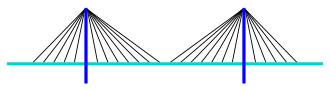
Cable-stayed bridges are a marvel of modern engineering, combining strength and elegance. They use cables attached directly to towers to support the deck, creating a unique structural system that efficiently distributes loads.
Compared to suspension bridges, cable-stayed bridges offer advantages in medium-span lengths. They're more economical, easier to build, and provide greater design flexibility. However, they have shorter maximum spans and require more complex analysis.
Cable-stayed vs Suspension Bridges
Structural System Comparison
- Cable-stayed bridges connect deck directly to towers with cables, while suspension bridges use main cables between towers with vertical suspenders supporting deck
- Towers in cable-stayed bridges typically taller and more substantial bear significant compressive forces
- Cable-stayed bridges have stiffer deck structure allows better distribution of live loads
- Anchorage system in cable-stayed bridges generally less extensive cables transfer loads directly to towers
- Cable-stayed bridges offer various cable arrangements (fan, harp, semi-fan patterns) while suspension bridges use uniform catenary cable arrangement
- Main span lengths of cable-stayed bridges generally shorter practical limits around 1,000 meters for cable-stayed and up to 2,000 meters for suspension bridges (Golden Gate Bridge)
- Both bridge types rely on cable tension to support deck, but cable-stayed bridges incorporate significant compression forces in towers and deck
Load Transfer and Force Distribution
- Cable-stayed bridges utilize tension in cables and compression in towers and deck creating self-anchoring system
- Suspension bridges primarily rely on tension in main cables and vertical suspenders
- Cable-stayed bridges distribute loads more efficiently along deck length through intermediate cable supports
- Suspension bridges transfer loads to main cables then to towers and anchorages
- Cable-stayed bridges experience varying load distribution among cables depending on angle and location
- Suspension bridges have more uniform load distribution along main cables
- Cable-stayed bridges can better accommodate asymmetrical loads due to their stiffer structure
Advantages and Disadvantages of Cable-stayed Bridges
Economic and Construction Benefits
- More economical for medium-span lengths (200-1,000 meters) reduced material requirements and simpler construction processes
- Construction can be more easily staged cantilevering sections outward from towers reduces need for temporary supports
- Lower maintenance costs easier cable inspection and replacement procedures
- Greater design flexibility accommodates various aesthetic options and complex geometries (Millau Viaduct)
- Efficient use of materials compared to traditional beam or truss bridges
- Shorter construction time compared to suspension bridges due to simpler erection process
- Reduced foundation requirements compared to suspension bridges lower anchorage forces
Structural and Performance Advantages
- Stiffer deck provides better aerodynamic stability less susceptible to wind-induced vibrations
- Better load distribution along deck length improves overall structural efficiency
- Can accommodate complex geometries and asymmetrical spans (Erasmus Bridge)
- Higher torsional rigidity improves stability under eccentric loads
- Better control of deck deformations under live loads enhances user comfort
- Ability to use partial cable layouts for aesthetic or functional purposes
- Can be designed with concrete towers and decks reducing steel requirements in some cases
Limitations and Challenges
- Shorter maximum span length compared to suspension bridges limited to around 1,000 meters
- More complex analysis required for load distribution and cable forces
- Higher sensitivity to construction tolerances and errors
- Potential for cable vibrations under certain wind conditions requires careful design
- More challenging to widen or modify after construction compared to some other bridge types
- Higher complexity in deck-tower connection design to accommodate forces and movements
- Potential for uneven settlement of towers can lead to significant force redistribution
Load Transfer in Cable-stayed Bridges
Primary Load Path Components
- Loads transfer from deck to towers through inclined cables under tension
- Deck acts as continuous beam with cables providing intermediate supports along length
- Compressive forces induced in deck and towers result from tensile forces in cables
- Load distribution among cables varies depending on angle and location steeper cables generally carry higher loads
- Towers resist vertical and horizontal components of cable forces through compression and bending
- Deck experiences combination of compression, bending, and torsion depending on load location and cable arrangement
- Anchorages at deck and tower levels crucial for efficient force transfer between components

Factors Influencing Load Transfer
- Stiffness of deck and towers plays crucial role in load transfer mechanism influences overall bridge behavior
- Cable arrangement (fan, harp, semi-fan) affects load distribution and structural efficiency
- Longitudinal forces (braking vehicles) resisted by cable inclination and tower bending stiffness
- Cross-sectional properties of deck and towers impact load distribution and deformation characteristics
- Connection details between cables, deck, and towers critical for proper force transfer
- Prestressing of deck and cables can optimize load distribution and reduce deformations
- Temperature effects and time-dependent material properties (creep, shrinkage) influence long-term load transfer behavior
Secondary Load Transfer Mechanisms
- Deck-tower interaction through bearings or rigid connections affects overall load distribution
- Transverse cable arrangements in wide bridges provide additional load transfer paths
- Stay pipe systems in multi-cable arrangements distribute forces more uniformly to deck
- Counterweight systems in some designs help balance cantilever moments during construction and service
- Earth anchors in soil or rock formations may supplement tower foundations in resisting cable forces
- Damping systems integrated into cables or deck structure influence dynamic load transfer
- Expansion joints and sliding bearings accommodate thermal movements and affect load transfer at supports
Behavior of Cable-stayed Bridges under Loads
Static Loading Response
- Dead loads and live loads induce complex stress patterns in cables, deck, and towers
- Non-linear behavior under large deformations requires iterative analysis techniques
- Cable sag effect influences overall stiffness and load distribution
- Prestressing of cables and deck optimizes stress distribution under service loads
- Long-term effects (creep, shrinkage) in concrete components lead to time-dependent deformations and stress redistributions
- Temperature changes cause thermal expansion and contraction stress redistribution in bridge components and potential changes in cable tensions
- Differential support settlements can significantly alter load distribution and internal forces
Dynamic Loading Characteristics
- Wind and seismic forces cause vibrations and oscillations require careful analysis of modal characteristics
- Vortex shedding, flutter, and galloping phenomena critical for aerodynamic stability analysis
- Traffic-induced vibrations affect user comfort and fatigue performance of components
- Cable vibrations under wind or rain-wind excitation may require installation of dampers
- Seismic response influenced by overall flexibility and energy dissipation capacity of structure
- Dynamic amplification factors for moving loads depend on span length and stiffness properties
- Modal coupling between deck, tower, and cable vibrations can lead to complex dynamic behavior
Long-term Performance Considerations
- Fatigue loading from cyclic stresses particularly important in cable anchorages and deck-to-cable connections
- Corrosion protection systems for cables and other steel components crucial for durability
- Concrete creep and shrinkage effects more pronounced in cable-stayed bridges compared to other bridge types
- Cable force monitoring and adjustment may be necessary to maintain optimal performance over time
- Wear and deterioration of bearings and expansion joints can alter load transfer mechanisms
- Long-term deflections and geometry changes may require periodic adjustments to maintain intended profile
- Maintenance of corrosion protection systems and replacement of wearing surfaces essential for longevity