
The inverse Laplace transform is a powerful tool for converting functions from the s-domain back to the time domain. It's crucial for analyzing system behavior after performing operations in the s-domain, like working with transfer functions or convolution.
Partial fraction expansion and Laplace transform pairs are key techniques for finding inverse transforms. These methods allow us to break down complex s-domain functions into simpler terms, making it easier to convert back to the time domain and understand system responses.
Inverse Laplace Transform
Inverse Laplace transform definition
- Converts a function from the s-domain (Laplace domain) back to the time domain (t-domain)
- Denoted as , where is the Laplace transform of the time-domain function
- Recovers the original time-domain function from its Laplace transform representation
- Essential for analyzing the behavior of systems in the time domain after performing operations in the s-domain (transfer functions, convolution)
Partial fraction expansion for inversion
- Decomposes rational Laplace transforms into a sum of simpler terms
- Rational Laplace transform is a ratio of two polynomials in the s-domain,
- Factors the denominator polynomial and expresses the rational function as a sum of partial fractions
- Each partial fraction has a denominator that is a linear or quadratic factor of (first-order poles, second-order poles)
- Resulting partial fractions are easier to inverse Laplace transform individually using Laplace transform pairs or tables
- Time-domain function is obtained by summing the inverse Laplace transforms of each partial fraction term
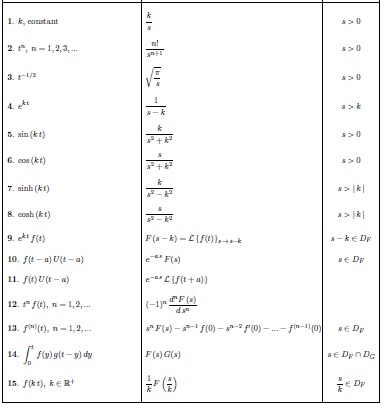
Laplace transform pairs and tables
- Set of correspondences between time-domain functions and their respective Laplace transforms
- Derived from the properties of the Laplace transform and well-established for common functions (exponential, sinusoidal)
- Compilation of these pairs used as a reference for finding the inverse Laplace transform of a given function
- Tables list the time-domain function and its corresponding Laplace transform
- Locate the entry in the table that matches the given Laplace transform and read off the corresponding time-domain function
- Common Laplace transform pairs:
- , where is a non-negative integer
System Response in Time Domain
Time-domain response from Laplace transforms
- Determined by finding the inverse Laplace transform of the system's transfer function
- Transfer function is the ratio of the Laplace transform of the output to the Laplace transform of the input ,
- Given and , the Laplace transform of the output is calculated as
- To find the time-domain output :
- Take the inverse Laplace transform of using partial fraction expansion (if necessary)
- Use Laplace transform pairs or tables
- Resulting time-domain function represents the system's response to the given input in the time domain (step response, impulse response)