7.4 Galactic Magnetic Fields and Cosmic Rays

🚀Astrophysics II Unit 7 Review
7.4 Galactic Magnetic Fields and Cosmic Rays
🚀 Astrophysics II
Galactic Magnetic Field and Synchrotron Radiation
Galactic magnetic fields thread through the interstellar medium and play a structural role in shaping the galaxy. They regulate star formation, confine and redirect cosmic rays, and produce observable synchrotron radiation. Cosmic rays, in turn, serve as probes of these fields: their composition, energy spectrum, and arrival directions encode information about acceleration processes and galactic transport. Together, magnetic fields and cosmic rays form a coupled system central to galactic dynamics.
Magnetic Field Structure and Detection
The large-scale galactic magnetic field has a typical strength of order Gauss (a few microgauss), with field lines that broadly trace the spiral arm pattern. This field has both a regular (ordered) component and a turbulent (random) component of comparable magnitude.
Several independent techniques are used to map the field:
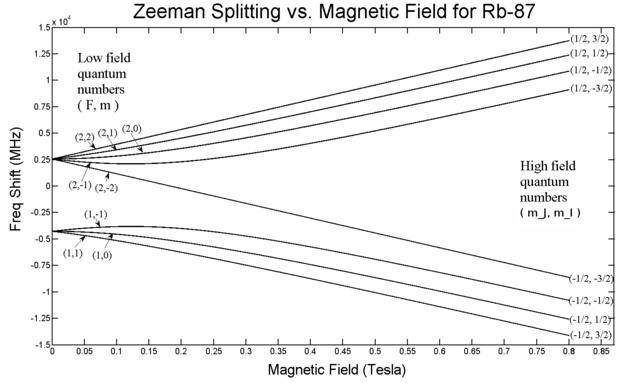
- Zeeman splitting of spectral lines (especially the 21 cm hydrogen line) directly measures the line-of-sight field strength in dense clouds, though it requires strong fields or high sensitivity because the splitting is small.
- Faraday rotation of polarized background radio sources probes the field along the line of sight through diffuse ionized gas (discussed in detail below).
- Interstellar polarization of starlight occurs because elongated dust grains align with their long axes perpendicular to the local magnetic field. The transmitted starlight becomes partially polarized parallel to the field direction, mapping the field orientation projected onto the plane of the sky.
- Synchrotron emission itself traces the field in regions with relativistic electrons, and its polarization reveals the field's ordered component.
The magnetic field influences dynamics at many scales: it provides pressure support against gravitational collapse in molecular clouds, channels cosmic ray diffusion, and contributes to the overall pressure balance of the interstellar medium.
Synchrotron Radiation and the Galactic Dynamo
Synchrotron radiation is emitted when relativistic (near-light-speed) electrons spiral around magnetic field lines. The radiation is intrinsically non-thermal, meaning its spectrum does not follow a blackbody curve. Instead, it follows a power-law distribution in frequency, which makes it distinguishable from thermal emission. Synchrotron sources include supernova remnants, pulsar wind nebulae, radio galaxies, and active galactic nuclei.
Key properties of synchrotron radiation:
- It is strongly linearly polarized, with the electric vector perpendicular to the projected magnetic field direction.
- The characteristic frequency radiated by a single electron scales as , where is the electron Lorentz factor and is the magnetic field strength.
- A population of electrons with a power-law energy distribution produces a synchrotron spectrum with spectral index .
The galactic dynamo is the mechanism that sustains and amplifies the large-scale magnetic field against ohmic dissipation. Without it, the field would decay on timescales shorter than the age of the galaxy. The dynamo operates through two coupled effects:
- Differential rotation (the -effect) stretches and amplifies the toroidal (azimuthal) component of the field, because the inner galaxy rotates faster than the outer regions.
- Helical turbulence in the interstellar medium (the -effect, driven by supernova explosions and other energy injection) twists the toroidal field to regenerate the poloidal component.
This -dynamo converts kinetic energy from galactic rotation and turbulence into magnetic energy, and it naturally produces the large-scale, coherent field geometry observed in spiral galaxies.
Faraday Rotation and Polarization Effects
When linearly polarized radiation passes through a magnetized plasma, the plane of polarization rotates. This is Faraday rotation, and it arises because the left- and right-circularly polarized components of the wave propagate at slightly different speeds in the presence of a magnetic field along the line of sight.
The total rotation angle is proportional to (the square of the observing wavelength), and the proportionality constant is the rotation measure (RM):
where is the thermal electron density in , is the magnetic field component along the line of sight in microgauss, is the path element in parsecs, and RM is in units of .
By observing the polarization angle at multiple wavelengths, you can extract the RM and thereby constrain the product integrated along the path. The sign of RM tells you whether the field points toward or away from the observer. Combining RM data from many lines of sight across the sky builds up a map of the large-scale field geometry.
Faraday rotation probes the line-of-sight field through ionized gas, while dust polarization probes the plane-of-sky field through the dusty ISM. Together, these complementary techniques constrain all three components of the magnetic field vector.
Cosmic Rays and Acceleration Mechanisms

Cosmic Ray Composition and Properties
Cosmic rays are high-energy charged particles arriving at Earth from space. Their composition at GeV energies is approximately:
- Protons: ~90%
- Alpha particles (helium nuclei): ~9%
- Heavier nuclei (carbon through iron and beyond): ~1%
- Plus a small fraction of electrons and positrons
Their energies span an enormous range, from eV up to beyond eV.
A distinctive feature of cosmic ray composition is the overabundance of light elements (lithium, beryllium, boron) relative to solar system material. These elements are rare products of stellar nucleosynthesis but are produced copiously when heavier cosmic ray nuclei (mainly carbon and oxygen) undergo spallation reactions, fragmenting upon collision with interstellar hydrogen and helium. The ratio of secondary to primary nuclei (e.g., boron-to-carbon) is a key diagnostic of how much material cosmic rays traverse before reaching us, and therefore of their propagation history.
Despite having preferred source locations (the galactic disk), cosmic rays arrive at Earth with nearly isotropic directions. This is because the galactic magnetic field repeatedly deflects charged particles, randomizing their trajectories over the year residence time in the galaxy. Only at the very highest energies (above eV), where the gyroradius becomes comparable to the galactic scale, might directional anisotropies emerge.
Acceleration Mechanisms and Energy Spectrum
The dominant acceleration mechanism for galactic cosmic rays is diffusive shock acceleration (DSA), also called first-order Fermi acceleration. Here is how it works:
- A strong shock wave propagates through the interstellar medium (typically from a supernova explosion).
- A charged particle ahead of the shock scatters off magnetic turbulence and crosses the shock front into the downstream region.
- In the downstream region, the particle scatters again and re-crosses the shock back upstream.
- Each round trip gives the particle a fractional energy gain , where is the shock velocity. Because the upstream and downstream gas converge at the shock, the particle always gains energy on average (hence "first-order" in ).
- After many crossings, the resulting energy distribution is a power law , with predicted to be close to 2 for strong shocks. Propagation effects steepen this to the observed .
There is also second-order Fermi acceleration, where particles scatter off randomly moving magnetic clouds. Energy gains and losses partially cancel, leaving a net gain proportional to . This process is slower and less efficient than DSA but may contribute to pre-acceleration or re-acceleration of particles.
The cosmic ray energy spectrum follows a broken power law with several notable features:
- From to eV, the spectrum goes as .
- The "knee" at eV: the spectrum steepens to . This likely marks the maximum energy achievable by supernova remnant shocks for protons, with heavier nuclei reaching proportionally higher energies (since maximum rigidity scales with charge ).
- The "ankle" at eV: the spectrum flattens again. This is widely interpreted as the transition from galactic to extragalactic cosmic ray sources.
- The GZK cutoff above eV: ultra-high-energy protons lose energy through pion production off cosmic microwave background photons ( or ), limiting the distance from which such particles can reach us to roughly 50–100 Mpc.
Sources and Propagation
The primary candidates for galactic cosmic ray sources are supernova remnants (SNRs). The energetics work out: if roughly 10% of a typical supernova's kinetic energy ( erg) goes into cosmic ray acceleration, and the galactic supernova rate is about 2–3 per century, this matches the observed cosmic ray energy density of . Direct evidence comes from gamma-ray observations of SNRs (by Fermi-LAT and ground-based Cherenkov telescopes), which reveal pion-decay signatures consistent with hadronic acceleration.
Other potential sources include pulsars and pulsar wind nebulae (especially for cosmic ray electrons and positrons) and active galactic nuclei (for the highest-energy extragalactic component).
Cosmic ray propagation through the galaxy is governed by several processes:
- Diffusion through turbulent magnetic fields, which is the dominant transport mechanism. The diffusion coefficient depends on particle energy and the turbulence spectrum.
- Convection by galactic winds, which can transport cosmic rays out of the disk.
- Energy losses: ionization losses dominate at low energies; synchrotron and inverse Compton losses dominate for high-energy electrons; hadronic interactions (pion production) affect high-energy protons in dense regions.
- Spallation, producing secondary nuclei and providing a clock for propagation. The observed ratio of secondary to primary species constrains the average grammage (column density of material traversed), roughly 5–10 g/cm².
- Radioactive secondaries (e.g., with a half-life of 1.4 Myr) constrain the cosmic ray residence time in the galaxy to years, much longer than the straight-line travel time across the disk, confirming that propagation is diffusive.
Galactic cosmic rays are confined by the magnetic field to a volume larger than the stellar disk, forming a cosmic ray halo extending several kiloparsecs above and below the plane. Only particles with gyroradii approaching galactic scales (the highest-energy particles, above eV) can escape this confinement, which is consistent with the ankle marking the galactic-to-extragalactic transition.
See Fiveable more often in Google
Mark Fiveable as a preferred source and Google is more likely to show you our guides in Top Stories, with a "preferred" badge in AI Mode and AI Overviews.