AP Spanish Language Unit 1 Cheatsheet: Families and Communities

AP Spanish Language Unit 1 Cheatsheet: Families and Communities

Start with the first 3 sections of the Unit 1 one-page cheatsheet below. The full sheet is a PDF you can print.

Interpretive Skills: Finding Main Ideas & Details

Recognize explicit meaning (1.A): Identify what is directly stated about families, communities, activities, and relationships.

Interpret meaning (1.B): Determine the main idea, theme, or purpose from context clues, tone, and supporting details.

Synthesize and infer (1.C): Connect details across sources to draw conclusions about family values, traditions, and community roles in Spanish-speaking societies.

Key strategy: Mark supporting details that answer "What?", "Who?", "Why?" and "How?" before stating the main idea.
Community Contexts: Urban vs. Rural

Essential question: How do families and communities experience today's world?

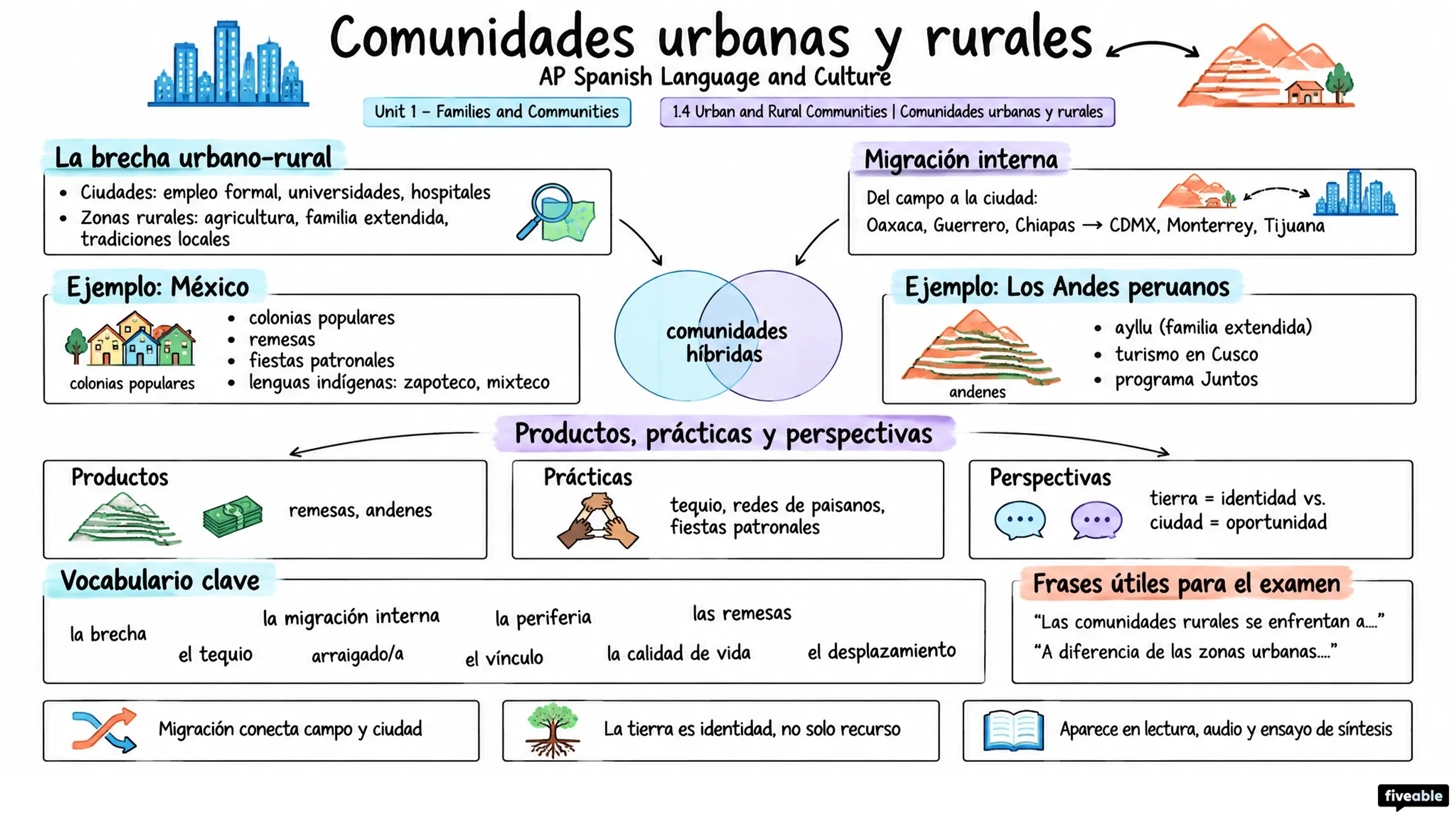
Urban communities (ciudades): Diverse populations, faster pace, more services, anonymity, economic opportunity, cultural institutions, social stratification.

Rural communities (pueblos/aldeas): Tight-knit networks, agricultural/traditional economies, stronger family interdependence, limited services, preservation of customs, slower change.

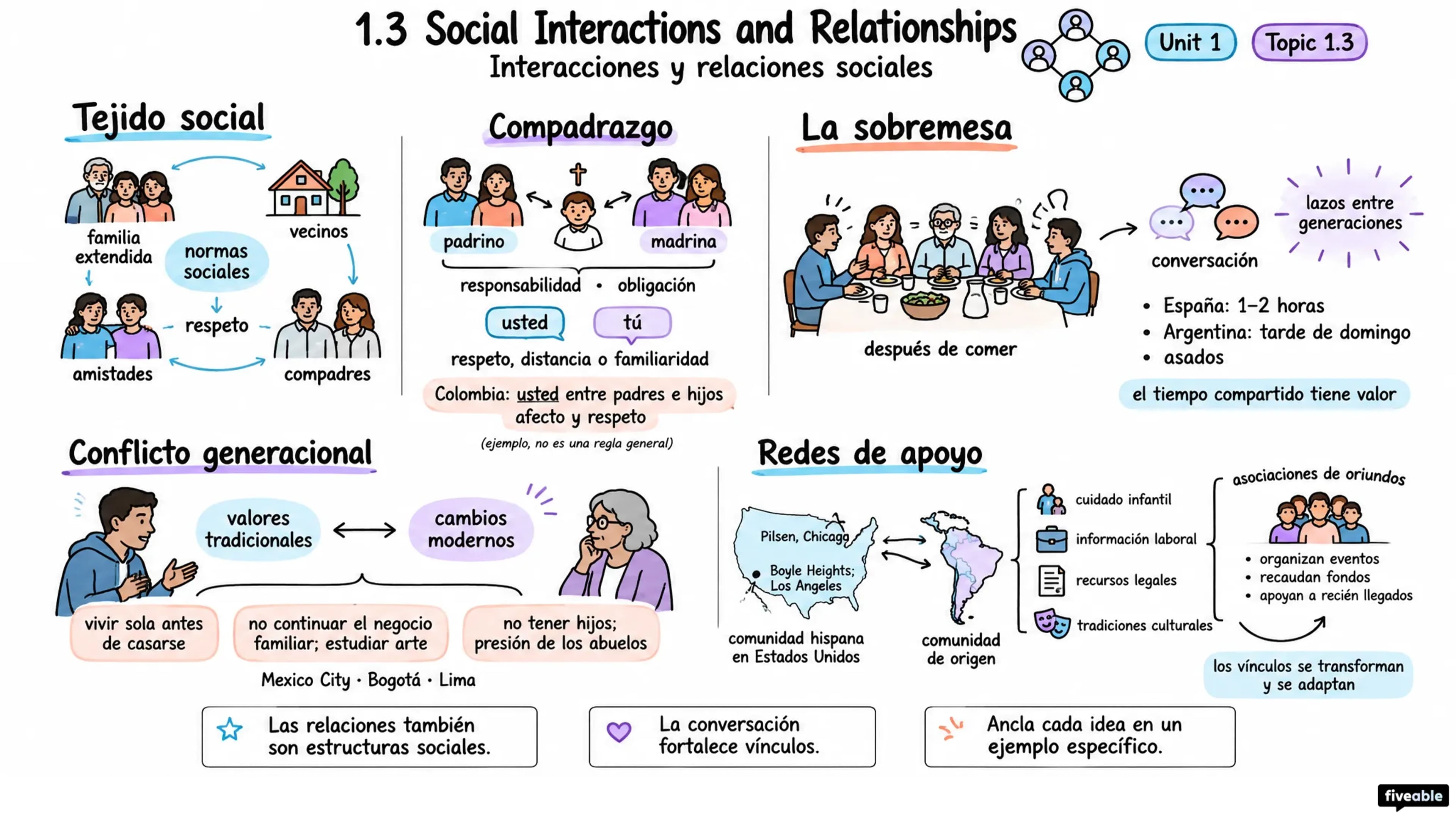
Social interactions vary by context: urban settings may involve more varied or anonymous encounters, while smaller rural communities may involve more repeated, familiar relationships.

Community role evolution: Shift from geographic proximity to digital/virtual communities; changing definitions of "belonging."

Cultural Connections & Synthesis

Cultural connections skill: Make connections within and across cultures.

Within Hispanic cultures: Compare family structures and community roles across different Spanish-speaking countries and regions.

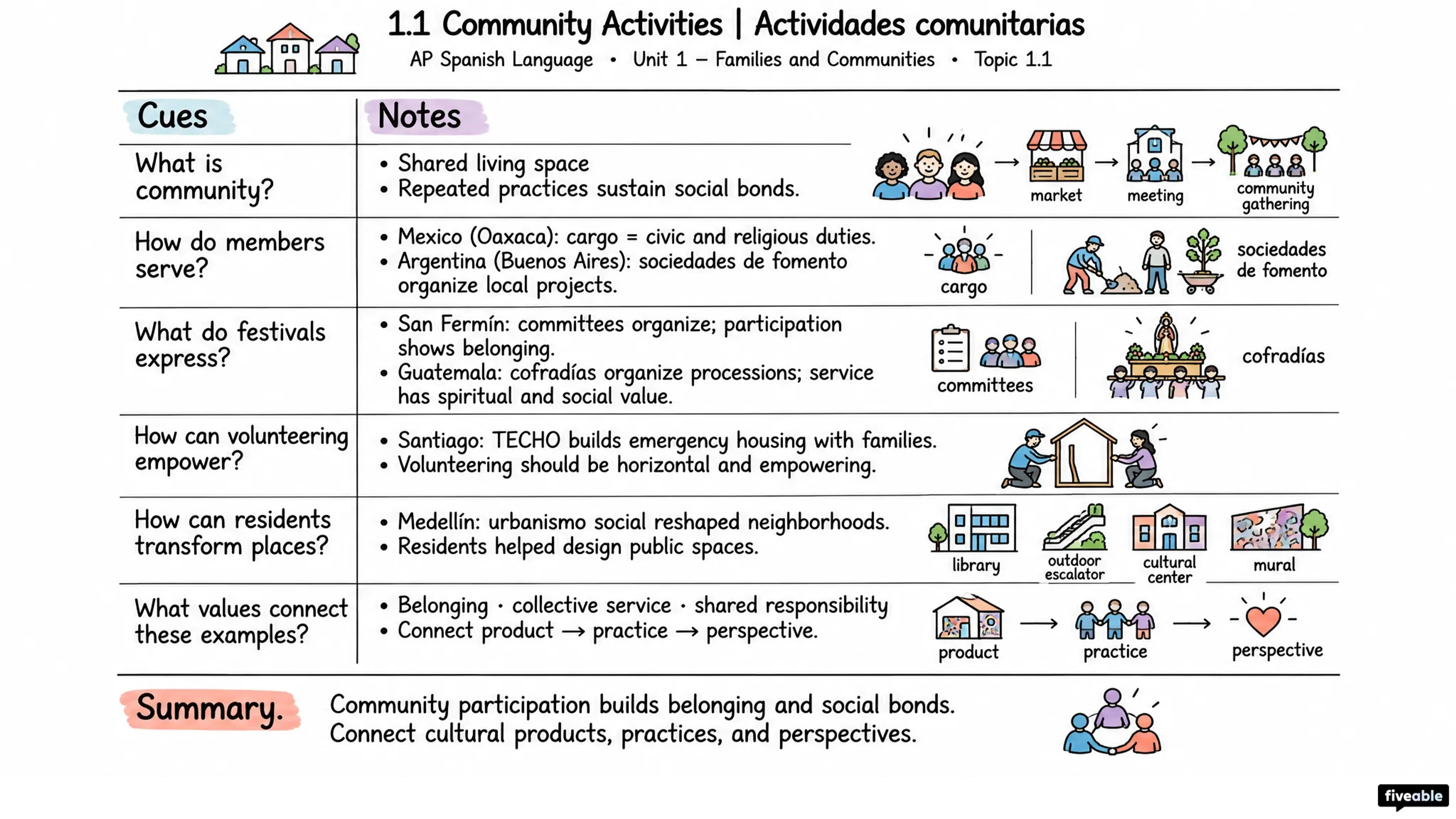
Across cultures: Contrast family values in a specific community of the Spanish-speaking world you know well (e.g., Oaxaca, Buenos Aires, San Juan) with your own community; identify shared themes (loyalty, tradition, adaptation) and distinctive practices, and avoid generalizing to all Spanish speakers.

On the exam: When synthesizing, show how cultural context shapes family decisions and community participation. Avoid stereotypes; acknowledge diversity within Spanish-speaking societies.

Example frame: "En la cultura hispanohablante, [specific practice], mientras que en mi cultura [contrast]. Esto refleja [underlying value/difference]."

The rest of the Unit 1 sheet

6 more sections are on the one-page PDF:

  • Vocabulary & Grammar Toolkit

  • Presentational Mode: Organizing Ideas About Families & Communities

  • Interpersonal Mode: Conversations About Relationships & Activities

  • Communication Strategies for Speaking & Writing

  • Family Definition & Values in Hispanic Societies

  • Family Life & Modern Challenges

Made by you

Visual Cheatsheets

Pick a Unit 1 topic and a format: flowchart, comparison chart, vocab sheet, Cornell notes and more. Ready in about a minute.

Printable PDF · from the Fiveable shop

AP Spanish Language and Culture Unit 1 Cheatsheet

1 page · Families and Communities · PDF

Visual Cheatsheets

One topic, the format you pick, ready in about a minute

Format

Topic

Takes 30–60 seconds

Preview: Standard

Unit 1: Families and Communities, topic by topic

Each topic has a full study guide. See the whole unit.