Conductors in Electrostatic Equilibrium
Key principle: Excess charges move to the conductor surface and stop there almost instantly.
- Why: Mutual repulsion of charge carriers forces them outward until equilibrium is reached
- Result: Zero net charge and zero electric field inside the conductor
- Surface property: All points on the surface are at the same electric potential (equipotential)
- Field direction: Perpendicular to the outer surface
Charge distribution:
- Negative net charge → excess electrons on surface
- Positive net charge → electron deficiency on surface (model as positive charges)
- Higher density at points and edges than on flat areas
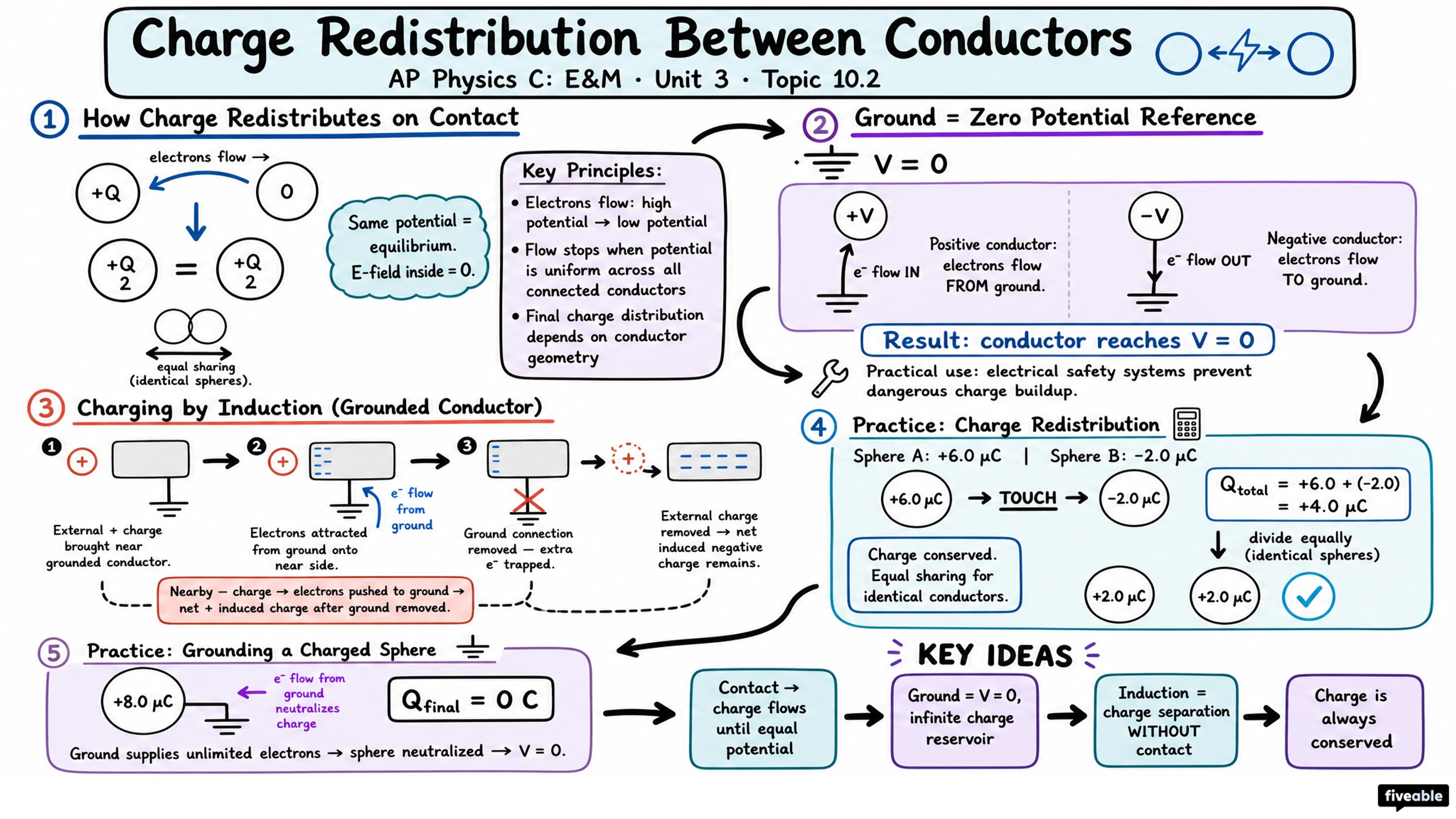
Polarization: Conductor remains equipotential even when external field is applied; charges redistribute to maintain this condition.