AP Physics 1 Experimental Design FRQ Practice
68 Experimental Design and Analysis questions written in the AP format. Pick one, read the setup and data, and write your response. Fiveable scores each Experimental Design FRQ response part by part on the AP rubric.
Your first scored response is included. A plan unlocks unlimited scoring.
68 questions
sorted by unit
Cart velocity measurement using motion analysis
Unit 1: Kinematics
Students are investigating the motion of objects as observed from different reference frames.
Describe an experimental procedure to collect data that would allow the students to determine the velocity of Cart B relative to the track. Assume that Cart B moves with constant velocity in the positive direction along the track. Include any steps necessary to reduce experimental uncertainty. In your description, state what quantities would be measured and what equipment would be used to measure them.
Describe how the data collected in part (A) could be graphed and how that graph would be analyzed to determine the velocity of Cart B relative to the track.
Figure 1. Two carts on a straight track
Figure 2. Grid for plotting a linearized graph
vA (m/s) | vBA (m/s) |
|---|---|
0.20 | 0.95 |
0.35 | 0.80 |
0.50 | 0.65 |
0.65 | 0.48 |
0.80 | 0.35 |
0.95 | 0.18 |
The students perform an experiment in which Cart A is set to various constant velocities vA in the positive direction along the track. Cart B moves with constant velocity in the positive direction along the track. For each trial, the motion sensor on Cart A measures the velocity vBA of Cart B relative to Cart A. Table 1 shows the measured values of vA and vBA.
The students correctly determine that the relationship between vBA and vA is given by vBA = vB - vA, where vB is the velocity of Cart B relative to the track.
The students create a graph with vA plotted on the horizontal axis.
Indicate what measured or calculated quantity could be plotted on the vertical axis to yield a linear graph whose slope can be used to calculate an experimental value for vB.
Vertical axis: Horizontal axis: vA
On the grid in Figure 2, plot the data points for the quantities indicated in part C(i). Use Table 2 to record any calculated quantities. Clearly label the vertical axis, including units as appropriate.
Draw a straight best-fit line for the data graphed in part C(ii).
Using the best-fit line that you drew in part C(iii), calculate an experimental value for the velocity vB of Cart B relative to the track.
What the Experimental Design FRQ asks
The Experimental Design and Analysis question is FRQ 3 on the AP Physics 1 exam. You design a procedure to answer a question about a physical system, then graph data from a similar experiment and use your best-fit line to find a physical quantity.
- 25–30 min
- suggested on the exam
- 10 points
- across parts A to D
- 95 min
- for all four FRQs
Part A: Procedure
How to collect the data: what you vary, what you measure, and with what
2 pts
Part B: Analysis plan
How you would graph the data and what the graph tells you
2 pts
Part C: Graph
Choose quantities that give a straight line, plot the data, and draw a best-fit line
4 pts
Part D: Calculation
A value calculated from your best-fit line
2 pts
How Experimental Design FRQ practice works
Each question follows the exam’s format, from the full prompt to a score on every part.
Read the setup and data
The lab scenario, the data table, and all four parts, A through D, laid out the way the exam shows them.
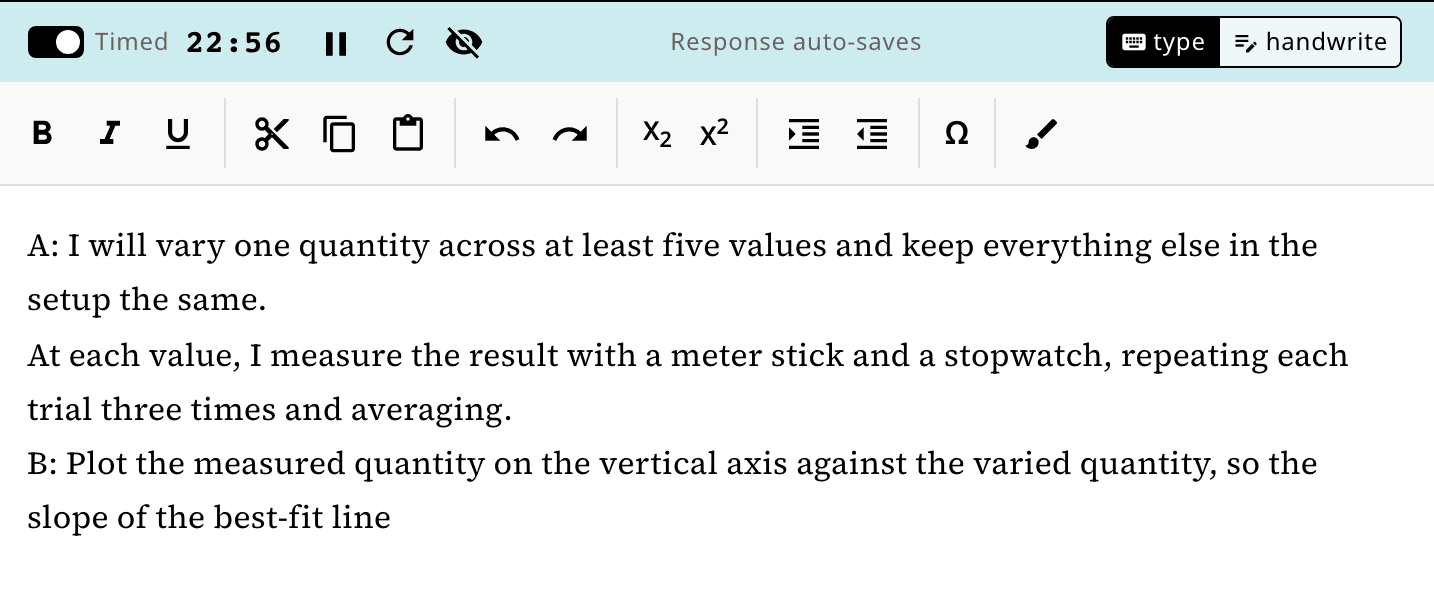
Write on a 27-minute timer
Inside the 25 to 30 minutes the exam suggests for this question. Pause it or turn it off, and your response saves as you go.
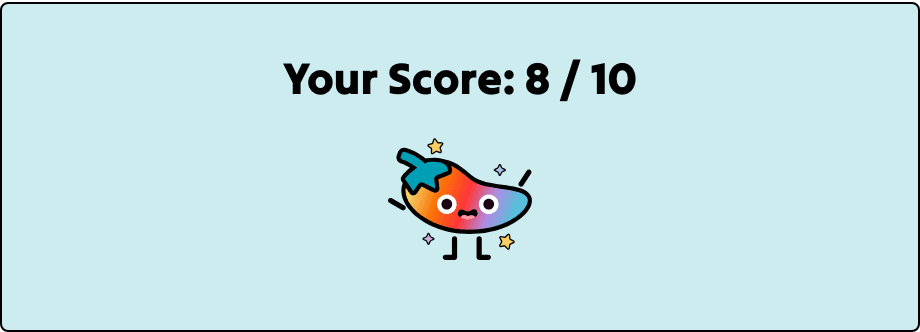
Submit for a score out of 10
Your response is scored against the scoring guidelines written for that question. Your first score is included.
Feedback on every part
A summary at the top tells you what to work on next. Below it, each part shows whether you earned the point and what the scoring guidelines were looking for.
Detailed Feedback
Part A: 1/1 point
You varied the motor’s constant acceleration across trials and measured both F and a each time.
Part A: 1/1 point
You proposed repeating trials and averaging the force readings to reduce uncertainty.
Part B: 0/1 point
You correctly identified the slope as m, but the vertical intercept is mg, not g. You needed to state that g equals the intercept divided by the slope.
Questions about the Experimental Design FRQ
How many responses can I get scored?
You can read every question without a plan. Your first scored response is included. A plan unlocks unlimited scoring.
How do I make the graph in part C?
Open the drawing tool in the editor and plot it there. You can also graph it on paper, switch to handwrite, and add a photo of your page.
What equipment can my procedure use?
Equipment a typical high school lab would have, like a meter stick, a stopwatch, or a motion sensor. Say what you vary, what you measure, and how you measure it.
Is the data in part C from my own procedure?
No. Part C gives you data from a similar experiment. Your analysis plan from part B still helps you choose what to graph.
Are these real College Board questions?
No. We wrote them in the AP format, with the same four parts, and wrote scoring guidelines for each one.
More AP Physics 1 practice
Mathematical Routines FRQ practice
Mathematical Routines questions with the full scenario, figures, and both parts.
Representations FRQ practice
Translation Between Representations questions with the full scenario and all four parts.
Qualitative/Quantitative FRQ practice
Qualitative/Quantitative Translation questions with the full scenario and all three parts.
Write your first Experimental Design FRQ
Pick one from the list, or let us choose for you.
Teaching AP Physics 1? Assign these Experimental Design FRQs to your class