AP Music Theory Unit 6 Cheatsheet: Harmony and Voice Leading III - Embellishments, Motives, and Melodic Devices

AP Music Theory Unit 6 Cheatsheet: Harmony and Voice Leading III - Embellishments, Motives, and Melodic Devices

Start with the first 3 sections of the Unit 6 one-page cheatsheet below. The full sheet is a PDF you can print.

Nonharmonic Tones: Core Concept

Embellishing tones (also called nonharmonic or nonchord tones) are decorative notes that lie outside the pitch content of the prevailing chord.

They enrich individual lines and intensify expression while maintaining the underlying harmonic framework.

Key distinction: Rhythmic placement determines classification:

  • Accented: falls directly on a beat
  • Unaccented: falls between beats (on a division)

Related terms: ornament, trill, preparation, resolution.
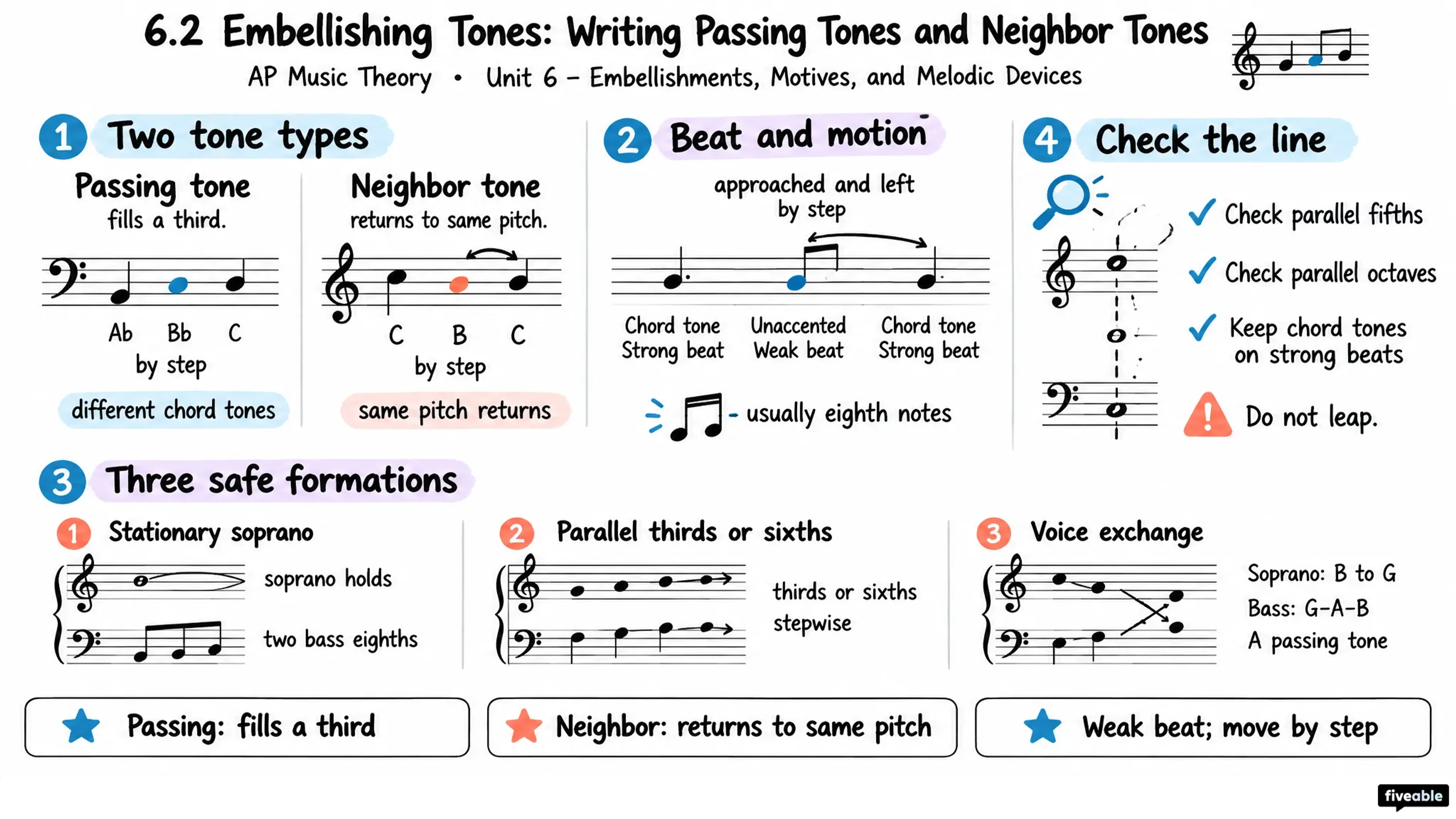
Writing Bass Lines with Embellishments

Context: 18th-century chorale style; soprano given, compose bass.

Framework: Essential quarter-note bass enlivened with eighth-note motion.

Unaccented passing and neighbor tones work best when they:

  • Complement a stationary soprano (two bass eighths against soprano quarter)
  • Move in parallel thirds or sixths with soprano
  • Engage in voice exchange with soprano

Key principle: Embellishments must follow normative 18th-century voice-leading rules; they decorate, not replace, harmonic function.

Figured Bass & Roman Numeral Notation

Indicating nonharmonic tones in figured bass or Roman numeral progressions:

Arabic numerals show specific nonharmonic tones:

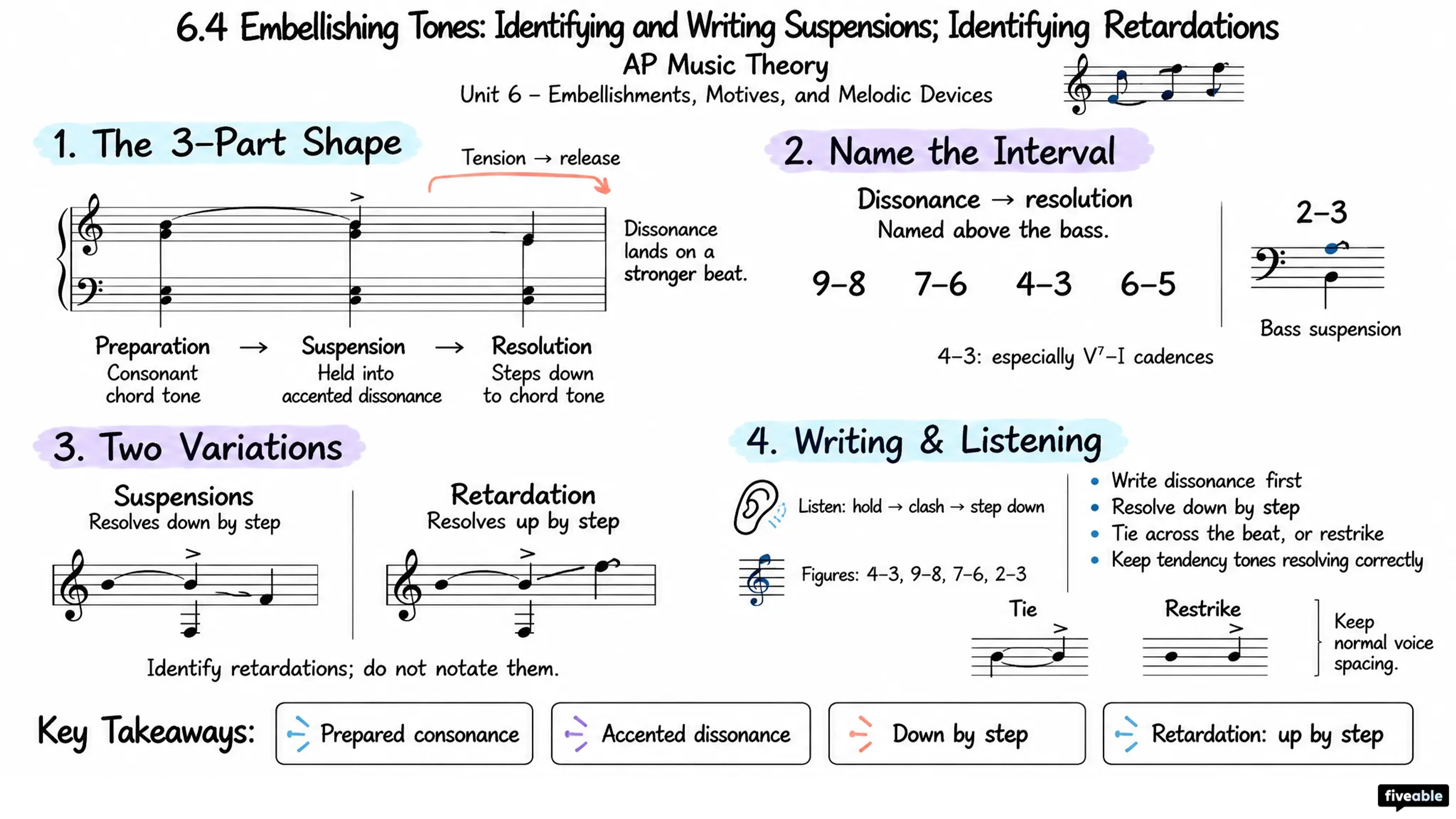
  • 4-3: suspension (4 resolves to 3)
  • Other figures indicate intervals and chord quality

When analyzing or composing:

  • Identify the underlying chord function first
  • Recognize embellishing tones as decorative, not harmonic
  • Ensure preparation and resolution follow voice-leading rules

Exam boundary: You must identify and notate suspensions; only identify retardations.

The rest of the Unit 6 sheet

6 more sections are on the one-page PDF:

  • Passing Tones & Neighbor Tones

  • Anticipation, Escape Tone, Appoggiatura, Pedal Point

  • Motive & Motivic Transformation

  • Suspension & Retardation

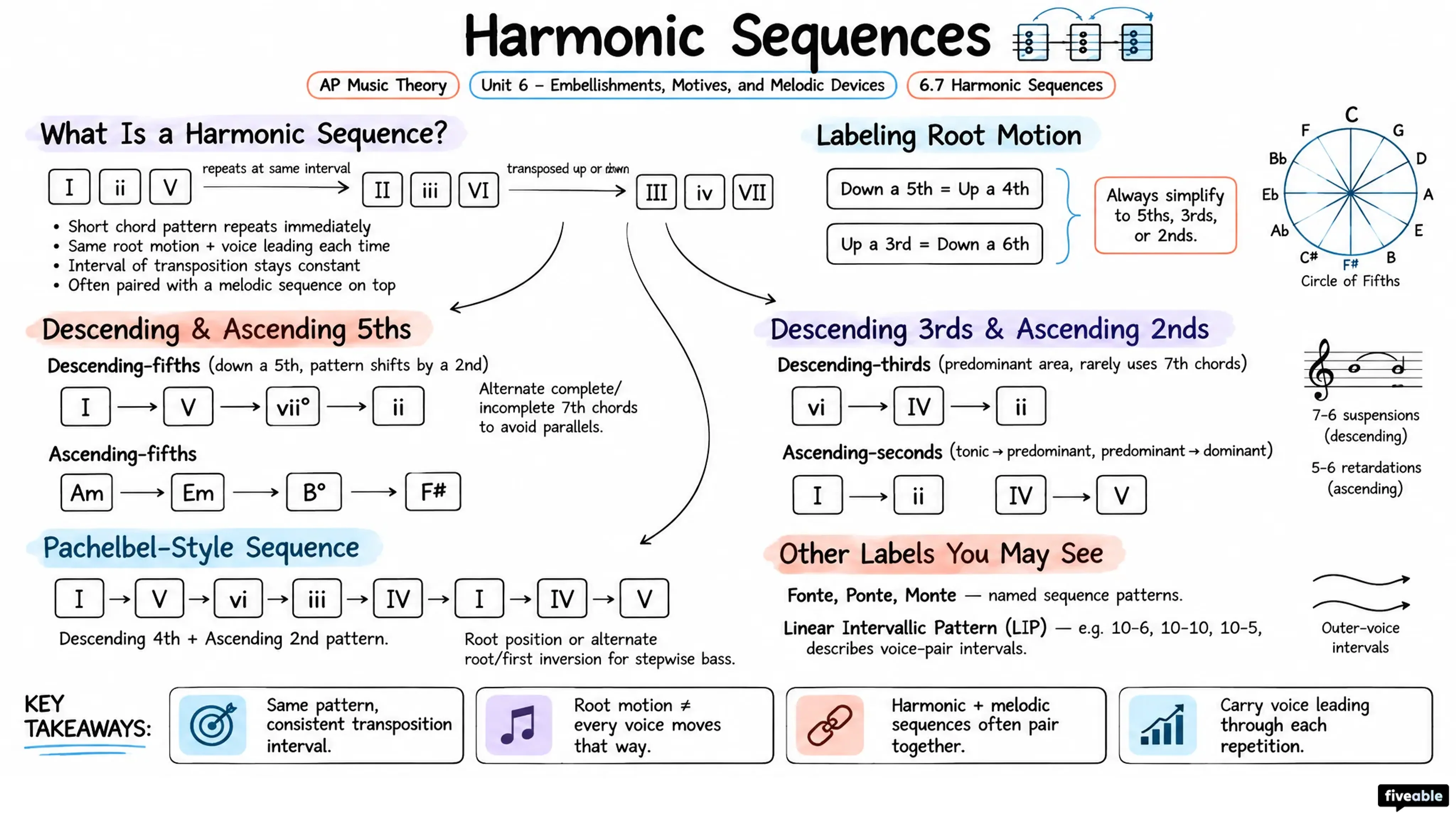
  • Melodic & Harmonic Sequence

  • Identification Strategy: Performed & Notated Music

Made by Fiveable

Text-Based Cheatsheet

Unit 6: Harmony and Voice Leading III - Embellishments, Motives, and Melodic Devices on one page, aligned to the 2026-2027 course. Made and checked by the Fiveable Content Team.

Or get the whole course

Made by you

Visual Cheatsheets

Pick a Unit 6 topic and a format: flowchart, comparison chart, vocab sheet, Cornell notes and more. Ready in about a minute.

Printable PDF · from the Fiveable shop

AP Music Theory Unit 6 Cheatsheet

1 page · Harmony and Voice Leading III - Embellishments, Motives, and Melodic Devices · PDF

Visual Cheatsheets

One topic, the format you pick, ready in about a minute

Format

Topic

Takes 30–60 seconds

Preview: Standard

Unit 6: Embellishments, Motives, and Melodic Devices, topic by topic

Each topic has a full study guide. See the whole unit.