AP Macroeconomics Unit 4 Cheatsheet: Financial Sector

AP Macroeconomics Unit 4 Cheatsheet: Financial Sector

Start with the first 3 sections of the Unit 4 one-page cheatsheet below. The full sheet is a PDF you can print.

Financial Assets & Opportunity Cost

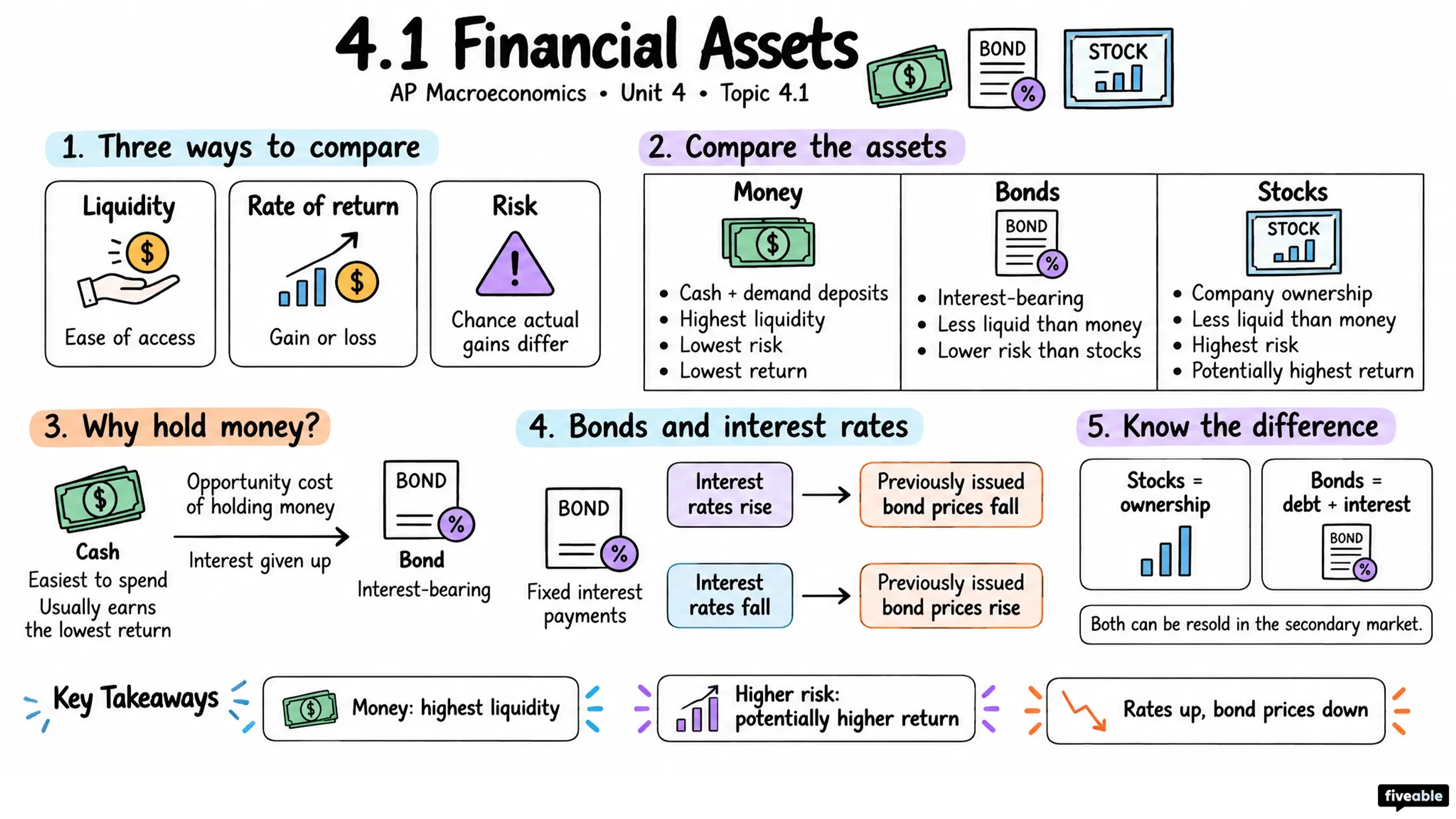
Three Key Attributes:

  • Liquidity: How easily converted to cash. Cash and demand deposits are most liquid.
  • Rate of Return: Interest or dividends earned.
  • Risk: Probability of losing value.

Asset Types:

  • Money (cash, demand deposits) — liquid, no return
  • Bonds — interest-bearing, inverse price-yield relationship
  • Stocks — equity ownership, variable return

Bond Price & Interest Rate: When interest rates rise, previously issued bond prices fall (and vice versa). Holding money means forgoing interest from bonds—this is the opportunity cost.
Monetary Policy Tools & Effects

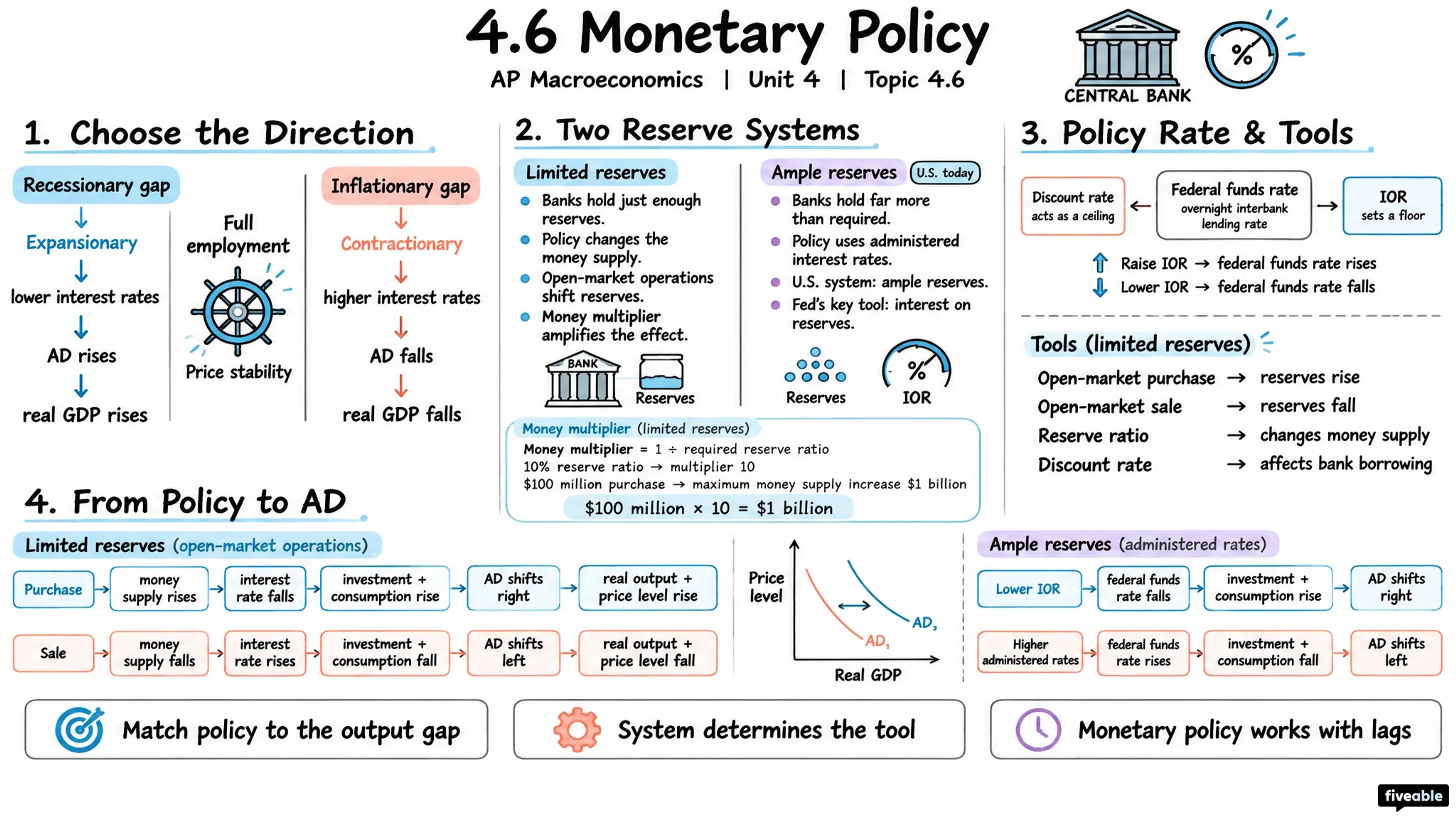
Central Bank Tools:

  • Open Market Operations (OMOs) — buy/sell securities
  • Discount Rate — rate charged to banks for borrowing
  • Required Reserve Ratio — % of deposits banks must hold
  • Interest on Reserves — rate paid on bank reserves (U.S. focus)

How OMOs Work:

  • Purchase: Increases reserves → increases monetary base → increases money supply
  • Sale: Decreases reserves → decreases monetary base → decreases money supply

Policy Types:

  • Expansionary: Increase money supply → lower interest rates → boost investment & consumption (fight recession)
  • Contractionary: Decrease money supply → raise interest rates → reduce spending (fight inflation)

Transmission: Policy affects interest rates → affects investment & consumption → affects aggregate demand → affects output & price level.

Lags: recognition lag (identifying the problem) + implementation lag (enacting the policy); impact lag is the time for the policy to affect the economy.

National Savings & Open Economy

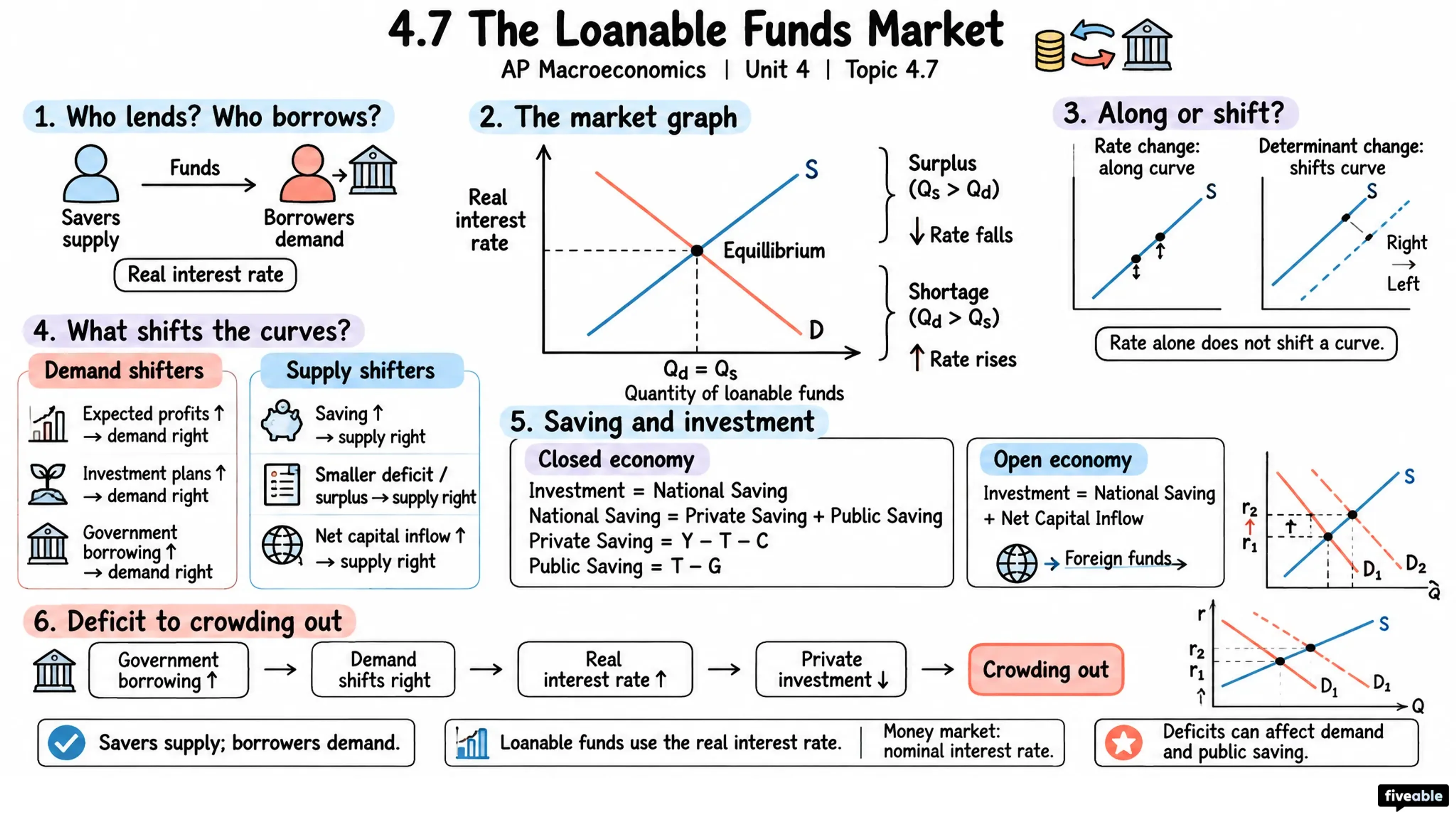
Closed Economy:

National Savings = Public Savings + Private Savings

  • Public Savings = Tax Revenue − Government Spending
  • Private Savings = Income − Taxes − Consumption

Open Economy:

Investment = National Savings + Net Capital Inflow

  • Net Capital Inflow = Foreign investment in domestic assets − Domestic investment abroad
  • If capital inflow is positive, domestic investment can exceed national savings

Key Insight: A country running a budget deficit (negative public saving) must increase private saving and/or attract net foreign capital inflows to maintain investment.

The rest of the Unit 4 sheet

6 more sections are on the one-page PDF:

  • Nominal vs. Real Interest Rates

  • Loanable Funds Market Basics

  • Loanable Funds Shifts & Policy Effects

  • Money: Definition & Measurement

  • Fractional Reserve Banking & Money Multiplier

  • Money Market: Demand, Supply & Equilibrium

Made by you

Visual Cheatsheets

Pick a Unit 4 topic and a format: flowchart, comparison chart, vocab sheet, Cornell notes and more. Ready in about a minute.

Printable PDF · from the Fiveable shop

AP Macroeconomics Unit 4 Cheatsheet

1 page · Financial Sector · PDF

Visual Cheatsheets

One topic, the format you pick, ready in about a minute

Format

Topic

Takes 30–60 seconds

Preview: Standard

Unit 4: Financial Sector, topic by topic

Each topic has a full study guide. See the whole unit.