all units 120
unit 1 20
unit 2 20
unit 3 20
unit 4 20
unit 5 20
unit 6 20
120 questions
sorted by unit
Japanese community center family cultural exchange event
Unit 1
Community volunteer opportunity in Japan
Unit 1
Community volunteer participation in autumn festival
Unit 1
Volunteer coordination for Japanese autumn festival
Unit 1
Community center autumn festival planning and coordination
Unit 1
Summer volunteer placement preferences and experience
Unit 1
Community cultural exchange event volunteer coordination
Unit 1
Japanese community center autumn festival planning
Unit 1
Community event planning and cultural perspectives
Unit 1
American family customs and cultural exchange activities
Unit 1
Community volunteering and cultural festival participation
Unit 1
Neighborhood summer festival planning and community coordination
Unit 1
Community volunteering at Japanese neighborhood festival
Unit 1
Community festival volunteer participation and cultural exchange activity
Unit 1
Japanese community center cultural exchange day planning
Unit 1
Community cultural celebration planning and family engagement
Unit 1
Community volunteer coordination for cultural festival event
Unit 1
Youth engagement at community cultural events
Unit 1
Community center volunteer registration for family festival
Unit 1
Community building through volunteer events and social gathering
Unit 1
Japanese customs and cultural celebrations planning
Unit 2
International customs and celebrations across cultures
Unit 2
Local customs and Japanese cultural exchange interests
Unit 2
Japanese customs and student body cultural appeal
Unit 2
Exchange student cultural festival booth planning
Unit 2
Cultural festivals and international exchange programs
Unit 2
Japanese customs, celebrations, cultural exchange activities
Unit 2
Local customs and cultural celebrations exchange
Unit 2
Japanese culture and customs festival booth planning
Unit 2
Japanese customs and cultural celebration traditions
Unit 2
Cultural exchange: Japanese customs and personal celebrations
Unit 2
International cultural exchange and US customs representation
Unit 2
Japanese customs and cultural celebrations introduction
Unit 2
Japanese cultural popularity and regional adoption
Unit 2
Cultural customs and celebrations across different societies
Unit 2
International cultural exchange event planning and coordination
Unit 2
Cultural exchange customs and celebrations between nations
Unit 2
Student booth planning for Japanese cultural customs
Unit 2
Japanese and American customs, celebrations, cultural differences
Unit 2
Japanese language education and cultural interest abroad
Unit 2
Japanese art exhibition planning and cultural representation
Unit 3
International art exchange between Japanese and American schools
Unit 3
Sister-city cultural exchange program art exhibition
Unit 3
Japanese art and international exhibition participation
Unit 3
International art exchange program collaboration
Unit 3
International student art exchange and collaboration
Unit 3
Japanese art styles and cross-cultural student collaboration
Unit 3
International art exhibition planning and cultural exchange
Unit 3
International student art exhibition theme and submissions
Unit 3
Japanese art and culture festival organization
Unit 3
Joint online art exhibition between schools
Unit 3
Japanese art and cultural creativity exchange
Unit 3
International student collaboration and cultural art exchange
Unit 3
International youth art exhibition participation and cultural exchange
Unit 3
Japanese art traditions and cultural exchange potential
Unit 3
Virtual art exhibition planning for international students
Unit 3
Japanese art exhibition cultural exchange program
Unit 3
Japanese Art and Culture Festival volunteer coordination
Unit 3
Student art club exhibition submission details
Unit 3
International art exhibition presentation ideas
Unit 3
Technology use in international educational contexts
Unit 4
Technology's impact on student learning experiences
Unit 4
Technology use in high school daily lives
Unit 4
High school students, AI adoption, technology's future impact
Unit 4
Summer exchange program digital detox weekend camp
Unit 4
Technology's impact on student daily lives
Unit 4
Technology's role in Japanese and American daily life
Unit 4
High school technology use and student perspectives
Unit 4
High school student technology use and impacts
Unit 4
Youth technology adoption across Japan and US cultures
Unit 4
Technology use and daily life patterns
Unit 4
Daily technology use and social media impacts
Unit 4
Personal technology's impact on high school students
Unit 4
Smartphone usage and digital detox strategies
Unit 4
Technology's societal impacts and personal usage patterns
Unit 4
Online communication tools and technology guidelines
Unit 4
Technology usage and perspectives across cultures
Unit 4
Technology's role in contemporary high school experiences
Unit 4
Technology use and societal impacts
Unit 4
Technology use and daily life impacts
Unit 4
Weekend activities preferences among high school students
Unit 5
Contemporary Japanese pop culture and cuisine preferences
Unit 5
Student exchange experience and cultural presentation preferences
Unit 5
Japanese pop culture popularity and festival planning
Unit 5
International cultural exchange through pop culture perspectives
Unit 5
Weekend activities, dietary needs, homestay placement
Unit 5
Local attractions and cultural entertainment recommendations
Unit 5
Cultural preferences and food experiences abroad
Unit 5
Japanese exchange student cultural integration and adaptation
Unit 5
Japanese visitor seeking local recommendations and dining suggestions
Unit 5
Japanese cultural immersion and dietary accommodation preferences
Unit 5
Japanese film genres and festival activity preferences
Unit 5
Weekend activities and meal preferences abroad
Unit 5
Summer study abroad program preferences and dietary needs
Unit 5
Everyday life and cultural practices in local communities
Unit 5
Japanese food culture and entertainment preferences
Unit 5
Contemporary Japanese culture and personal activity preferences
Unit 5
Sister-city exchange, local attractions, youth culture
Unit 5
Local cultural attractions and regional cuisine recommendations
Unit 5
Japanese contemporary culture and student interests exploration
Unit 5
Local environmental issues and community sustainability efforts
Unit 6
Japan-US youth environmental collaboration and local initiatives
Unit 6
Environmental issues and cultural attitudes globally
Unit 6
Global environmental issues across different countries
Unit 6
Global environmental issues and international student collaboration
Unit 6
Global tourism's impact on local communities
Unit 6
Environmental sustainability initiatives in home communities
Unit 6
Environmental initiatives and sustainability practices
Unit 6
Global environmental issues and school-level awareness campaigns
Unit 6
Environmental issues and daily life impacts
Unit 6
Environmental initiatives and community sustainability efforts
Unit 6
Global environmental issues and cultural practices
Unit 6
Global environmental issues, local school sustainability
Unit 6
Global youth perspectives on local social issues
Unit 6
Community plastic waste environmental initiatives and solutions
Unit 6
Environmental sustainability initiatives in American schools
Unit 6
Environmental initiatives and cultural behavior shifts
Unit 6
Food waste, sustainability, and cultural values
Unit 6
Local environmental practices and conference topic suggestions
Unit 6
Environmental issues and cross-cultural perspectives
Unit 6
〇〇さん、こんにちは。地域のコミュニティセンターの田中です。
来月、センターで「家族と地域」をテーマにした国際交流イベントを行います。
イベントで、あなたの国の家族の週末の過ごし方について発表してもらえませんか。
また、地域の人が一緒に参加できるアクティビティを一つ提案してください。
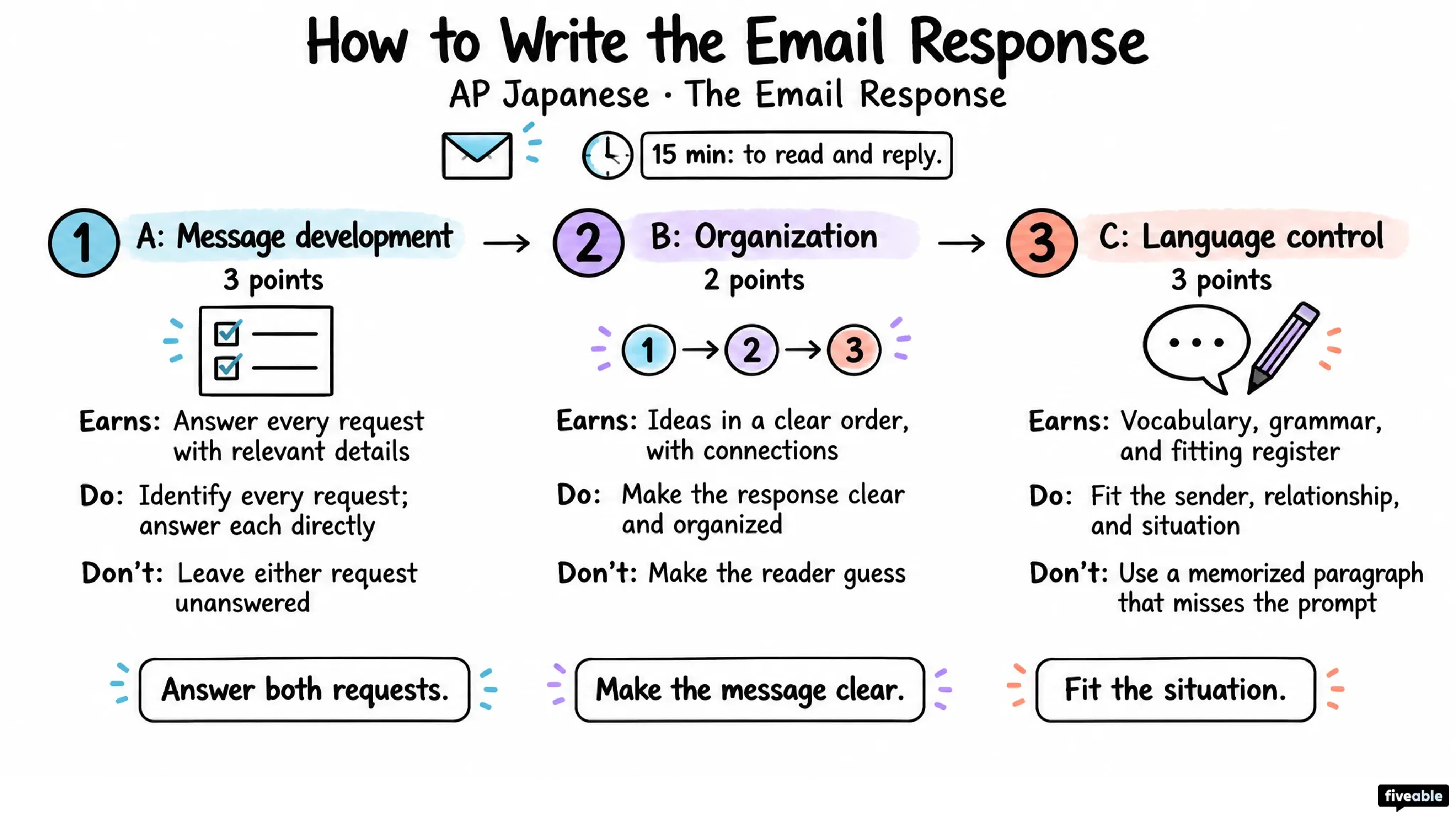
What the Email Response asks Email Response is FRQ 4 on the AP Japanese exam starting in May 2027. You read an email and write a reply that answers both of its requests, in a register that fits the person and the situation.
15 min to read and reply
8 points across rows A to C
15% of your exam score, with FRQ 3 A
Part A: Message development An answer to every request in the email, with relevant details
3 pts
B
Part B: Organization Ideas in a clear order, with connections between them
2 pts
C
Part C: Language control Vocabulary, grammar, and a register that fits the sender
3 pts
How Email Response practice works Each question follows the exam’s format, from the full prompt to a score on every part.
1
Read the full email The email and both of its requests, laid out the way the exam shows them.
2
Write on a 15-minute timer The time to plan for on exam day. Pause it or turn it off, and your response saves as you go.
3
Submit for a score out of 8 Your response is scored against the scoring guidelines written for that question. Your first score is included.
Questions about the Email Response How many responses can I get scored? You can read every question without a plan. Your first scored response is included. A plan unlocks unlimited scoring.
How do I type in Japanese? Turn on your computer’s Japanese keyboard and type in kana and kanji. You can also switch to handwrite, write on paper, and add a photo of your page.
How formal should my reply be? Match the sender and the situation. A teacher or an adult you don’t know calls for です and ます forms and polite expressions. Register is part of the score.
How is the Email Response different from Story Narration? The Email Response asks you to answer every request in an email. Story Narration asks you to tell a story from four pictures.
Are these real College Board questions? No. We wrote them in the AP format and wrote scoring guidelines for each one.
More AP Japanese practice Story Narration practice Story Narration prompts with all four pictures.
AP Japanese FRQs Every FRQ type for AP Japanese, with practice for each.
AP Japanese study guides Unit-by-unit review for the whole course.