
Cellular homology groups are a powerful tool for understanding the topological structure of CW complexes. They provide a way to compute and interpret the "holes" and "twists" in spaces, using the cellular structure to simplify calculations compared to simplicial homology.
The cellular boundary formula is key to computing these groups. It expresses boundary maps in terms of attaching map degrees, allowing us to determine kernels and images. This process reveals the free and torsion components of homology groups, giving insights into a space's topology.
Cellular chain complexes
Definition and properties
- A cellular chain complex is a sequence of abelian groups and homomorphisms between them, denoted as , associated with the cellular structure of a CW complex
- The boundary maps, denoted as , connect the chain groups and are defined based on the attaching maps of the cells in the CW complex
- The composition of two consecutive boundary maps is always zero, i.e., , which is a crucial property for defining homology groups
- The cellular chain groups are free abelian groups generated by the -cells of the CW complex (e.g., 0-cells, 1-cells, 2-cells)
- The boundary map applied to an -cell gives a linear combination of -cells in the cellular structure of
Boundary maps and attaching maps
- The boundary maps are determined by the attaching maps of the cells in the CW complex
- For an -cell , the boundary is given by the sum of -cells multiplied by the degrees of the attaching maps
- The degree is the number of times the attaching map of the -cell wraps around the -cell , counted with signs depending on the orientation
- The cellular boundary formula expresses the boundary map in terms of the degrees of the attaching maps:
- Calculating the boundary maps using the cellular boundary formula requires determining the degrees of the attaching maps for each pair of cells in the CW complex
Cellular homology groups
Definition and computation
- The -th cellular homology group, denoted as , is defined as the quotient group , where is the kernel of the boundary map and is the image of the boundary map
- To compute , one needs to find the kernel of , which consists of the -cycles (elements in that are mapped to zero by ), and the image of , which consists of the -boundaries (elements in that are the image of elements in under )
- The rank of the free part of is equal to the dimension of minus the dimension of as vector spaces
- The torsion coefficients of can be determined by analyzing the quotient group structure and identifying the orders of the torsion elements (e.g., , )
Interpreting homology groups
- The rank of the free part of corresponds to the number of -dimensional "holes" in the CW complex that are not boundaries of -dimensional cells
- Torsion coefficients in represent the presence of "twists" or "torsion" in the -dimensional structure of the CW complex
- The homology groups provide a way to distinguish between topological spaces based on their "hole" structure and torsion
- Examples of spaces with non-trivial homology groups include the circle (), the torus (), and the real projective plane ()
Cellular vs simplicial homology

Relationship between cellular and simplicial homology
- For a CW complex , the cellular homology groups are isomorphic to the simplicial homology groups of any simplicial complex that is a subdivision of
- The cellular boundary maps and the simplicial boundary maps are compatible under this isomorphism, meaning that the homology groups computed using either method will be the same
- The relationship between cellular and simplicial homology is an example of the functoriality of homology, which states that homology is independent of the choice of the chain complex used to compute it
Advantages of cellular homology
- Cellular homology provides a more efficient way to compute homology groups compared to simplicial homology, as it often requires fewer generators and relations
- The cellular chain complex is typically smaller than the simplicial chain complex for the same topological space, leading to simpler computations
- Cellular homology can be applied to a wider range of topological spaces, including those that do not have a natural simplicial structure (e.g., CW complexes obtained by attaching cells)
Cellular boundary formula
Formulation and application
- The cellular boundary formula expresses the boundary map in terms of the degrees of the attaching maps of the cells in the CW complex
- For an -cell , the boundary is given by the sum of -cells multiplied by the degrees of the attaching maps :
- The degree is the number of times the attaching map of the -cell wraps around the -cell , counted with signs depending on the orientation
- To calculate the boundary maps using the cellular boundary formula, one needs to determine the degrees of the attaching maps for each pair of cells in the CW complex
Examples and calculations
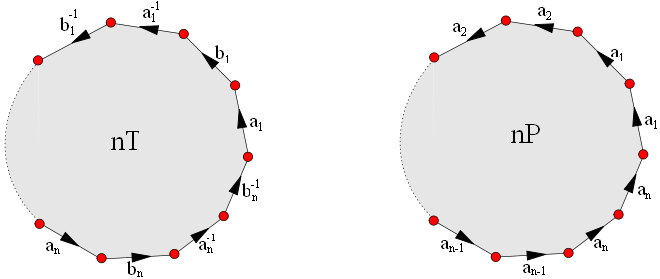
- Consider the CW complex structure of the torus , which consists of one 0-cell, two 1-cells ( and ), and one 2-cell () attached via the map
- The cellular boundary formula yields: , and
- The resulting cellular chain complex is , which leads to the homology groups , , and
- Similar calculations can be performed for other CW complexes, such as the real projective plane or the Klein bottle, using the cellular boundary formula to determine the boundary maps and compute the homology groups