
📚English 10 Unit 12 Review
12.2 Punctuation and Capitalization
12.2 Punctuation and Capitalization
Unit & Topic Study Guides
Literary Analysis: Critical Reading Skills
Short Stories: Elements and Interpretation
Poetry
Novel Structure and Narrative Techniques
Drama: Theatrical Elements & Performance
Rhetoric and Argumentation in Non-Fiction
Writing Process and Essay Fundamentals
Narrative Writing: Personal & Fictional Stories
Expository Writing
Persuasive Writing: Crafting Arguments
Research Skills: Finding & Using Sources
Refining Writing: Grammar and Style
Vocabulary Building and Word Choice
Revision and Editing Strategies
Oral Communication: Presenting and Discussing
Cultural and Historical Contexts in Literature
Punctuation and capitalization are essential tools for clear communication in writing. These elements help organize thoughts, convey meaning, and guide readers through your text. Mastering their use is crucial for effective writing.
From commas to colons, each punctuation mark serves a specific purpose. Proper capitalization highlights important words and concepts. Together, they form the backbone of well-structured, easily understood written language.
Punctuation for Clarity
Functions and Types of Punctuation
- Punctuation marks clarify meaning, convey emotion, and organize written language
- Proper punctuation helps readers understand the intended message and avoid confusion
- Three main types of punctuation:
- Terminal (periods, question marks, exclamation points)
- Pausing (commas, semicolons, colons, dashes)
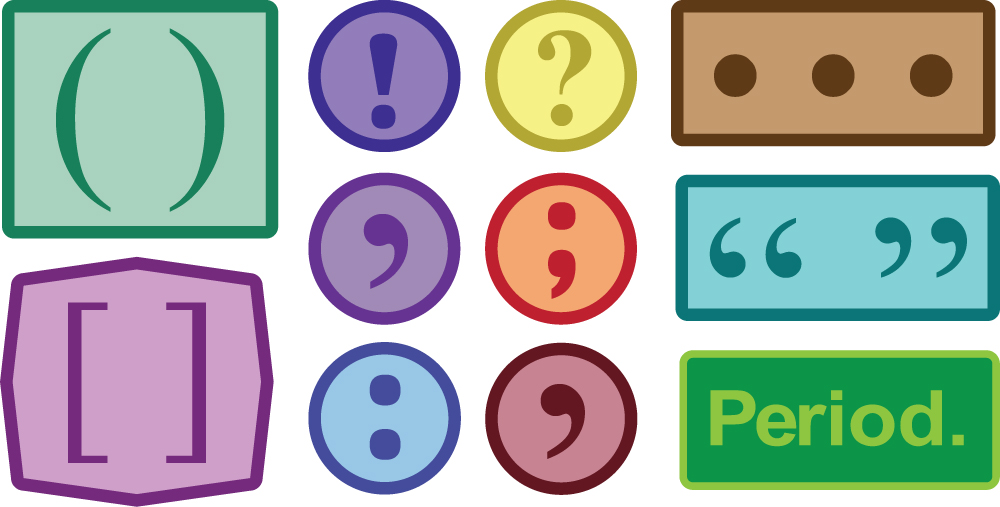
- Special purpose (apostrophes, quotation marks, parentheses, brackets)
Punctuation Rules and Effects
- Punctuation marks have specific rules for usage that ensure clear communication
- Periods end declarative sentences
- Question marks end interrogative sentences
- Exclamation points express strong emotion
- Punctuation can change the meaning of a sentence
- "Let's eat, Grandma!" is a polite invitation
- "Let's eat Grandma!" suggests cannibalism
- Punctuation marks work together with grammar, sentence structure, and word choice to create effective and engaging written communication
Commas, Semicolons, and Colons
Comma Usage
- Commas are the most frequently used punctuation mark with several functions:
- Separating items in a list
- Setting off nonessential clauses
- Indicating a pause in a sentence
- Use a comma before a coordinating conjunction (for, and, nor, but, or, yet, so) that joins two independent clauses
- Use commas to set off nonessential clauses, phrases, or words not necessary for the sentence to make sense
- Use commas to separate three or more items in a list, including the Oxford or serial comma between the last two items
Semicolon Usage
- Semicolons have two main uses:
- Joining two closely related independent clauses
- Separating items in a list that already contain commas
- Use a semicolon to join two independent clauses that are closely related in meaning, without using a coordinating conjunction
- Use semicolons to separate items in a list when one or more of the items already contain commas to avoid confusion
Colon Usage
- Colons have three main uses:
- Introducing a list, quotation, or explanation
- Separating independent clauses when the second clause explains or illustrates the first
- Writing certain conventions
- Use a colon to introduce a list, quotation, or explanation that follows an independent clause
- Use a colon to separate two independent clauses when the second clause explains or illustrates the first
- Use colons in certain conventional situations (business letter salutations, ratios, between hours and minutes)
Punctuation Errors
Common Errors and Corrections
- Comma splices occur when a comma joins two independent clauses without a coordinating conjunction
- Fix comma splices using a period, semicolon, or coordinating conjunction with a comma
- Run-on sentences occur when two or more independent clauses are joined without appropriate punctuation or conjunctions
- Fix run-on sentences using a period, semicolon, or coordinating conjunction with a comma
- Apostrophes are often misused, especially with possessives and contractions
- Use apostrophes to show possession (the student's book) and form contractions (can't, won't)
- Do not use apostrophes to form plurals of nouns, unless the plural is formed from a letter or number (mind your p's and q's, the 1960's)

Quotation Marks and Misplaced Punctuation
- Quotation marks are often misused, especially with other punctuation marks
- Periods and commas always go inside the closing quotation mark
- Colons and semicolons go outside the closing quotation mark
- Question marks and exclamation points depend on the context
- Misplaced or missing punctuation can change the meaning of a sentence or make it difficult to understand
- Always proofread your writing to ensure punctuation is used correctly and consistently
Capitalization Rules
Sentence and Proper Noun Capitalization
- Capitalize the first word of every sentence, including quoted sentences and sentences following a colon
- Capitalize proper nouns, which are specific names of people, places, organizations, and things
- Capitalize titles preceding names (President Lincoln)
- Do not capitalize common nouns or titles that follow or replace a name (the president)
Other Capitalization Guidelines
- Capitalize days of the week, months, and holidays, but not seasons
- Capitalize the first word, last word, and all major words in titles of books, articles, songs, and other works
- Minor words (articles, prepositions, conjunctions) are not capitalized unless they are the first or last word
- Capitalize languages, nationalities, ethnicities, and religions
- Do not capitalize "the" before languages or nationalities (the French, the English)
- Capitalize brand names and trademarks, but not the common nouns that follow (Nike shoes, Kleenex tissues)
- Capitalize the pronoun "I" and the interjection "O"
- In acronyms and initialisms, capitalize each letter (NASA, FBI)