15.4 RNA Processing in Eukaryotes

🔬General Biology I Unit 15 Review
15.4 RNA Processing in Eukaryotes
🔬 General Biology I
RNA Processing in Eukaryotes
In eukaryotes, the RNA that comes straight off the DNA template isn't ready to use. This initial transcript, called pre-mRNA, needs several modifications before it can leave the nucleus and be translated into protein. These processing steps protect the RNA from degradation, remove non-coding sequences, and ensure the molecule can be recognized by ribosomes in the cytoplasm.

Top images from around the web for Steps in eukaryotic RNA processing
How Genes Are Regulated · Concepts of Biology View original
Is this image relevant?
Eukaryotic Transcription gene regulation – Understanding Gene Regulation and Gene expression View original
Is this image relevant?
RNA splicing - wikidoc View original
Is this image relevant?
How Genes Are Regulated · Concepts of Biology View original
Is this image relevant?
Eukaryotic Transcription gene regulation – Understanding Gene Regulation and Gene expression View original
Is this image relevant?
Steps in Eukaryotic RNA Processing
Here's the sequence of events that converts pre-mRNA into mature mRNA:
-
Transcription
- RNA polymerase synthesizes a pre-mRNA molecule using a DNA template strand as a guide.
- This pre-mRNA contains both exons (coding sequences) and introns (non-coding sequences that will be removed).
-
5' Capping
- A 7-methylguanosine cap is added to the 5' end of the pre-mRNA shortly after transcription begins.
- This cap serves two purposes: it protects the mRNA from being broken down by exonucleases, and it helps ribosomes recognize and bind the mRNA to start translation.
-
3' Polyadenylation
- A poly(A) tail, a string of 100–200 adenine nucleotides, is added to the 3' end of the pre-mRNA.
- The poly(A) tail increases mRNA stability and helps the finished mRNA get exported out of the nucleus through nuclear pores.
-
Splicing
- The spliceosome, a large complex made of proteins and small RNAs, recognizes specific splice sites at intron-exon boundaries.
- Introns are cut out and exons are joined together, producing a continuous coding sequence.
- The result is a mature mRNA molecule ready for translation.
-
Nuclear Export
- The mature mRNA is actively transported through nuclear pore complexes into the cytoplasm.
- Once in the cytoplasm, ribosomes can translate the mRNA into a functional protein.

Exons and Introns in mRNA Splicing
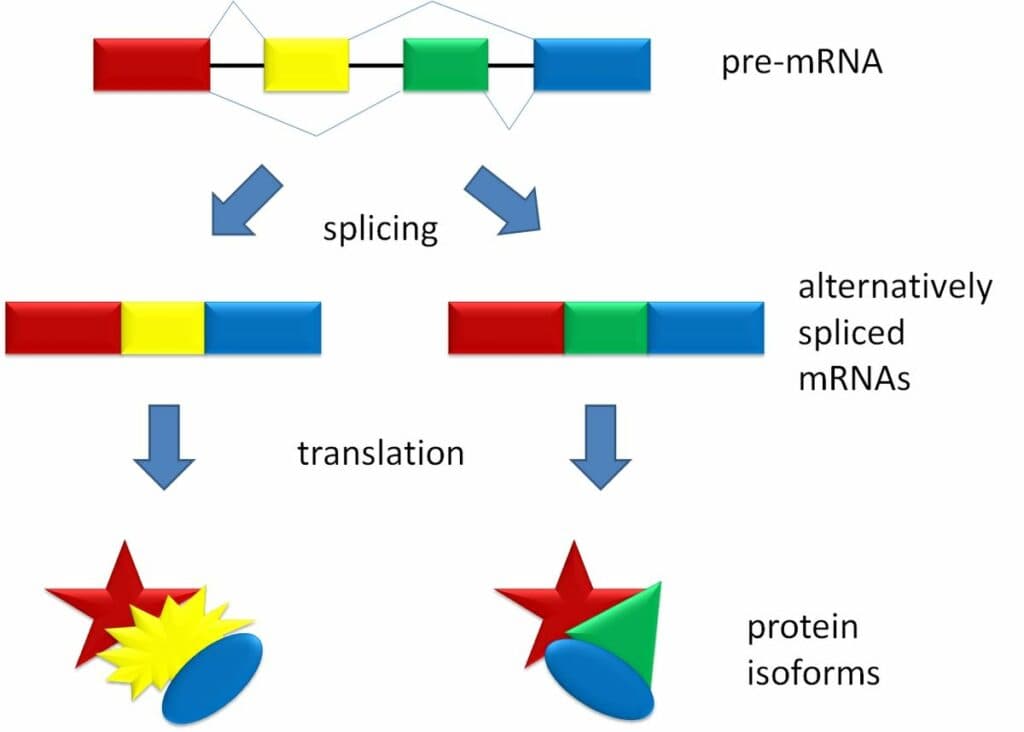
Exons are the portions of the gene that actually code for protein. During splicing, exons are stitched together to form the final mRNA sequence. One of the most important consequences of having separate exons is alternative splicing: by including or skipping certain exons, a single gene can produce multiple different protein variants (called isoforms). For example, the human CD44 gene can generate over a dozen protein isoforms through alternative splicing, each with different functions in cell signaling and adhesion.
Introns are the non-coding sequences between exons. They're removed during splicing, but that doesn't mean they're useless:
- Some introns contain regulatory sequences (like enhancers) that influence how much of a gene gets expressed.
- During splicing, each intron forms a loop called a lariat structure, which depends on a specific nucleotide within the intron called the branch point.
- Certain organisms have self-splicing introns (Group I and Group II) that can catalyze their own removal without the spliceosome.

Processing of mRNA vs. tRNA vs. rRNA
Each major type of RNA undergoes its own distinct processing. Here's how they compare:
mRNA Processing
- Pre-mRNA receives a 5' cap, a 3' poly(A) tail, and has its introns spliced out.
- The mature mRNA then travels to the cytoplasm to serve as the template for protein synthesis.
tRNA Processing
- Pre-tRNA is transcribed by RNA polymerase III and arrives with extra sequences on both ends.
- The 5' leader is trimmed by RNase P, and the 3' trailer is removed by RNase Z.
- If introns are present, they're removed by tRNA-specific splicing enzymes (not the spliceosome).
- A CCA sequence is added to the 3' end by a nucleotidyltransferase. This is the site where an amino acid will attach.
- Various nucleotides are chemically modified (e.g., pseudouridine, dihydrouridine) to help stabilize the tRNA's 3D structure.
rRNA Processing
- Pre-rRNA is transcribed mainly by RNA polymerase I (producing 28S, 18S, and 5.8S rRNAs), while RNA polymerase III transcribes 5S rRNA separately.
- The large pre-rRNA transcript is cleaved by endonucleases and exonucleases into the individual mature rRNA molecules.
- Chemical modifications like pseudouridylation and 2'-O-methylation help the rRNA fold correctly.
- Mature rRNAs combine with ribosomal proteins to form the small (40S) and large (60S) ribosomal subunits.
Additional RNA Processing Mechanisms
- RNA editing alters the actual nucleotide sequence of an RNA molecule after transcription. This means the final mRNA can encode a slightly different protein than what the DNA sequence alone would predict.
- Ribonucleoproteins are complexes of RNA and protein that carry out many RNA processing tasks.
- snRNPs (small nuclear ribonucleoproteins) are the key building blocks of the spliceosome. Each snRNP contains a small RNA molecule that base-pairs with specific sequences in the pre-mRNA to identify splice sites accurately.
See Fiveable more often in Google
Mark Fiveable as a preferred source and Google is more likely to show you our guides in Top Stories, with a "preferred" badge in AI Mode and AI Overviews.