
🌍AP World History: Modern Unit 1 Review
1.2 Developments in Dar al-Islam from 1200-1450
1.2 Developments in Dar al-Islam from 1200-1450
Unit & Topic Study Guides
Unit 1 – The Global Tapestry (1200-1450)
Unit 2 – Networks of Exchange (1200-1450)
Unit 3 – Land-Based Empires (1450-1750)
Unit 4 – Global Connections: 1450-1750
Unit 5 – Revolutions (1750-1900)
Unit 6 – Industrialization's Impact (1750-1900)
Unit 7 – Global Conflicts (1900-Present)
Unit 8 – Cold War & Decolonization (1900-Present)
Unit 9 – Globalization: 1900 to Today
AP World History: Modern Exam
Historical Thinking Skills
AMSCO Notes
Exam Skills
Subject Guides
Thematic Guides
The DBQ
Frequently Asked Questions

Between about 1200 and 1450, the Islamic world (Dar al-Islam) stayed connected by faith, trade, and learning even as the Abbasid Caliphate broke apart politically. New states led mostly by Turkic peoples, like the Seljuk Empire, the Mamluk Sultanate, and the Delhi Sultanates, rose to power, while Islam kept spreading through merchants, missionaries, and Sufis.
Dar al-Islam in AP World
Dar al-Islam means the "house of Islam," or the regions where Islam shaped public life, law, scholarship, and trade. For AP World Topic 1.2, the key idea is that political unity weakened after the Abbasid Caliphate fragmented, but Islamic culture, trade networks, and intellectual life remained connected across Afro-Eurasia.

Why This Matters for the AP World History Exam
This topic is part of Unit 1, which builds the foundation for thinking about state formation across the world around 1200 to 1450. Dar al-Islam gives you a strong example of a region that stayed culturally and economically connected even while it fragmented politically, which is exactly the kind of nuance the AP World History exam rewards.
You can use this material to:
- Analyze causation when explaining why new Islamic states rose as Abbasid power weakened.
- Track continuity and change as Islam, Judaism, and Christianity kept shaping societies while new political powers emerged.
- Compare state formation here with East Asia, South and Southeast Asia, the Americas, Africa, and Europe in the same period.
- Build evidence for arguments about how belief systems, trade, and intellectual exchange shaped societies.
Key Takeaways
- As the Abbasid Caliphate fragmented, new Islamic political entities emerged, and most were led by Turkic peoples while showing continuity, innovation, and diversity.
- Islam, Judaism, and Christianity all continued to shape societies in Africa and Asia during this period.
- Muslim rule expanded through military expansion, and Islam spread further through merchants, missionaries, and Sufis.
- The Seljuk Empire, the Mamluk Sultanate of Egypt, and the Delhi Sultanates are useful examples of new Turkic-led Islamic states.
- Muslim states and empires encouraged innovation and supported the translation movement that preserved and expanded earlier learning.
- Intellectual and cultural transfers, including work at the House of Wisdom and exchanges in Muslim and Christian Spain, connected this region to the wider world.
How Belief Systems Shaped Society
Islam, Judaism, and Christianity all continued to influence societies across Africa and Asia in this period. Religion shaped law, education, community life, and trade networks, and these faiths often coexisted in the same regions.
Islam Across a Connected World
Islam continued to grow and structure daily life for many communities:
- Shared beliefs and practices connected Muslims across a wide region.
- The Five Pillars (declaration of faith, prayer, charity, fasting, pilgrimage) organized religious life.
- Islamic law (Sharia) guided personal conduct and social relations.
- Mosques served as centers for worship, education, and community gatherings.
- Arabic spread as a language of religion, scholarship, and trade.
The Islamic world was not uniform. Regions blended Islam with local customs, languages, and architectural styles, which is part of the diversity the AP World History exam wants you to recognize.
Judaism and Christianity in the Islamic World
These communities remained important in many areas:
- Jewish communities maintained their traditions, and many Jews spoke Arabic and took part in shared intellectual culture.
- Jewish and Christian merchants participated in major trade networks.
- Christians formed significant communities in regions like Egypt, Syria, and Anatolia, and helped preserve older texts.
- Muslim Spain (al-Andalus) is often cited as an example of periods of relative religious coexistence and scholarly exchange.
Sufism and the Spread of Islam
Sufism, the mystical dimension of Islam, became especially influential and helped carry Islam into new regions:
- Sufi orders (tariqas) spread widely, often centered on respected teachers.
- Practices like chanting, music, and meditation emphasized a personal connection with God.
- Sufi lodges provided education and social services in frontier areas.
- This emphasis on personal devotion appealed to many new converts.
Note: Rumi, Hafez, and Ibn Battuta are helpful examples of Islamic culture and travel in this era, but they are illustrations, not required names you must memorize for this topic.
The Rise of New Islamic States
Fragmentation of the Abbasid Caliphate
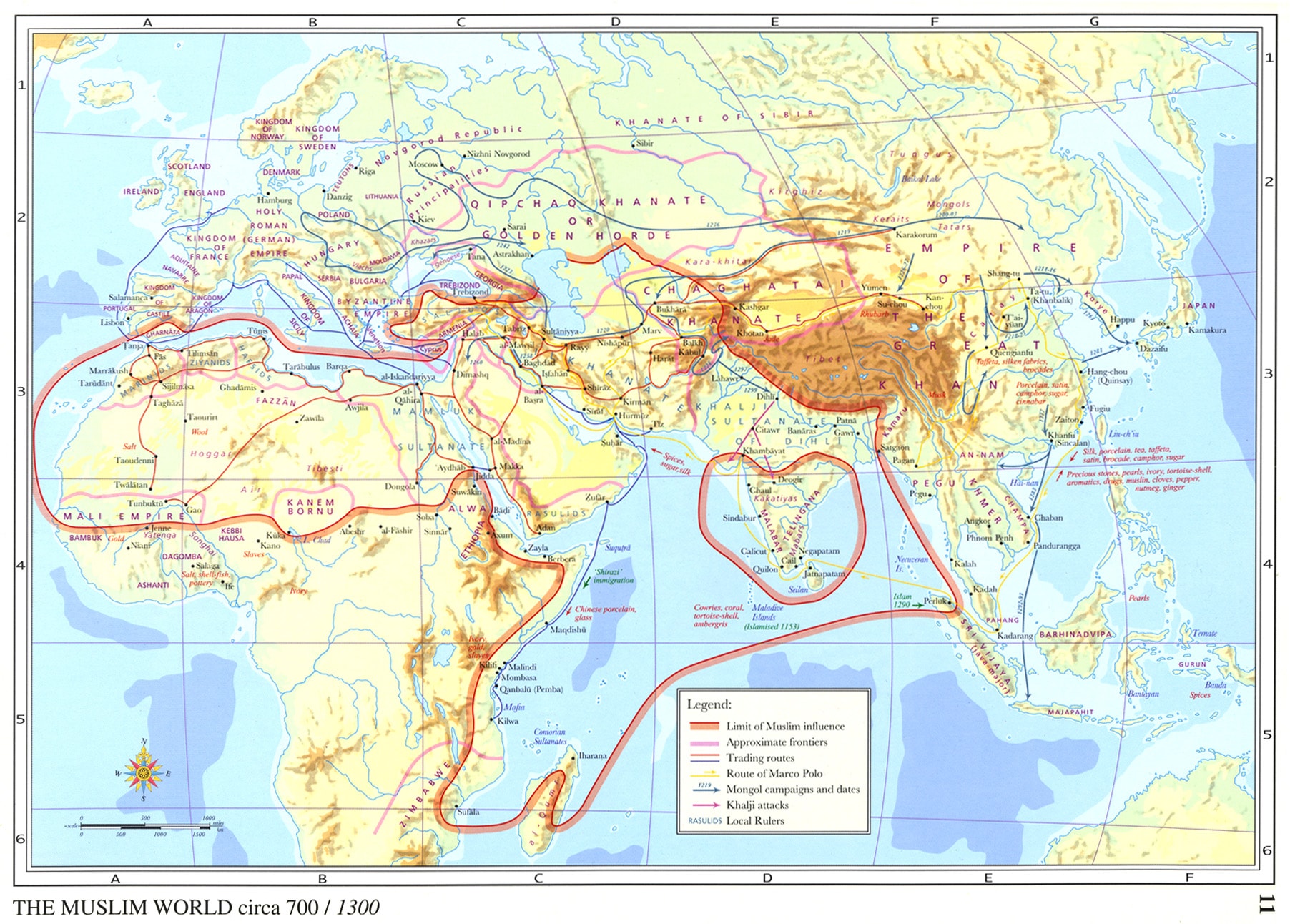
By this period, the once-unified Abbasid Caliphate based in Baghdad had broken apart:
- Regional rulers had formed independent states.
- The Abbasid caliph remained mostly as a religious figurehead with little real power.
- New groups, especially Turkic peoples from Central Asia, built their own states.
- Political fragmentation did not stop cultural or economic connections; trade and intellectual exchange continued across borders.
Turkic peoples were central to this shift. Many had served as soldiers before gaining power, brought strong military traditions, and generally maintained Islamic institutions while adding their own practices. The result was a set of states that showed continuity, innovation, and diversity.
Three Useful Examples of New Islamic States
These are illustrative examples of the new Turkic-led entities, not a required list to memorize:
Seljuk Empire
- A major early Turkic state that controlled parts of Central Asia, Persia, and Anatolia.
- Claimed authority in the name of the Abbasid caliph and helped establish the sultanate as a form of political authority.
- Promoted Sunni Islam and supported madrasas (schools).
Mamluk Sultanate of Egypt
- Ruled Egypt and Syria, founded by former slave soldiers (mamluks).
- Halted Mongol expansion at the Battle of Ain Jalut in 1260.
- Kept Cairo as a major center of Islamic culture and helped preserve scholarship after the Mongol destruction of Baghdad.
Delhi Sultanates
- A series of dynasties that ruled northern India, founded by Turkic military leaders.
- Extended Islamic political control into a Hindu-majority region.
- Created a blended Indo-Islamic culture and built monuments like the Qutb Minar.
Expansion Through Trade and Conversion
Beyond military expansion, Islam continued to spread through:
- Merchants traveling along trade routes.
- Missionaries and religious scholars.
- Sufi orders establishing lodges in new regions.
- Gradual conversion, cultural influence, and intermarriage.
This kind of expansion was especially important in Southeast Asia, West Africa across the Sahara, coastal East Africa, and parts of the Indian subcontinent.
Intellectual Innovation in Dar al-Islam
Muslim states and empires encouraged innovation and supported the translation movement, which preserved older knowledge and added new discoveries.
The Translation Movement and Knowledge Transfers
Scholars gathered, translated, and expanded learning from many traditions:
- They preserved and wrote commentaries on Greek moral and natural philosophy.
- The House of Wisdom in Abbasid Baghdad is a key example of a center for translation and study.
- Scholarly and cultural transfers in Muslim and Christian Spain connected this learning to Europe.
Centers of learning across the Islamic world supported education through madrasas, libraries, observatories, and hospitals.
Advances in Mathematics, Medicine, and Literature
Islamic scholars made contributions across many fields. Useful examples include:
- Advances in mathematics, associated with figures like Nasir al-Din al-Tusi.
- Advances in literature, including the work of 'A'ishah al-Ba'uniyyah.
- Advances in medicine, including detailed medical writing and hospital practice.
Note: Ibn Sina (Avicenna), Ibn Rushd (Averroes), and Ibn al-Nafis are commonly cited examples of Islamic scholarship, but for this topic the named examples to know are al-Tusi and al-Ba'uniyyah.
Art, Literature, and Architecture
Artistic expression flourished in many forms:
- Persian poetry reached new heights.
- Calligraphy and geometric patterns became central to visual art.
- Architecture produced mosques, madrasas, and palaces with domes, arches, and minarets.
- Decorative arts produced fine ceramics, metalwork, and textiles.
How to Use This on the AP World History Exam
Causation
Be ready to explain why new Islamic states arose. Connect the fragmentation of the Abbasid Caliphate to the rise of Turkic-led states, and link military expansion plus the work of merchants, missionaries, and Sufis to the continued spread of Islam.
Continuity and Change
Show what stayed the same and what shifted. A strong response notes that Islam, Judaism, and Christianity kept shaping societies (continuity) even as political power moved from a unified caliphate to many separate states (change), while trade and learning stayed connected.
Comparison
Practice comparing state formation in Dar al-Islam with other regions in Unit 1, such as Song China, South and Southeast Asia, Africa, the Americas, and Europe. Look for shared patterns (continuity, innovation, diversity) and clear differences.
Using Sources Effectively
If you get a document tied to this period, watch for how religion, trade, or scholarship shaped the source. Use specific support like the translation movement, the House of Wisdom, or transfers in Muslim and Christian Spain as evidence.
Common Trap
Do not treat political fragmentation as collapse. Dar al-Islam stayed economically and culturally connected even without one central ruler, and showing that nuance earns credit.
Common Misconceptions
- "Dar al-Islam was one unified empire." It was a connected cultural and religious world, not a single state, especially after the Abbasid Caliphate fragmented.
- "Political fragmentation meant decline." Trade, scholarship, and cultural exchange continued and even thrived across political borders.
- "Islam spread only through military expansion." Military expansion mattered, but merchants, missionaries, and Sufis spread Islam widely through peaceful means.
- "Mamluks were just slaves." They began as slave soldiers but became a ruling elite who governed Egypt and Syria and stopped Mongol expansion.
- "Muslim scholars only copied Greek texts." They preserved older works but also corrected, expanded, and produced original advances in math, medicine, and literature.
- "Only Muslims lived in Dar al-Islam." Jewish and Christian communities remained important and often took part in shared trade and intellectual life.
Related AP World History Guides
Vocabulary
The following words are mentioned explicitly in the AP® course framework for this topic.Term | Definition |
|---|---|
Abbasid Caliphate | The Islamic empire that ruled from the 8th to 13th centuries; its fragmentation in the 12th-13th centuries led to the emergence of new Islamic political entities. |
advances in literature | Literary innovations and creative works produced by Islamic scholars and writers. |
advances in mathematics | Mathematical innovations and developments made by Islamic scholars that contributed to the advancement of the discipline. |
advances in medicine | Medical innovations and improvements in medical knowledge developed by Islamic physicians and scholars. |
belief systems | Organized sets of religious and philosophical ideas that shape the values, practices, and social structures of societies. |
Christianity | A monotheistic religion whose core beliefs and practices shaped societies in Africa and Asia during the period from 1200-1450. |
Dar al-Islam | The Islamic world or the lands under Islamic rule and cultural influence. |
Delhi sultanates | Muslim sultanates that ruled parts of the Indian subcontinent, establishing Islamic political authority in South Asia. |
Greek moral and natural philosophy | Ancient Greek philosophical traditions concerning ethics and the study of the natural world that were preserved and commented upon by Muslim scholars. |
House of Wisdom | An intellectual center in Abbasid Baghdad where scholars translated, preserved, and advanced knowledge in mathematics, astronomy, medicine, and philosophy. |
intellectual innovation | The development of new ideas, discoveries, and advances in knowledge within Islamic civilization during this period. |
Islam | A monotheistic religion founded in the 7th century based on the teachings of the Prophet Muhammad and the Quran. |
Islamic states | Political entities governed by Islamic rulers that emerged as the Abbasid Caliphate fragmented, often dominated by Turkic peoples. |
Judaism | An ancient monotheistic religion whose beliefs and practices continued to influence societies in Africa and Asia from 1200-1450. |
Mamluk sultanate | A military state in Egypt ruled by the Mamluks, a slave-soldier class that became a dominant political force in the Islamic world. |
military expansion | The process of extending territorial control and political authority through military conquest and warfare. |
Muslim rule | The political authority and governance exercised by Islamic states and leaders over territories in Afro-Eurasia. |
religious practices | The rituals, customs, and observances through which believers express and live out their faith traditions. |
Seljuk Empire | A major Muslim state and empire that ruled parts of Asia Minor, the Levant, and Persia during the medieval period. |
Sufis | Islamic mystics and spiritual teachers who played a key role in spreading Islam through personal devotion and missionary activities. |
translation movement | The systematic effort by Muslim scholars to translate and preserve Greek, Persian, and other texts into Arabic. |
Turkic peoples | Central Asian ethnic groups who came to dominate many of the new Islamic political entities that emerged after the Abbasid Caliphate's fragmentation. |
Frequently Asked Questions
What does Dar al-Islam mean?
Dar al-Islam means the "house of Islam." In AP World, it refers to the broad Islamic world where Islam shaped politics, law, scholarship, trade, and culture.
What happened to Dar al-Islam from 1200 to 1450?
The Abbasid Caliphate fragmented, and new Islamic political entities emerged. Most were dominated by Turkic peoples, while trade, scholarship, Sufism, and shared Islamic institutions kept the region connected.
Which Islamic states should I know for Topic 1.2?
Useful examples include the Seljuk Empire, the Mamluk Sultanate of Egypt, and the Delhi Sultanates. These states show continuity, innovation, and diversity in Islamic political life.
How did Islam spread in this period?
Muslim rule expanded through military expansion, while Islam also spread through merchants, missionaries, and Sufis. Sufi teachers and lodges helped make Islam accessible in new regions.
What was the translation movement?
The translation movement was the preservation, translation, and expansion of earlier learning by scholars in Muslim states and empires. It helped transfer Greek, Persian, Indian, and other knowledge across Afro-Eurasia.
How should I use Dar al-Islam on the AP World exam?
Use Dar al-Islam for causation, continuity and change, and comparison. Strong answers explain political fragmentation alongside continued cultural, religious, commercial, and intellectual connections.