2.5 The Catholic Reformation

🇪🇺AP European History Unit 2 Review
2.5 The Catholic Reformation
🇪🇺 AP European History
2.1
Contextualizing 16th and 17th-Century Challenges and Developments
2.2
Luther and the Protestant Reformation
2.3
Protestant Reform Continues
2.4
Wars of Religion
2.5
The Catholic Reformation
2.6
16th-Century Society & Politics in Europe
2.7
Mannerism and Baroque Art
2.8
Causation in the Age of Reformation and the Wars of Religion
The Catholic Reformation, also called the Counter Reformation, was the Catholic Church's response to the Protestant Reformation. It revived the Church through the Council of Trent and the Jesuit Order, fixed some internal corruption, and reaffirmed traditional doctrine, but it also locked in the lasting split within Western Christianity.
Why This Matters for the AP European History Exam
This topic supports a core skill for the period from 1450 to 1648: explaining continuity and change in the role of the Catholic Church. You should be able to show how the Church both held onto old beliefs (papal authority, sacraments, tradition) and changed its practices (clerical reform, better priest training, new orders, censorship) in reaction to Protestantism.
On the exam, this shows up most often in multiple-choice questions tied to documents about Catholic reform, and in free-response writing where you analyze causation or continuity and change over time. The Jesuits and the Council of Trent are the two examples worth knowing well because they show how the Church revived itself while cementing division within Christianity.
Key Takeaways
- The Catholic Reformation revived the Church but cemented a permanent division within Christianity, so it was both a comeback and a confirmation of the split.
- The Council of Trent (1545-1563) reaffirmed Catholic doctrine and corrected abuses like the sale of indulgences and poorly trained clergy.
- The Society of Jesus (Jesuits), founded by Ignatius of Loyola, spread Catholicism through education and missionary work.
- Continuity: the Church kept papal supremacy, the sacraments, and tradition as authority, rejecting Protestant sola scriptura.
- Change: stricter clerical discipline, new seminaries for priest training, and censorship tools like the Index of Prohibited Books and the Roman Inquisition.
- Figures like St. Teresa of Avila and groups like the Ursulines show the spiritual renewal side of the movement.
Key Parts of the Catholic Reformation
Council of Trent (1545-1563)
The Council of Trent was the central event of the Catholic Reformation. Convened by Pope Paul III, it met on and off over 18 years to:
- Define Catholic doctrine in response to Protestant criticism, reaffirming papal authority, the need for both faith and good works for salvation, and the seven sacraments.
- Address corruption by banning the sale of indulgences and enforcing stricter discipline for clergy.
- Improve religious education by requiring seminaries to train better priests.
- Standardize the Mass and liturgy.
The result reinforced Catholic tradition while strengthening Church authority and administration.
Jesuit Order (Society of Jesus)
The Jesuit Order, founded by Ignatius of Loyola, became one of the most influential forces of the Catholic Reformation. The Jesuits focused on:
- Education, building schools and universities across Europe.
- Missionary work, spreading Catholicism to the Americas, Africa, and Asia.
- Loyalty to the pope, with rigorous intellectual training and discipline.
Their work helped reassert Catholic strength in regions where Protestantism was gaining ground.
Censorship and Enforcement
The Church used tools to control religious thought and limit heresy:
- The Index of Prohibited Books listed works considered dangerous to Catholic faith, including Protestant writings.
- The Roman Inquisition investigated and punished those accused of heresy.
These efforts show how the revived Church tried to police belief, not just inspire it.
Spiritual Renewal
The movement was not only about doctrine and enforcement. It included a wave of spiritual renewal:
- St. Teresa of Avila, a Spanish mystic, renewed Carmelite monasticism with stricter discipline, prayer, and contemplation.
- The Ursulines focused on educating girls and women.
- Ignatius of Loyola's Spiritual Exercises emphasized prayer and personal discipline.
Continuity and Change in the Role of the Church
The learning goal for this topic is continuity and change in the Catholic Church from 1450 to 1648, so frame your answers around both.
Continuities
- Papal supremacy stayed central, with the pope reaffirmed as the ultimate religious authority.
- Sacraments and tradition remained sources of authority, rejecting Protestant calls for scripture alone.
- The religious hierarchy and centralized Church governance persisted.
Changes
- Stricter clerical discipline: corrupt practices like the sale of indulgences were curbed.
- Better education: seminaries improved priest training.
- Increased censorship: the Roman Inquisition and the Index of Prohibited Books targeted non-Catholic ideas.
- Religious art was used to reinforce Catholic teaching visually.
These reforms renewed the Church and helped Catholicism recover in regions such as Poland and southern Germany.
Baroque Art as a Tool (Example Application)
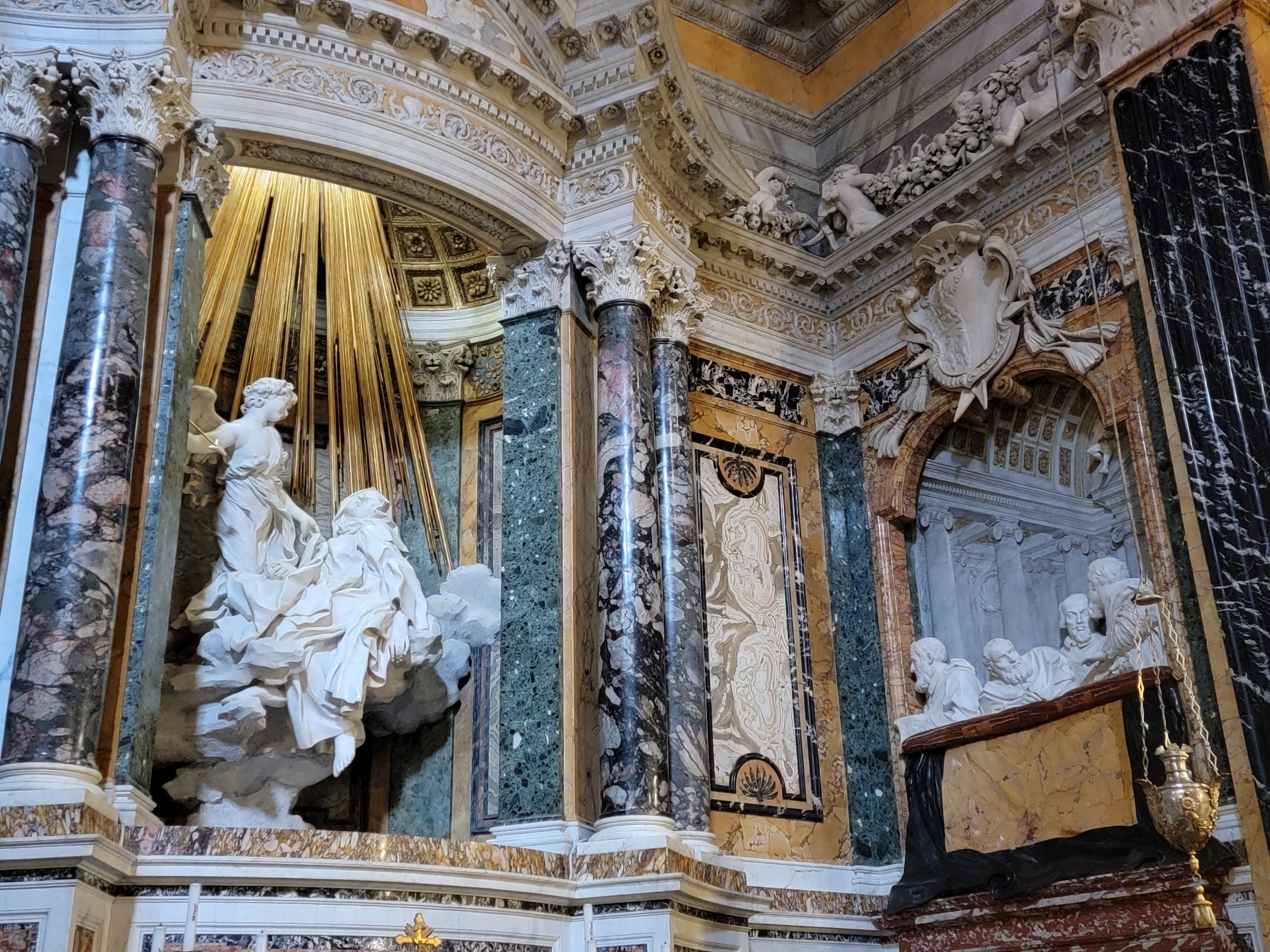
Baroque art is covered more directly in a later topic, but it connects here as a way the Counter-Reformation appealed to believers. The Church used dramatic, emotional, and immersive imagery to inspire devotion and contrast with Protestant simplicity, which often rejected religious imagery.
Common features include grandeur and drama, strong light and shadow contrasts (chiaroscuro), lifelike realism, and Catholic symbolism such as martyrdom and divine intervention. Bernini's Ecstasy of St. Teresa and Caravaggio's The Calling of St. Matthew are often cited examples. Treat Baroque art here as an application of Catholic Reformation goals rather than the core of this topic.
Timeline
- 1517 - Martin Luther posts the Ninety-Five Theses, triggering the Protestant Reformation.
- 1521 - Luther is excommunicated by Pope Leo X but gains protection from German princes.
- 1540 - Ignatius of Loyola's Society of Jesus is approved.
- 1545-1563 - Council of Trent reaffirms Catholic doctrine and reforms Church practices.
- 1559 - The Index of Prohibited Books is established.
- 1598 - Edict of Nantes grants limited toleration to French Protestants (Huguenots), later revoked.
How to Use This on the AP European History Exam
Free Response
When a prompt asks about the role of the Catholic Church in this era, build your answer around continuity and change. Pair one continuity (papal supremacy, sacraments) with one change (clerical reform, seminaries, censorship). Use the Council of Trent and the Jesuits as your strongest specific evidence because they directly show how the Church revived while the Christian split became permanent.
Using Sources Effectively
For documents about Catholic reform, watch for purpose and point of view. A decree from the Council of Trent is trying to reaffirm doctrine and answer Protestant attacks, so its intended audience and goal matter. Connect the source to the bigger pattern of revival plus division.
Common Trap
Do not treat the Catholic Reformation as only a reaction. It included real internal reform and spiritual renewal that was already building before and alongside the Protestant challenge. Showing both the defensive side and the reform side makes a stronger argument.
Common Misconceptions
- Misconception: "Counter-Reformation" and "Catholic Reformation" are totally different things.Actually: They describe the same broad movement. "Catholic Reformation" highlights internal renewal, while "Counter-Reformation" highlights the response to Protestantism.
- Misconception: The Council of Trent compromised with Protestants.Actually: It did not. It reaffirmed Catholic doctrine like papal authority, the sacraments, and salvation through faith and works, rejecting core Protestant claims.
- Misconception: The Catholic Reformation healed the split in Christianity.Actually: It revived the Church but actually cemented the division, since Trent drew clear lines instead of reuniting Christians.
- Misconception: The Jesuits only fought Protestantism.Actually: They were also major educators and missionaries who spread Catholicism well beyond Europe.
- Misconception: Reform meant the Church became more tolerant.Actually: Alongside renewal came tighter control through the Roman Inquisition and the Index of Prohibited Books.
Related AP European History Guides
Practice Questions for 2.5
1 of 10
The Council of Trent's decision to ban the sale of indulgences and establish seminaries for priest training best reflects which of the following developments in sixteenth-century Catholicism?
A.
An attempt to reduce the Church's political influence by limiting clerical involvement in secular governance
B.
The Church's response to declining membership caused by the spread of Islamic Ottoman expansion into Europe
C.
The Church's effort to address internal corruption while reaffirming papal authority against Protestant challenges
D.
The Church's adoption of Protestant principles regarding education and the elimination of sacramental theology
Vocabulary
The following words are mentioned explicitly in the AP® course framework for this topic.Term | Definition |
|---|---|
Catholic Reformation | A movement within the Catholic Church from the mid-16th century onward that sought to reform church practices, combat Protestantism, and revitalize Catholic spirituality. |
Council of Trent | A major church council (1545-1563) that defined Catholic doctrine, reformed church practices, and established responses to Protestant challenges. |
Index of Prohibited Books | A list maintained by the Catholic Church of books deemed heretical or immoral that Catholics were forbidden to read. |
Jesuit Order | A Catholic religious order founded in the 16th century known for its emphasis on education, missionary work, and strict discipline in service to the Pope. |
Roman Inquisition | An institution established by the Catholic Church to investigate and suppress heresy, particularly in response to Protestant reform movements. |
St. Teresa of Avila | A Spanish mystic and Carmelite nun of the 16th century who reformed her order and exemplified Catholic spiritual renewal during the Catholic Reformation. |
Ursulines | A Catholic religious order founded in the 16th century dedicated to education and charitable work, particularly the education of girls. |
Frequently Asked Questions
What was the Catholic Reformation?
The Catholic Reformation, also called the Counter-Reformation, was the Catholic Church's response to Protestant reform and a broader movement of internal renewal, discipline, education, and doctrinal reaffirmation.
What did the Council of Trent do?
The Council of Trent reaffirmed Catholic teachings on papal authority, sacraments, tradition, and faith plus works. It also addressed abuses such as indulgence sales and required better clergy training.
Who were the Jesuits?
The Jesuits, or Society of Jesus, were founded by Ignatius of Loyola. They became important educators, missionaries, and defenders of Catholic doctrine during the Catholic Reformation.
What changed during the Catholic Reformation?
The Church improved clerical discipline, created seminaries, expanded new religious orders, increased censorship, and used education and missionary work to strengthen Catholicism.
What stayed the same during the Catholic Reformation?
The Church reaffirmed papal supremacy, the seven sacraments, tradition as a source of authority, and Catholic doctrine rather than compromising with core Protestant claims.
How is the Catholic Reformation tested on AP Euro?
AP Euro questions often use the Catholic Reformation for continuity and change, causation, and source analysis. The Council of Trent and Jesuits are especially useful evidence.