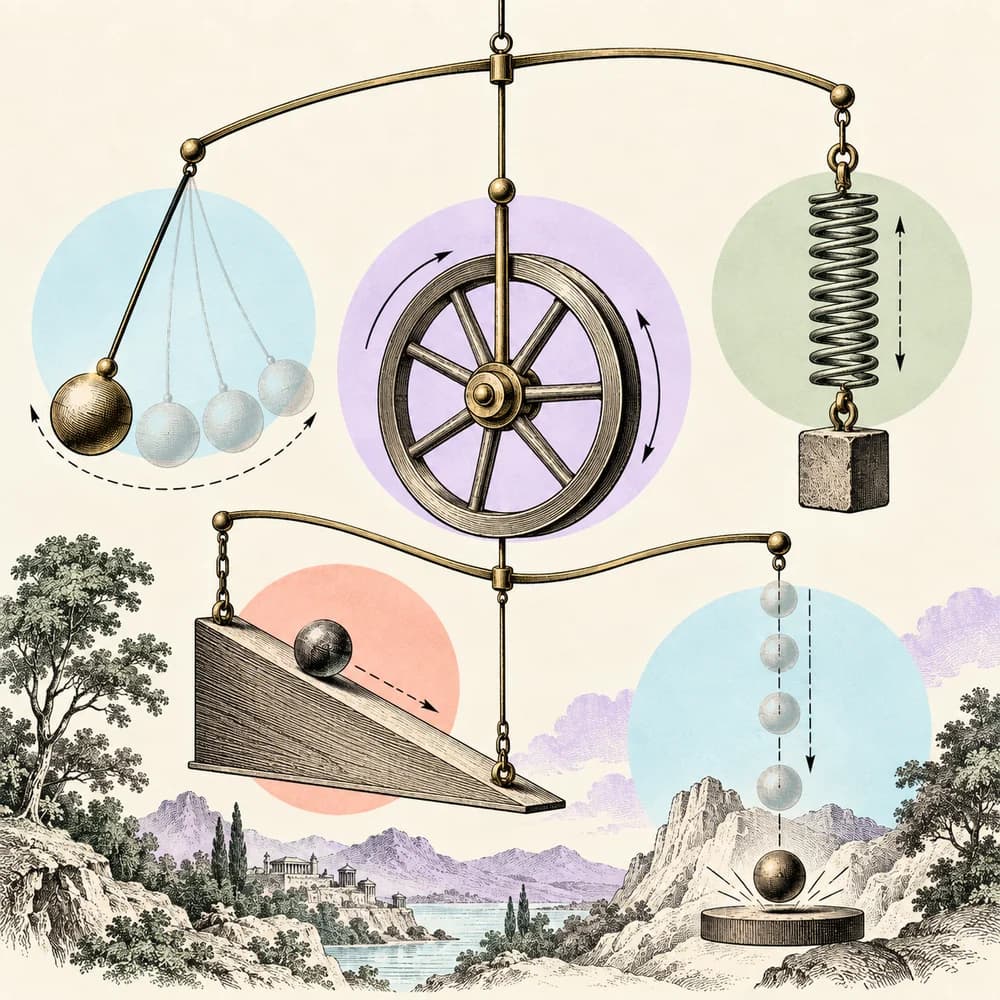
Work, energy, and power are fundamental concepts in physics that describe how objects interact and change. These principles explain how forces cause motion, how energy is transferred and transformed, and how quickly work is done in various systems. Understanding work, energy, and power helps us analyze everything from roller coasters to renewable energy sources. By mastering these concepts, we can better comprehend the physical world around us and solve complex problems in mechanics and engineering.
What is Unit 3 of AP Physics 1?
Unit 3 of AP Physics 1 is Work, Energy, and Power (https://library.fiveable.me/ap-physics-1-revised/unit-3). It makes up about 18–23% of the exam and usually takes ~22–27 class periods. You’ll learn translational kinetic energy (K = 1/2 mv^2), work (W = F d cosθ and the work–energy theorem), potential energy (gravitational and elastic forms), conservation of mechanical energy, and power (P = ΔE/Δt and Pinst = F·v). Expect to practice identifying conservative vs. nonconservative forces, computing energy changes, and choosing energy methods instead of force-only approaches. For focused review, Fiveable has a unit study guide at the link above, plus practice questions and cram videos (https://library.fiveable.me/practice/physics-1-revised).
What topics are covered in AP Physics 1 Unit 3 (Work, Energy, and Power; Circular Motion and Gravitation)?
This unit covers Work, Energy, and Power — see the official Fiveable unit page (https://library.fiveable.me/ap-physics-1-revised/unit-3). Topics 3.1–3.5 include translational kinetic energy (K = 1/2 mv^2 and frame dependence). You’ll study work (W = F·d, the work–energy theorem, conservative vs nonconservative forces, and area under the F∥ vs displacement curve). Potential energy comes next: near-Earth and pairwise U_g = -Gm1m2/r, spring energy U_s = 1/2 kx^2, and choosing zero points. Then conservation of mechanical energy—how KE and PE trade and how nonconservative forces dissipate energy. Finally, power (average and instantaneous, P = ΔE/Δt and P_inst = F v cosθ). These topics are ~18–23% of the exam. Fiveable’s study guide, cheatsheets, and practice questions are at the linked page.
How much of the AP Physics 1 exam is Unit 3 content?
Unit 3 (Work, Energy, and Power) is weighted 18–23% of the AP Physics 1 exam (https://library.fiveable.me/ap-physics-1-revised/unit-3). It usually takes about 22–27 class periods and covers translational kinetic energy, work, potential energy, conservation of energy, and power. On the exam, roughly one-fifth of the questions focus on these ideas, so practicing energy calculations, work integrals, and conservation problems is important. Spend time on recognizing when energy methods simplify a problem and on work by variable forces. For targeted review, Fiveable’s Unit 3 study guide and related practice problems can help you solidify concepts and get comfortable with common question types (https://library.fiveable.me/practice/physics-1-revised).
What's the hardest part of AP Physics 1 Unit 3?
The trickiest part is applying energy concepts flexibly — especially choosing conservation of energy versus the work–energy theorem and handling work by nonconservative or variable forces (like springs). Students often stumble on which quantities are conserved, setting the right sign for potential energy, computing work as a dot product for angled forces, and moving between kinematics and energy methods. Watch out for systems with friction or external work, spring problems (variable force and 1/2 k x^2), and defaulting to kinematics when an energy approach is simpler. Doing practice problems that force you to pick a method makes this unit click faster. See the Unit 3 study guide for focused practice (https://library.fiveable.me/ap-physics-1-revised/unit-3).
How should I study AP Physics 1 Unit 3 — notes, practice problems, and labs?
Start with focused notes: list formulas and definitions for kinetic energy, work (W = F·d and W = Fd cosθ), gravitational and elastic potential energy, conservation of energy, and power (P = ΔE/Δt). Use the College Board topics (3.1–3.5) as a checklist. Practice energy-bar diagrams and algebraic energy-change problems. Do lots of mixed conceptual and calculation questions, plus multi-step conservation problems with friction. For labs, review reports that measure work, energy changes, and power — analyze uncertainties and show full energy accounting. Time yourself under exam-like conditions and review mistakes to improve equation selection and algebra. For unit guides, practice problems, cheatsheets, and cram videos, check Fiveable’s resources (https://library.fiveable.me/ap-physics-1-revised/unit-3) and extra practice (https://library.fiveable.me/practice/physics-1-revised).
Where can I find AP Physics 1 Unit 3 PDF notes and practice problems?
You can find a full Unit 3 study guide (Work, Energy, and Power: topics 3.1–3.5) on Fiveable’s library (https://library.fiveable.me/ap-physics-1-revised/unit-3). That page includes downloadable PDF notes, cheatsheets, and cram videos for quick review. For extra practice problems with worked explanations, use Fiveable’s practice hub (https://library.fiveable.me/practice/physics-1-revised). If you want the official scope and learning objectives, the College Board’s Course and Exam Description lists Unit 3 content and the exam weight (Work, Energy, and Power — 18–23% of the exam). Between the Fiveable notes/cheatsheets and the practice problems, you’ll have compact review material and plenty of problems to build fluency before the exam.
Are there specific AP Physics 1 Unit 3 practice questions or progress checks I should use?
You’ll find Unit 3 practice and resources on Fiveable’s Unit 3 page at https://library.fiveable.me/ap-physics-1-revised/unit-3, and more drill problems at https://library.fiveable.me/practice/physics-1-revised. The College Board recommends using AP Classroom’s Progress Checks at the end of Unit 3 to track skills tied to topics 3.1–3.5 (kinetic energy, work, potential energy, conservation of energy, power). Also download past free-response questions and scoring rubrics from the College Board to practice multi-step energy FRQs. Use AP Classroom progress checks for formative tracking, then supplement with Fiveable’s study guide, cheatsheets, and 1000+ practice questions to cover the common problem types you’ll see on the exam.
How long should I spend studying AP Physics 1 Unit 3 before the exam?
Plan on about 8–20 focused hours on Unit 3 (Work, Energy, and Power) before the exam — roughly 8–10 hours if your goal is a 3, and 12–20 hours to aim for a 4–5. Unit 3 is weighted 18–23% of the exam and usually takes ~22–27 class periods in a course, so spread study over 1–3 weeks. Start each session with 2–3 hours reviewing key concepts (kinetic/potential energy, work, conservation, power). Then do 1–2 hours of practice problems per session. In the final 1–2 days, finish with 2–3 timed mixed problems and a quick formula/cheatsheet review. For guided lessons and practice, see Fiveable’s Unit 3 study guide at https://library.fiveable.me/ap-physics-1-revised/unit-3 and extra practice at https://library.fiveable.me/practice/physics-1-revised.