6.2 Externalities

🤑AP Microeconomics Unit 6 Review
6.2 Externalities
🤑 AP Microeconomics
An externality is a cost or benefit from an economic decision that falls on a third party who is not part of the transaction. Because rational buyers and sellers only respond to their own private costs and benefits, markets with externalities produce too much (negative externality) or too little (positive externality) compared to the socially optimal quantity. Governments can use per unit taxes, subsidies, regulation, or property rights to move the market closer to the efficient outcome.
Microeconomics Externalities
In microeconomics, externalities are costs or benefits from a market transaction that affect a third party. They create market failure because private buyers and sellers do not account for the full social cost or social benefit of the good.
For AP Micro 6.2, the shortcut is: negative externalities lead to overproduction because MSC is greater than MPC, while positive externalities lead to underproduction because MSB is greater than MPB. The socially optimal quantity is always where MSB equals MSC.
Why This Matters for the AP Microeconomics Exam
Externalities are one of the most frequently tested and most commonly missed parts of the AP Microeconomics exam. They pull together skills from across the course: supply and demand, market equilibrium, consumer and producer surplus, and deadweight loss. On both multiple-choice and free-response questions, you may need to identify whether an externality is positive or negative, locate the socially optimal quantity, shade deadweight loss, and explain how a per-unit tax or subsidy corrects the outcome. Graphing externalities and the effects of government intervention is a frequent challenge area, so getting comfortable with these graphs gives you an edge on questions other students miss.
Key Takeaways
- An externality is a side effect of a decision that affects a third party, and it shows up as a gap between social and private costs or benefits.
- The socially optimal quantity is where marginal social benefit (MSB) equals marginal social cost (MSC); the free-market quantity differs from it whenever an externality exists.
- A negative externality means MSC is above marginal private cost (MPC), so the market overproduces and creates deadweight loss.
- A positive externality means MSB is above marginal private benefit (MPB), so the market underproduces and creates deadweight loss.
- Externalities arise from a lack of well-defined property rights and/or high transaction costs.
- Policy fixes include per-unit taxes, per-unit subsidies, environmental regulation, public provision, and assigning or reassigning property rights.
Core Idea: Private vs. Social

Markets work efficiently when everyone affected by a transaction is part of it. An externality breaks that. When a decision spills costs or benefits onto people outside the market, the private decision-makers ignore those effects because they only respond to their own private costs and benefits.
That gap is the whole topic. Define these four terms and you can handle almost any externality question:
- Marginal private cost (MPC): the extra cost to the firm of producing one more unit.
- Marginal social cost (MSC): the extra cost to all of society, including external costs.
- Marginal private benefit (MPB): the extra benefit to the consumer of one more unit.
- Marginal social benefit (MSB): the extra benefit to all of society, including external benefits.
The socially optimal quantity is always where MSB = MSC. The market produces there only when private costs and benefits already include all social costs and benefits. When they do not, you get a market failure.
Externalities arise when property rights are not well defined or when transaction costs are too high for the affected parties to settle the problem on their own.
Negative Externalities

A negative externality exists when producing or consuming a good creates an external cost for a third party. Pollution from a factory is the classic example: the factory pays for labor, materials, and equipment, but it does not pay for the dirty air or water that affects the surrounding community. Secondhand smoke is another common example.
With a negative externality in production, MSC sits above MPC. The vertical distance between the two curves is the size of the external cost per unit.
How to read the graph:
- The market produces where MPB (demand) meets MPC (supply). That is the free-market quantity.
- The socially optimal quantity is smaller, where MSB = MSC.
- Because the market quantity is larger than the optimal quantity, the good is overproduced.
- The overproduction creates deadweight loss, the triangle between the MSC and MSB curves out to the free-market quantity.
To fix it, the government can place a per-unit tax equal to the external cost. The tax raises the firm's costs, shifting MPC up toward MSC, so the firm cuts back to the socially optimal quantity. A negative externality means overproduction, and a corrective tax cuts production back to where society wants it.
Positive Externalities
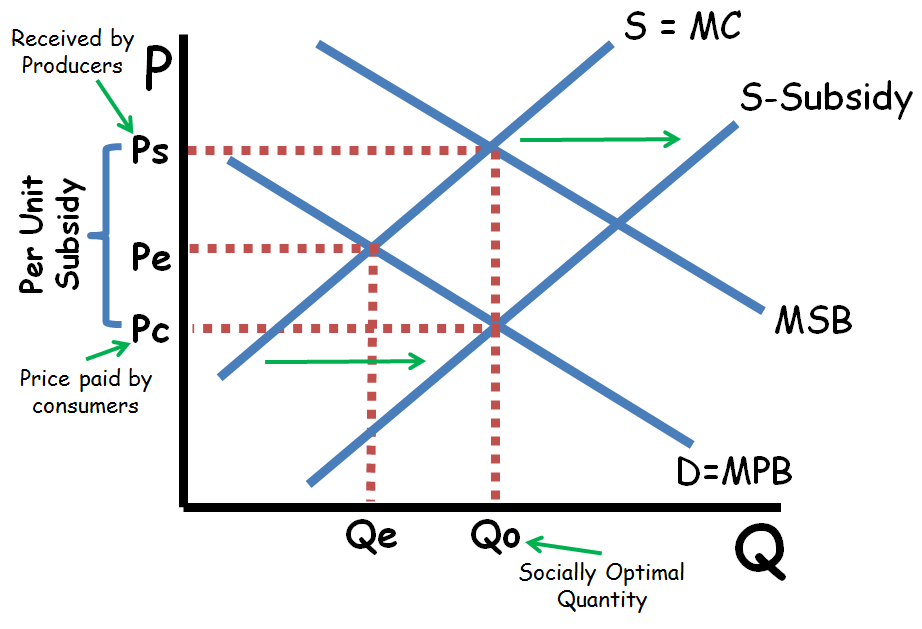

A positive externality exists when producing or consuming a good creates an external benefit for a third party. Vaccines are a common example: getting a flu shot protects you, but it also protects people around you through reduced spread. Education is another example, since a more educated population can mean higher productivity and lower crime.
With a positive externality in consumption, MSB sits above MPB. The vertical distance between those curves is the size of the external benefit per unit.
How to read the graph:
- The market produces where MPB meets MSC. That is the free-market quantity.
- The socially optimal quantity is larger, where MSB = MSC.
- Because the market quantity is smaller than the optimal quantity, the good is underproduced.
- The underproduction creates deadweight loss, the triangle between the MSB and MPB curves.
To fix it, the government can provide a per-unit subsidy equal to the external benefit. The subsidy lowers the effective price or cost, encouraging more production and consumption, which moves the market up to the socially optimal quantity. A positive externality means underproduction, and a subsidy expands output to where society wants it.
Policy Tools to Correct Externalities
When a market fails, it will not fix itself, so an outside party, usually the government, steps in. Beyond per-unit taxes and subsidies, the policies you should know include:
- Per-unit taxes: used for negative externalities to raise private costs toward social costs and reduce overproduction.
- Per-unit subsidies: used for positive externalities to encourage more output toward the socially optimal quantity.
- Environmental regulation: rules that directly limit harmful activity, such as caps on pollution.
- Public provision: the government supplies the good directly when private markets underprovide it.
- Assigning property rights: giving someone clear ownership so the cost or benefit gets accounted for.
- Reassigning property rights through private transactions: letting parties trade those rights to address the externality.
The goal of every one of these tools is the same: get the market to produce where MSB = MSC.
How to Use This on the AP Microeconomics Exam
MCQ
- Spot the externality type fast. If MSC is above MPC, it is a negative externality and the market overproduces. If MSB is above MPB, it is a positive externality and the market underproduces.
- Remember the optimal quantity is always where MSB = MSC, not where the market lands.
- Match the fix to the problem: tax for negative, subsidy for positive.
- Know that deadweight loss appears whenever the market produces a quantity other than the socially optimal one.
Free Response
- When asked to graph, label all relevant curves clearly: MPC, MSC, MPB or MSB, and demand. Show both the free-market quantity and the socially optimal quantity.
- When asked to identify the size of a corrective tax or subsidy, use the vertical distance between the private and social curves at the socially optimal quantity, stated with the price labels from the graph.
- When asked to shade deadweight loss, find the area between the social benefit and social cost curves out to the market quantity.
- Use precise cause-and-effect language. For a tax: it raises private cost, shifts the curve, reduces quantity, and moves the market toward MSB = MSC. Explain the steps, do not just name the policy.
Common Trap
- Do not stop at "the market is inefficient." You earn points by naming the direction (over- or underproduction) and the specific policy fix.
- Do not confuse a movement along a curve with a shift. A corrective tax or subsidy shifts the private cost curve; it is not just a change in quantity demanded.
Common Misconceptions
- Misconception: An externality is the same as a normal cost.Actually: An externality is not the same as a normal cost. It only counts as an externality if it lands on a third party outside the transaction, not on the buyer or seller.
- Misconception: Negative externalities are just "bad stuff."Actually: Negative externalities cause overproduction, not just "bad stuff." The key economic claim is that too much is produced relative to the social optimum, which creates deadweight loss.
- Misconception: Positive externalities do not cause a market failure.Actually: Positive externalities still cause a market failure. Even though the spillover is good, the market underproduces, so there is still deadweight loss and a reason for policy.
- Misconception: The socially optimal quantity is where MSC crosses MPC.Actually: The socially optimal quantity is not where MSC crosses MPC. It is where MSB = MSC. Mixing these up costs easy points.
- Misconception: A per-unit tax moves the social cost curve instead of shifting the private cost curve.Actually: A per-unit tax shifts the private cost curve; it does not move the social cost curve. The tax brings private costs up to meet social costs, not the other way around.
- Misconception: Taxes and subsidies are the only tools.Actually: Taxes and subsidies are not the only tools. Regulation, public provision, and assigning or reassigning property rights are also valid policy responses to externalities.
Related AP Microeconomics Guides
Practice Questions for 6.2
1 of 10
The graph above shows the market for electricity generated by burning coal.
The fact that the unregulated market produces at the market equilibrium rather than the social optimum illustrates which economic concept?
A.
Government failure due to overregulation
B.
Market failure due to a negative externality
C.
Allocative efficiency in a competitive market
D.
Market failure due to a positive externality
E.
Allocative inefficiency due to underproduction
Vocabulary
The following words are mentioned explicitly in the AP® course framework for this topic.Term | Definition |
|---|---|
economic surplus | The sum of consumer surplus and producer surplus; total economic surplus is maximized at the socially optimal quantity. |
environmental regulation | Government rules and standards designed to limit pollution and protect natural resources from negative externalities. |
external benefits | Benefits of an economic activity received by third parties who did not pay for them. |
external costs | Costs of an economic activity borne by third parties who did not choose to incur them. |
externalities | Costs or benefits of an economic activity experienced by unrelated third parties, arising from a lack of well-defined property rights and/or high transaction costs. |
free ride | The act of benefiting from a non-excludable good without paying for it or contributing to its provision. |
marginal social benefit | The total benefit to society of consuming one additional unit of a good, including both private and external benefits. |
marginal social cost | The total cost to society of producing one additional unit of a good, including both private and external costs. |
negative externalities | External costs imposed by the production or consumption of a good that are borne by third parties without compensation. |
non-excludable | A characteristic of a good where it is impossible or impractical to prevent individuals from consuming it once it is provided. |
positive externalities | External benefits generated by the production or consumption of a good that are received by third parties at no cost. |
private benefits | The direct benefits received by a producer or consumer from engaging in an economic activity. |
private costs | The direct costs incurred by a producer or consumer in engaging in an economic activity. |
private transactions | Voluntary exchanges between individuals that can reassign property rights to internalize externalities. |
property rights | Legal entitlements that specify who owns a resource and what they can do with it; well-defined property rights help internalize externalities. |
public provision | Government production and distribution of goods or services that generate positive externalities. |
socially optimal quantity | The quantity of a good where marginal social benefit equals marginal social cost, maximizing total economic surplus. |
subsidies | Government payments or incentives that can be used to encourage production or consumption of goods that generate positive externalities. |
taxes | Mandatory payments to the government that can be used to discourage production or consumption of goods that generate negative externalities. |
transaction costs | The costs of negotiating, monitoring, and enforcing agreements; high transaction costs can prevent the internalization of externalities. |
Frequently Asked Questions
What are externalities in microeconomics?
Externalities are costs or benefits from a market transaction that affect a third party. They cause market failure because private decision-makers do not account for full social costs or benefits.
What is a negative externality in AP Micro?
A negative externality creates an external cost, so marginal social cost is greater than marginal private cost. The market overproduces relative to the socially optimal quantity.
What is a positive externality in AP Micro?
A positive externality creates an external benefit, so marginal social benefit is greater than marginal private benefit. The market underproduces relative to the socially optimal quantity.
How do you find the socially optimal quantity with externalities?
The socially optimal quantity is where marginal social benefit equals marginal social cost. This is true for both positive and negative externalities.
How can government correct externalities?
Governments can use per-unit taxes for negative externalities, subsidies for positive externalities, regulation, public provision, or property rights to move output toward the social optimum.
How does Topic 6.2 show up on the AP Micro exam?
Questions may ask you to identify overproduction or underproduction, label MPC, MSC, MPB, and MSB, calculate a corrective tax or subsidy, or shade deadweight loss.