6.9 Hess’s Law

🧪AP Chemistry Unit 6 Review
6.9 Hess’s Law
🧪 AP Chemistry
Hess's Law says the enthalpy change of a reaction is the same no matter how many steps you take to get from reactants to products. If you know the enthalpy changes for a set of related reactions, you can reverse them, scale them, and add them together to find the enthalpy change for a target reaction. For AP Chemistry, reverse the sign of when you reverse a reaction.
Hess's Law Summary
Hess's Law in AP Chemistry says the enthalpy change for an overall chemical or physical process equals the sum of the enthalpy changes for the steps that make it up. The path does not matter as long as the steps add to the same overall reaction.
For Topic 6.9, the main moves are mechanical but easy to misapply: reverse a reaction and flip the sign of ΔH, multiply a reaction and multiply ΔH by the same factor, then add the adjusted ΔH values after the equations cancel to the target reaction.
Why This Matters for the AP Chemistry Exam
Hess's Law is one of the most reliable ways to calculate an enthalpy of reaction when you cannot measure it directly. On the AP Chemistry exam, you may need to combine given thermochemical equations to find the overall enthalpy change, which means selecting the right equations, manipulating them correctly, and tracking sign changes. This topic builds the same reasoning used with bond enthalpies and standard enthalpies of formation, so getting comfortable with it strengthens a large chunk of Unit 6.
A key skill here is identifying exactly which quantities and equations you need to solve a problem, then following a clean computational path while attending to signs and coefficients.
Key Takeaways
- The enthalpy change of an overall reaction equals the sum of the enthalpy changes of its individual steps.
- This works because total energy is conserved (first law of thermodynamics), and at constant pressure the heat of a reaction equals its enthalpy change.
- Reversing a reaction keeps the magnitude of ΔH the same but flips its sign.
- Multiplying a reaction by a factor multiplies its ΔH by that same factor.
- Adding reactions together means adding their ΔH values together.
- Intermediate species that appear on both sides cancel out when you add the steps.
Breaking Processes into Steps
Many chemical and physical processes can be broken down into a series of steps, and each step has its own energy change (ΔH). This is what makes Hess's Law possible: you can reach the same products through different pathways and still get the same total enthalpy change.
For example, the formation of CO₂ from graphite can happen two ways:
- Directly: C(s) + O₂(g) → CO₂(g)
- In steps:
- Step 1: C(s) + ½O₂(g) → CO(g)
- Step 2: CO(g) + ½O₂(g) → CO₂(g)
Both routes start at the same reactants and end at the same product, so the enthalpy change is identical.
Energy Conservation and Hess's Law
The first law of thermodynamics states that energy is conserved. It cannot be created or destroyed, only transferred or converted. This is the foundation of Hess's Law.
Because total energy is conserved:
- Each individual reaction in a sequence transfers thermal energy to or from the surroundings.
- The net thermal energy transferred in the whole sequence equals the sum of the transfers in each step.
- These energy transfers come from potential energy changes among the species in the reaction sequence.
- At constant pressure, the enthalpy change of the overall process equals the sum of the enthalpy changes of the individual steps.
The Rules of Hess's Law
Hess's Law states that the enthalpy change for a reaction is the same regardless of the pathway taken from reactants to products. If you know the enthalpy changes for related reactions, you can manipulate and combine them to find the enthalpy change for a new reaction. Think of it like taking different routes to the same destination: the total change in elevation is the same no matter which path you take.
When you manipulate thermochemical equations, follow these rules:
- When a reaction is reversed, the enthalpy change keeps the same magnitude but its sign flips.
- When a reaction is multiplied by a factor, ΔH is multiplied by that same factor.
- When two or more reactions are added to get an overall reaction, their individual enthalpy changes are added to get the net enthalpy change.
Representing a Process as a Sequence of Steps
To use Hess's Law, represent your target reaction as a combination of known steps:
- Identify known reactions (steps) that contain the reactants and products you care about.
- Manipulate those steps (reverse them, multiply them) so they match the target reaction.
- Add the steps together to get the overall process, canceling intermediates that appear on both sides.
Worked Example 1

You want to find ΔH° for forming C₂H₂ from carbon and hydrogen using three given thermochemical equations. The general strategy is to manipulate the three simple reactions (your steps) and then add them together to form the overall reaction.
How to Think Through It
Start by locating the reactants and products from the overall equation inside the given equations:
- C(s) is a reactant in equation #2 and in the overall equation, but the overall equation needs two carbon atoms. So equation #2 needs a coefficient adjustment.
- H₂(g) is a reactant in equation #3 and the overall equation with a coefficient of 1 in both, so equation #3 does not need to change.
- C₂H₂(g) is a reactant in equation #1 but a product in the overall equation, so equation #1 needs to be flipped.
Steps to Take
Step 1: Flip equation 1 to put C₂H₂ on the product side. Flipping the reaction flips the sign on the enthalpy. The manipulated equation is:
2CO₂(g) + H₂O(l) → C₂H₂(g) + 5/2 O₂(g) with ΔH° = +1299.5 kJ
Step 2: Multiply equation 2 to get 2 carbon atoms. Multiplying the reaction by 2 also multiplies its enthalpy by 2.
Whatever you do to the equation, you have to do the same to the enthalpy.
Adding It Up

Once the equations are set up, the species that appear on both sides cancel out. Here the O₂ terms cancel, H₂O cancels, and the CO₂ terms cancel.
Since you added the reactions together, add their enthalpies together too (this is rule 3):
ΔH = +1299.5 kJ + (−787 kJ) + (−285.8 kJ) = +226.7 kJ
Worked Example 2

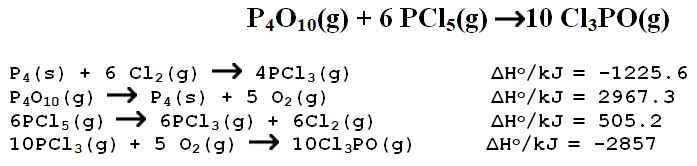
Calculate ΔH for the target reaction using the listed thermochemical equations.
How to Think Through It
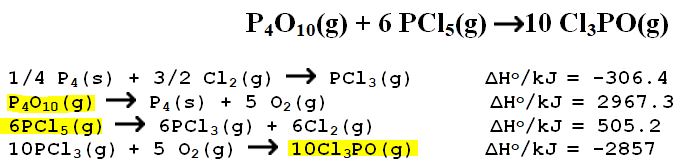
Check where each species sits compared to the overall equation:
- P₄O₁₀ is on the wrong side, so equation 2 needs to be flipped.
- PCl₅ is on the wrong side and needs a coefficient of 6, so equation 3 needs work.
- Cl₃PO needs a coefficient of 10, so equation 4 needs work.
Steps to Take
Step 1: Flip equation 2 to move P₄O₁₀ to the other side. Flipping the equation flips the sign on the enthalpy.
Step 2: Flip equation 3 to move PCl₅ to the other side, then multiply equation 3 by 6 so PCl₅ has a coefficient of 6. That means multiplying the enthalpy by 6 and reversing its sign (two changes at once).
Step 3: Multiply equation 4 by 10 so Cl₃PO has a coefficient of 10, which also multiplies its enthalpy by 10.
Checking the Spectators
After those manipulations, count up the remaining species to see what still needs balancing:
| Compound | Reactant Side | Product Side | Is Manipulation Necessary? |
|---|---|---|---|
| P₄ | 1/4 | 1 | ✔️ |
| Cl₂ | 3/2 | 6 | ✔️ |
| PCl₃ | 10 | 7 | ✔️ |
| O₂ | 5 | 5 | ❌ |
All three compounds that still need balancing appear in equation 1, so that is the one to adjust. To match the amounts, multiply equation 1 by 4 and its enthalpy by 4.
Now everything cancels and you are left with the overall equation. Add up all the enthalpies:
ΔH = −1225.6 kJ + 2967.3 kJ + 505.2 kJ + (−2857 kJ) = −610.1 kJ
How to Use This on the AP Chemistry Exam
Problem Solving
- Write the target reaction first, then label where each reactant and product should end up.
- For each given equation, decide if it needs to be flipped, scaled, or left alone so its species land on the correct side with the correct coefficient.
- Apply every change to ΔH at the same time you change the equation. Flip the sign when you reverse, multiply ΔH when you scale.
- Cancel intermediates that appear on both sides, then add the remaining enthalpies for your final answer.
Common Trap
- Forgetting to flip the sign of ΔH when you reverse an equation is the most frequent mistake. Adjust the equation and its enthalpy in the same move so you do not lose track.
- When you scale by a fraction or a large factor, double check that you multiplied ΔH by the exact same factor.
Common Misconceptions
- Misconception: Hess's Law is only for combustion.Actually: Hess's Law is not just for combustion. Any set of thermochemical equations that combine into a target reaction can be used.
- Misconception: Reversing a reaction changes both the size and sign of ΔH.Actually: Reversing a reaction does not change the size of ΔH, only its sign. Students sometimes change both incorrectly.
- Misconception: Multiplying a reaction changes the sign of ΔH.Actually: Multiplying a reaction multiplies ΔH, but it does not change the sign on its own. The sign only flips when you reverse the reaction.
- Misconception: Intermediates can cancel even when they do not appear on opposite sides in equal amounts.Actually: Intermediates only cancel when they appear on opposite sides in equal amounts. If the amounts do not match after scaling, the equation still needs adjustment.
- Misconception: The overall ΔH depends on how many steps you use to connect the starting reactants and final products.Actually: The overall ΔH depends only on the starting reactants and final products, not on how many steps you use to connect them.
Related AP Chemistry Guides
Practice Questions for 6.9
1 of 10
is carried out in a calorimeter attached to a gas syringe. The temperature change and collected volume are used to determine for the reaction as part of a Hess's law calculation. The calculated value is more exothermic than the accepted value.
Which error would make the calculated too exothermic?
A.
Inadequate calorimeter insulation allowed heat to escape to the surroundings.
B.
A leak in the tubing allowed some to escape before reaching the syringe.
C.
The zinc sample contained inert impurities that did not react.
D.
The hydrochloric acid concentration was higher than expected.
Vocabulary
The following words are mentioned explicitly in the AP® course framework for this topic.Term | Definition |
|---|---|
chemical process | A transformation in which substances are converted into different substances through the breaking and forming of chemical bonds. |
energy change | The difference in energy between the initial and final states of a system during a process or reaction step. |
enthalpy | The total heat content of a system; at constant pressure, the enthalpy change equals the thermal energy transferred to or from the surroundings during a chemical or physical process. |
enthalpy change | The difference in enthalpy between products and reactants in a chemical or physical process, representing the heat absorbed or released. |
first law of thermodynamics | The principle that energy is conserved in chemical and physical processes; energy cannot be created or destroyed, only transferred or transformed. |
Hess's law | The principle that the enthalpy change of an overall reaction equals the sum of the enthalpy changes of the individual steps in the reaction sequence. |
physical process | A change in the state or properties of matter that does not alter the identity of the substances involved. |
potential energy | The stored energy in chemical bonds and molecular structures that can be released or absorbed during a reaction. |
thermal energy transfer | The movement of heat energy to or from the surroundings during a chemical or physical process. |
Frequently Asked Questions
What is Hess’s Law in AP Chemistry?
Hess’s Law says the enthalpy change for an overall process equals the sum of the enthalpy changes for the steps that add up to that process. It works because energy is conserved.
How do you use Hess’s Law?
Write the target reaction, adjust given thermochemical equations so their species cancel to the target, then add the adjusted enthalpy changes. Track every flipped sign and scaled coefficient.
What happens to ΔH when you reverse a reaction?
When you reverse a reaction, ΔH keeps the same magnitude but changes sign. An exothermic step becomes endothermic, and an endothermic step becomes exothermic.
What happens to ΔH when you multiply a reaction?
When you multiply every coefficient in a reaction by a factor, you multiply ΔH by that same factor. The sign does not change unless you also reverse the reaction.
Why do intermediates cancel in Hess’s Law problems?
Intermediates cancel because they are produced in one step and consumed in another. After cancellation, the remaining species should match the overall target reaction.
What is a common Hess’s Law mistake?
A common mistake is changing the reaction equation but forgetting to make the matching change to ΔH. Flip the sign when reversing, multiply ΔH when scaling, and only add enthalpies after the equations match.
See Fiveable more often in Google
Mark Fiveable as a preferred source and Google is more likely to show you our guides in Top Stories, with a "preferred" badge in AI Mode and AI Overviews.