1.6 Photoelectron Spectroscopy

🧪AP Chemistry Unit 1 Review
1.6 Photoelectron Spectroscopy
🧪 AP Chemistry
AP Chemistry 1.6 Photoelectron Spectrum Summary
Photoelectron spectroscopy (PES) measures how much energy it takes to remove electrons from different subshells of an atom, which lets you read off its electron configuration. In a photoelectron spectrum, peak position tells you binding energy (how tightly electrons are held), and peak height tells you how many electrons are in that subshell.
Why This Matters for the AP Chemistry Exam
PES is one of the main ways AP Chemistry tests whether you can connect experimental data to atomic structure. You will be expected to translate between a photoelectron spectrum and an electron configuration, and to explain why peaks fall where they do based on how electrons interact with the nucleus.
This topic builds directly on electron configuration and sets up periodic trends like ionization energy. Being fluent here means you can support claims with evidence, which is exactly the kind of reasoning AP rewards on both multiple-choice questions and free-response.
Key Takeaways
- Peak position shows binding energy, the energy needed to remove an electron from a specific subshell. Higher binding energy means the electron is held more tightly.
- Peak height is proportional to the number of electrons in that subshell, so a peak twice as tall means twice as many electrons.
- Electrons closer to the nucleus (core electrons like 1s) have higher binding energy because of stronger attraction to the positive nucleus.
- You can build the full electron configuration of an atom or ion straight from its PES.
- Once you have the configuration, count the electrons and use the periodic table to identify the element.
- More protons and less shielding both increase the attraction an electron feels, raising its binding energy.
How to Read a Photoelectron Spectrum
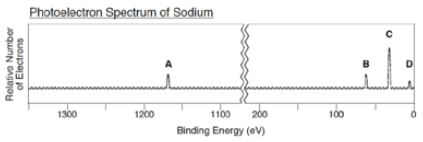

PES works by shining high-energy light on a sample. Electrons absorb that energy and get ejected, and the spectrometer measures how much energy was needed to remove them. Each subshell holds electrons at a characteristic energy, so each subshell shows up as its own peak.
The Axes
The x-axis is binding energy, which behaves much like ionization energy: the energy required to pull an electron away from the atom. On most PES graphs, binding energy increases toward the left, so the leftmost peaks are the electrons held most tightly.
Why does position matter? The closer an electron sits to the nucleus, the stronger the attraction between the positive nucleus and that negative electron, so more energy is needed to remove it. That means core electrons (like 1s) appear at high binding energy, and valence electrons appear at low binding energy.
The y-axis shows relative number of electrons. A taller peak means more electrons occupy that subshell.
The Peaks
Each peak represents one subshell. To assign peaks, start from the highest binding energy (usually the left) and work outward:
- The first peak (closest to the nucleus) is 1s.
- The next peaks correspond to 2s, 2p, and so on, in order of increasing distance from the nucleus.
- The height of each peak tells you how many electrons are in that subshell.
Worked Example: Carbon
Read a carbon spectrum from high binding energy to low:
- A peak at very high binding energy with height 2 is the 1s subshell: 1s^2
- The next peak with height 2 is 2s: 2s^2
- A lower peak with height 2 is 2p, but it is not full (2p holds up to 6): 2p^2
Put it together and you get 1s^2 2s^2 2p^2, which is carbon. Even without being told the element, you could count the electrons (2 + 2 + 2 = 6) and find element 6 on the periodic table.
Connecting Position to Attraction
Two ideas explain peak position:
- Distance from the nucleus: electrons in lower shells sit closer in, feel stronger attraction, and need more energy to remove.
- Effective nuclear charge: when an electron feels more positive pull from the nucleus (more protons, less shielding from other electrons), its binding energy goes up.
This is why, in a single atom, the 1s peak is always at much higher binding energy than the 2p peak.
Background Concepts That Support PES
Atomic Structure Refresher

An atom contains:
- Protons: in the nucleus, +1 charge, mass about 1 amu.
- Neutrons: in the nucleus, no charge, mass about 1 amu.
- Electrons: around the nucleus, -1 charge, very small mass.
Electrons live in shells (the number in a configuration, like 1, 2, 3) and subshells (the letters s, p, d, f). The maximum electrons per subshell are 2, 6, 10, and 14. If you need a refresher on writing these out, review the electron configuration guide.
The Photoelectric Effect
The photoelectric effect is the physics behind PES: when light of high enough frequency hits a surface, it ejects electrons. If the light's frequency (and therefore energy) is below a threshold, no electrons come off. Once the frequency is high enough, electrons are released, and the leftover energy reflects how tightly those electrons were held. You will see more about light and photon energy in Unit 3.
How to Use This on the AP Chemistry Exam
Free Response
A common task gives you an unlabeled PES and asks you to write the electron configuration and identify the element. Steps that work:
- Find the side with the highest binding energy (usually the left) and label that first peak 1s.
- Move outward, assigning 2s, 2p, 3s, and so on in order.
- Use each peak height to set the exponent (number of electrons in that subshell).
- Add up all electrons and match that total to the atomic number on the periodic table.
When writing the configuration from a PES, it is often safer to write it out fully (like 1s^2 2s^2 2p^6 ...) rather than using the noble gas shortcut, since the shortcut is easy to mess up under time pressure.
MCQ

Multiple-choice questions often ask you to compare peaks. Practice explaining:
- Why a core-electron peak (like 1s) sits at higher binding energy than a valence peak: core electrons feel a stronger attraction to the nucleus.
- Why one element's peak appears at higher binding energy than another's: more protons or less shielding raises effective nuclear charge.
Common Trap
Always confirm which direction binding energy increases before assigning peaks. If you assume the wrong direction, your whole configuration flips. Read the axis carefully.
Common Misconceptions
- Misconception: Peak height measures energy.Actually: Peak height does not measure energy. Height is proportional to the number of electrons in a subshell, not how much energy they have. Energy is the x-axis (peak position).
- Misconception: Higher binding energy is less stable.Actually: Higher binding energy is not "less stable." A high binding energy means the electron is held more tightly, which takes more energy to remove.
- Misconception: Binding energy is identical to first ionization energy.Actually: Binding energy is not identical to first ionization energy. PES measures the energy to remove electrons from every subshell, including core electrons, not just the easiest valence electron to remove.
- Misconception: More peaks mean more shells only.Actually: More peaks does not mean more shells only. Each peak is a subshell, not just a shell. For example, the n = 2 shell can show two separate peaks (2s and 2p).
- Misconception: The 1s peak is small just because it is far left.Actually: The 1s peak is not small just because it is far left. Its position (left) shows high binding energy, while its height still reflects 2 electrons. Position and height are independent.
- Misconception: Light below the threshold frequency ejects electrons slowly.Actually: Light below the threshold frequency does not eject electrons slowly. It does not eject them at all. Increasing intensity of low-frequency light still will not free an electron.
Related AP Chemistry Guides
Practice Questions for 1.6
1 of 10
In the photoelectron spectrum of chlorine, the peak at 20.2 MJ/mol has a relative height of 1, while the peak at 1.25 MJ/mol has a relative height of 2.5. Which claim best identifies the subshells represented by these peaks?
A.
The peak at 20.2 MJ/mol represents 2s electrons, and the peak at 1.25 MJ/mol represents 3p electrons.
B.
The peak at 20.2 MJ/mol represents 1s electrons, and the peak at 1.25 MJ/mol represents 2p electrons.
C.
The peak at 20.2 MJ/mol represents 2p electrons, and the peak at 1.25 MJ/mol represents 3s electrons.
D.
The peak at 20.2 MJ/mol represents 3s electrons, and the peak at 1.25 MJ/mol represents 3p electrons.
Vocabulary
The following words are mentioned explicitly in the AP® course framework for this topic.Term | Definition |
|---|---|
electron configuration | The arrangement of electrons in an atom or ion, describing which orbitals and subshells are occupied and how many electrons are in each. |
ionization energy | The energy required to remove an electron from an atom in the gas phase. |
photoelectron spectroscopy | An experimental technique that measures the energy required to remove electrons from different subshells of an atom or ion. |
photoelectron spectrum | A graphical representation of data from photoelectron spectroscopy showing peaks that correspond to electrons in different subshells of an atom or ion. |
subshell | A subdivision of an electron shell characterized by a specific orbital type (s, p, d, or f) and containing orbitals of similar energy. |
Frequently Asked Questions
What is photoelectron spectroscopy in AP Chemistry?
Photoelectron spectroscopy, or PES, measures the energy needed to remove electrons from different subshells. AP Chemistry uses PES data to connect experimental spectra to electron configuration and electron-nucleus attraction.
How do you read a photoelectron spectrum?
Read peak position as binding energy and peak height as the relative number of electrons in a subshell. Start with the highest binding energy peak, usually on the left, and assign subshells in order.
What does peak height mean in a PES graph?
Peak height is proportional to the number of electrons in that subshell. A peak that is twice as tall represents about twice as many electrons as the shorter peak.
What does peak position mean in photoelectron spectroscopy?
Peak position shows binding energy, or how much energy is required to remove an electron from that subshell. Higher binding energy means the electron is held more tightly by the nucleus.
How does PES show electron configuration?
Each peak corresponds to a subshell, and the peak height gives the number of electrons in that subshell. Reading the peaks from core to valence lets you write the full electron configuration.
What is the common AP Chem mistake with PES graphs?
The common mistake is assuming the x-axis always increases to the right. Many PES graphs place higher binding energy on the left, so check the axis direction before assigning subshells.
See Fiveable more often in Google
Mark Fiveable as a preferred source and Google is more likely to show you our guides in Top Stories, with a "preferred" badge in AI Mode and AI Overviews.