5.1 Unicellular Eukaryotic Parasites

🦠Microbiology Unit 5 Review
5.1 Unicellular Eukaryotic Parasites
🦠 Microbiology
Unicellular Eukaryotic Parasite Characteristics and Taxonomy
Unicellular eukaryotic parasites are single-celled organisms with all the hallmarks of eukaryotic cells (nucleus, mitochondria, endomembrane system), but they've adapted to live at the expense of a host organism. They cause some of the most significant infectious diseases worldwide, including malaria, and understanding their biology is central to controlling them.

Top images from around the web for Characteristics of unicellular eukaryotic parasites
Unicellular Eukaryotic Parasites | Microbiology View original
Is this image relevant?
Unicellular Eukaryotic Parasites | Microbiology View original
Is this image relevant?
Unicellular Eukaryotic Parasites | Microbiology View original
Is this image relevant?
Unicellular Eukaryotic Parasites | Microbiology View original
Is this image relevant?
Characteristics of Unicellular Eukaryotic Parasites
Like all eukaryotes, these organisms have membrane-bound organelles: a nucleus housing their genetic material, mitochondria for energy production (though some have reduced or modified versions), and an endoplasmic reticulum and Golgi apparatus for protein synthesis and transport.
What sets them apart from free-living protists is their suite of parasitic adaptations:
- Attachment and invasion structures that let them latch onto or enter host cells (e.g., Giardia's adhesive disc grips the intestinal wall)
- Immune evasion mechanisms that help them dodge the host's defenses (e.g., Trypanosoma constantly switches its surface proteins through antigenic variation)
- Nutrient acquisition strategies that let them feed off the host (e.g., Entamoeba uses phagocytosis to engulf bacteria and host tissue)
Classification of Unicellular Eukaryotes
Classifying these organisms has historically been difficult because of their wildly diverse morphologies and complex life cycles. Molecular techniques, particularly phylogenetic analyses of ribosomal RNA sequences and multigene comparisons, have dramatically improved our understanding of how they're related.
Current classification relies on a combination of morphological, biochemical, and molecular characteristics. The major groups you need to know:
- Excavata: Giardia, Trichomonas, Trypanosoma (many have modified or reduced mitochondria and distinctive flagella)
- Chromalveolata (specifically the Apicomplexa): Plasmodium, Toxoplasma (characterized by the apical complex used for host cell invasion)
- Rhizaria: mostly free-living, but included in the broader eukaryotic framework
- Unikonta (Amoebozoa): Entamoeba (moves and feeds via pseudopodia)
Life Cycles, Infections, and Adaptations of Unicellular Eukaryotic Parasites
Life Cycles of Eukaryotic Parasites
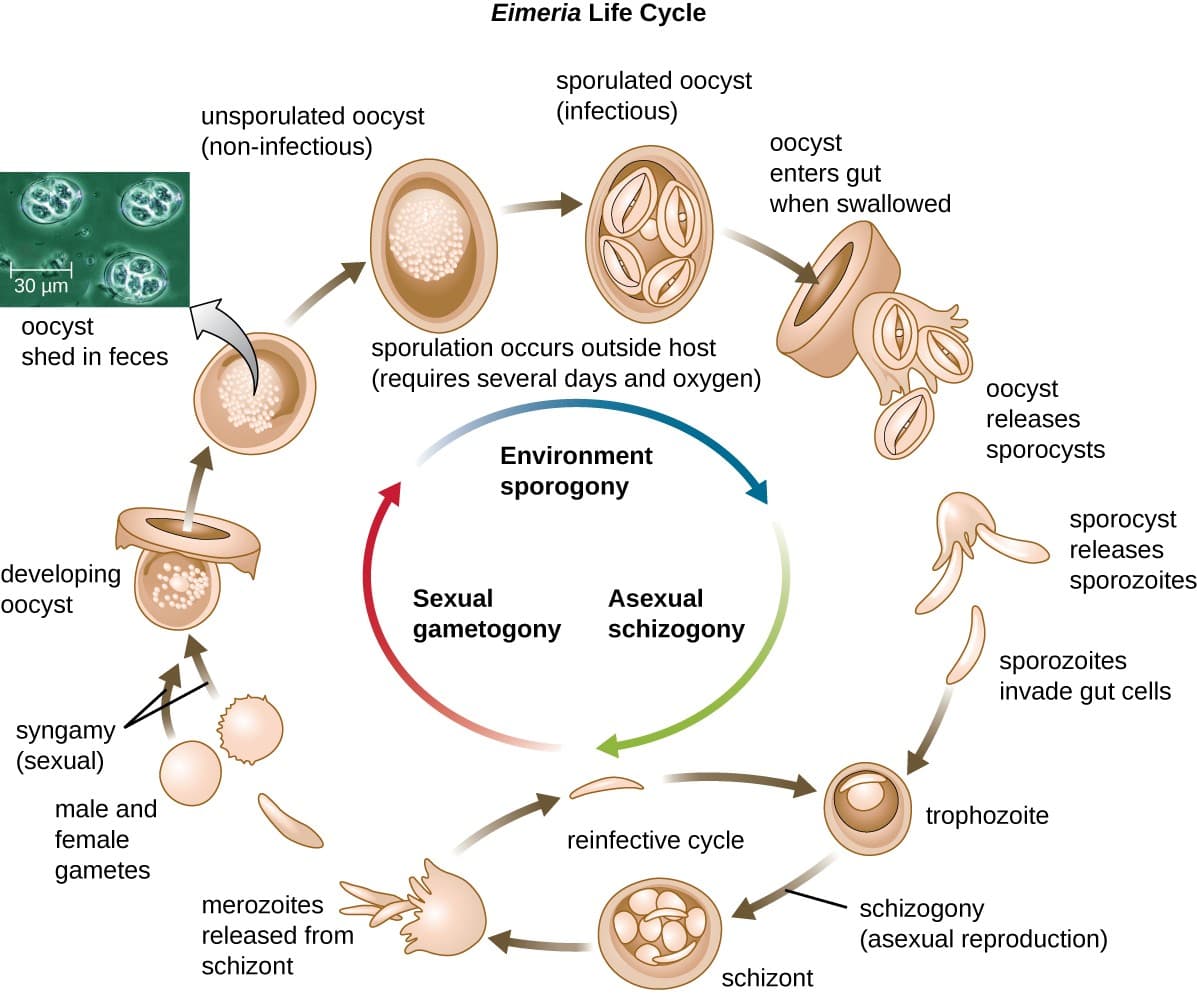
Most parasitic protists have multi-stage life cycles that alternate between different forms and often require more than one host. Transmission routes vary: some are vector-borne (carried by mosquitoes, tsetse flies, or sandflies), while others spread via the fecal-oral route (ingesting contaminated water or food).
Plasmodium (malaria) life cycle:
- An infected Anopheles mosquito injects sporozoites into the human bloodstream during a blood meal.
- Sporozoites travel to the liver, invade hepatocytes, and multiply into merozoites.
- Merozoites are released into the blood and infect red blood cells, where they reproduce asexually. The synchronized rupture of RBCs causes the cyclical fevers characteristic of malaria.
- Some merozoites differentiate into gametocytes (sexual stage) instead of continuing asexual reproduction.
- A mosquito picks up gametocytes during a blood meal. Sexual reproduction occurs in the mosquito midgut, eventually producing new sporozoites that migrate to the salivary glands, completing the cycle.
Entamoeba histolytica life cycle: Infectious cysts are ingested through contaminated food or water (fecal-oral route). Excystation occurs in the small intestine, releasing trophozoites that colonize the colon, where they can invade the intestinal lining.
Giardia lamblia life cycle: Also fecal-oral. Cysts are ingested, excystation happens in the small intestine, and trophozoites attach to the intestinal wall using their adhesive disc. Cysts are extremely hardy and can survive in cold water for months, which is why giardiasis is a common waterborne infection.

Infections from Eukaryotic Parasites
| Disease | Causative Agent | Key Symptoms | Transmission | Notes |
|---|---|---|---|---|
| Malaria | Plasmodium spp. | Cyclical fever, anemia, flu-like symptoms; severe cases cause organ failure | Anopheles mosquito bite | ~250 million cases/year; highest burden in sub-Saharan Africa |
| Amoebiasis | Entamoeba histolytica | Diarrhea, abdominal pain, bloody stools; liver abscesses in severe cases | Fecal-oral (contaminated water/food) | Common where sanitation is poor |
| Giardiasis | Giardia lamblia | Watery diarrhea, cramps, malabsorption; can become chronic | Fecal-oral (contaminated water) | One of the most common waterborne parasites globally |
| African sleeping sickness | Trypanosoma brucei | Fever, headache progressing to neurological symptoms (sleep disruption, confusion); fatal if untreated | Tsetse fly bite | Found in sub-Saharan Africa |
| Leishmaniasis | Leishmania spp. | Cutaneous (skin sores), mucocutaneous, or visceral (affects internal organs) depending on species | Sandfly bite | Tropical and subtropical regions |
Adaptations for Parasitism
These parasites have evolved highly specialized tools for surviving inside a host. Here are the key adaptations organized by function:
Attachment and invasion:
- Giardia's adhesive disc creates suction to grip the intestinal epithelium
- Plasmodium's apical complex (including rhoptries and micronemes) secretes proteins that actively drive invasion of red blood cells
Nutrient acquisition:
- Trypanosoma uses glycosomes (specialized peroxisomes) to compartmentalize glycolysis for efficient glucose metabolism in the nutrient-rich bloodstream
- Entamoeba uses phagocytosis to engulf host cells and bacteria
Immune evasion:
- Trypanosoma brucei coats itself in variant surface glycoproteins (VSGs). It can switch among ~1,000 different VSG genes, so by the time the host mounts an antibody response, the parasite has already changed its coat.
- Plasmodium uses antigenic variation of the PfEMP1 protein displayed on the surface of infected red blood cells, making it a moving target for the immune system.
Environmental resistance:
- Giardia and Entamoeba form tough-walled cysts that survive harsh conditions outside the host (stomach acid, chlorinated water in some cases)
- Toxoplasma produces oocysts that persist in the environment and can infect new hosts when ingested
A recurring theme: the most successful parasites combine multiple strategies. Plasmodium, for example, hides inside host cells (avoiding antibodies), varies its surface antigens, and uses a complex multi-host life cycle that makes it difficult to interrupt transmission at any single point.
Host-Parasite Interactions and Disease Dynamics
Host-Parasite Interactions
The relationship between parasite and host is an ongoing evolutionary arms race. Parasites evolve better ways to exploit host resources and evade defenses, while hosts evolve stronger immune responses. Neither side "wins" permanently, which is why these diseases persist.
Zoonotic transmission occurs when parasites jump from animal reservoirs to humans. Toxoplasma gondii is a classic example: cats are the definitive host, but the parasite can infect virtually any warm-blooded animal, including humans. Close contact with animals and environmental contamination facilitate these jumps.
Vector-borne transmission adds another layer of complexity. Diseases like malaria and sleeping sickness depend on arthropod vectors (mosquitoes, tsetse flies) to move between hosts. This means control strategies have to target not just the parasite, but also the vector, through measures like insecticide-treated bed nets, indoor spraying, and habitat management.
Pathogenesis and Epidemiology
Pathogenesis refers to how a parasite actually causes disease. The mechanisms vary:
- Direct tissue damage: Entamoeba histolytica secretes proteolytic enzymes that destroy intestinal tissue, causing ulcers and bloody diarrhea
- Destruction of host cells: Plasmodium lyses red blood cells when merozoites burst out, leading to anemia
- Immune-mediated pathology: Sometimes the host's own immune response causes much of the damage (inflammation, fever, tissue scarring)
Epidemiology studies how parasitic diseases are distributed across populations and what factors drive transmission. This information directly shapes public health interventions: where to distribute bed nets, which water sources to treat, and how to allocate limited resources for disease control.
See Fiveable more often in Google
Mark Fiveable as a preferred source and Google is more likely to show you our guides in Top Stories, with a "preferred" badge in AI Mode and AI Overviews.