14.1 Brønsted-Lowry Acids and Bases

💏Intro to Chemistry Unit 14 Review
14.1 Brønsted-Lowry Acids and Bases
💏 Intro to Chemistry
Acids and bases are central to chemistry, and the Brønsted-Lowry theory gives you a precise way to define them: acids donate protons, bases accept them. Every acid-base reaction creates conjugate pairs, and understanding those pairs is the key to predicting what happens in solution.
Water plays a special role here. Its ion-product constant () connects hydronium and hydroxide concentrations, which is the foundation for the pH scale. Some substances, including water itself, can act as either an acid or a base depending on what they're reacting with.
Brønsted-Lowry Acids and Bases

Top images from around the web for Brønsted-Lowry acids and bases
Brønsted-Lowry Acids and Bases | Chemistry: Atoms First View original
Is this image relevant?
Proton donors and acceptors View original
Is this image relevant?
Brønsted-Lowry Acids and Bases (14.1) – Chemistry 110 View original
Is this image relevant?
Brønsted-Lowry Acids and Bases | Chemistry: Atoms First View original
Is this image relevant?
Proton donors and acceptors View original
Is this image relevant?
Brønsted-Lowry acids and bases
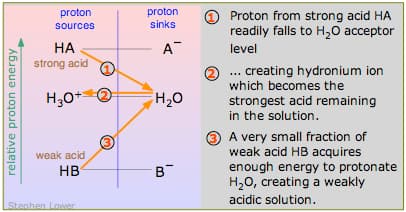
A Brønsted-Lowry acid donates a proton () to another substance. A Brønsted-Lowry base accepts a proton () from another substance. The whole framework revolves around proton transfer.
Common Brønsted-Lowry acids:
- (hydrochloric acid)
- (sulfuric acid)
- (acetic acid)
Common Brønsted-Lowry bases:
- (ammonia)
- (hydroxide ion)
- (carbonate ion)
Acid strength depends on how completely an acid donates its protons in solution. A strong acid like donates essentially all of its protons, while a weak acid like only partially ionizes. The same logic applies to bases: a strong base accepts protons nearly completely, while a weak base does so only partially.

Acid-base ionization equations
When an acid donates a proton, what's left behind is its conjugate base. When a base accepts a proton, it becomes a conjugate acid. A conjugate acid-base pair always differs by exactly one .
Take the reaction of with water:
There are two conjugate pairs here:
- (acid) and (conjugate base)
- (base) and (conjugate acid)
The general acid ionization equation looks like this:
Here, is the acid, acts as the base, is the conjugate acid of water, and is the conjugate base of the acid.
For a base reacting with water, the equation flips:
Now acts as the acid (it donates a proton to ), is the conjugate acid of the base, and is the conjugate base of water.
Neutralization occurs when an acid and a base react to produce water and a salt. For example: .

Ion concentrations from water's ion-product
Water undergoes a small amount of self-ionization, producing both hydronium and hydroxide ions. The ion-product constant of water () expresses this relationship:
In pure water at 25°C, the concentrations are equal:
This gives you a way to classify any aqueous solution:
- Acidic: M (and M)
- Neutral: M
- Basic: M (and M)
To find an unknown concentration, rearrange . For example, if M:
The pH scale measures acidity on a logarithmic scale from 0 to 14 (at 25°C). A pH below 7 is acidic, exactly 7 is neutral, and above 7 is basic.
Amphiprotic substances in reactions
An amphiprotic substance can act as either an acid or a base, depending on what it's reacting with. Whether it donates or accepts a proton is determined by the relative strength of the other reactant.
Water is the most common example. With an acid, water acts as a base and accepts a proton:
With a base, water acts as an acid and donates a proton:
Other amphiprotic substances include:
- (bicarbonate ion): can donate a proton to become , or accept one to become
- (dihydrogen phosphate ion): can donate a proton to become , or accept one to become
The pattern is the same for all of them: the stronger acid or base in the reaction determines which role the amphiprotic substance plays.
Lewis Acids and Bases
The Lewis definition broadens the concept of acids and bases beyond proton transfer. A Lewis acid is an electron pair acceptor, and a Lewis base is an electron pair donor.
This is useful because it covers reactions where no proton is exchanged at all. For example, (boron trifluoride) acts as a Lewis acid by accepting an electron pair from (a Lewis base), even though no is involved. Every Brønsted-Lowry acid-base reaction is also a Lewis acid-base reaction, but not the other way around.
See Fiveable more often in Google
Mark Fiveable as a preferred source and Google is more likely to show you our guides in Top Stories, with a "preferred" badge in AI Mode and AI Overviews.