1.2 Ligands and Coordination Numbers

💍Inorganic Chemistry II Unit 1 Review
1.2 Ligands and Coordination Numbers
Ligands and coordination numbers are key players in coordination chemistry. They determine how metal complexes form and behave. Ligands can be simple or complex, with varying charges and binding abilities.
Coordination numbers tell us how many ligand atoms are attached to a metal center. This affects the shape and properties of the complex. Understanding these concepts is crucial for predicting and explaining metal complex behavior.
Ligand Denticity and Charge

Top images from around the web for Types of Ligands
5.2: Ligands and Nomenclature - Chemistry LibreTexts View original
Is this image relevant?
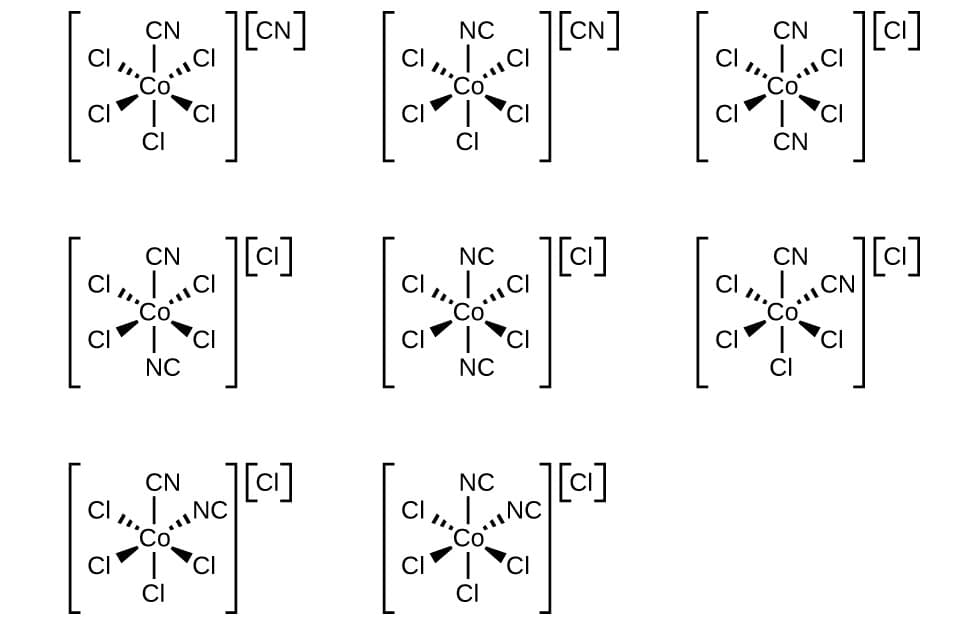
Coordination Chemistry of Transition Metals | Chemistry: Atoms First View original
Is this image relevant?
Coordination Compounds | Boundless Chemistry View original
Is this image relevant?
5.2: Ligands and Nomenclature - Chemistry LibreTexts View original
Is this image relevant?
Coordination Chemistry of Transition Metals | Chemistry: Atoms First View original
Is this image relevant?
Types of Ligands
- Ligands are ions or molecules that bond to a central metal atom or ion to form a coordination complex
- Monodentate ligands bind to the central metal atom through a single donor atom (H2O, NH3, CN-, Cl-, CO)
- Polydentate ligands bind through multiple donor atoms (ethylenediamine (en), ethylenediaminetetraacetate (EDTA4-))
Ligand Charge and Denticity
- Ligands can be neutral, anionic (negatively charged), or cationic (positively charged)
- The charge of a ligand affects the overall charge of the coordination complex
- The denticity of a ligand refers to the number of donor atoms that coordinate to the central metal atom
- Bidentate ligands have two donor atoms
- Tridentate ligands have three donor atoms
- Tetradentate and higher denticity ligands also exist (EDTA4- is hexadentate)
Coordination Number of Central Metal

Definition and Range
- The coordination number is the number of ligand donor atoms bonded to the central metal atom in a coordination complex
- Coordination numbers typically range from 2 to 9
- 4 and 6 are the most common coordination numbers
- Examples: [Cu(NH3)4]2+ (coordination number 4), [Co(NH3)6]3+ (coordination number 6)
Determining Coordination Number
- The coordination number is determined by counting the total number of ligand donor atoms, regardless of the ligand's denticity
- A complex with two bidentate ligands and two monodentate ligands has a coordination number of 6
- Example: [Co(en)2Cl2]+ has two bidentate en ligands and two monodentate Cl- ligands, giving a coordination number of 6
Denticity and Coordination Number Relationship

Polydentate Ligands and Coordination Sites
- The denticity of the ligands and the coordination number of the central metal atom are related but not always equal
- Polydentate ligands can occupy multiple coordination sites on the central metal atom, reducing the total number of ligands needed to achieve a given coordination number
- A complex with three bidentate ligands has a coordination number of 6 (e.g., [Co(en)3]3+)
- A complex with six monodentate ligands also has a coordination number of 6 (e.g., [Co(NH3)6]3+)
Maximum Number of Polydentate Ligands
- The maximum number of polydentate ligands that can bind to a central metal atom depends on the coordination number and the ligand's denticity
- For a coordination number of 6, up to three bidentate ligands, two tridentate ligands, or one hexadentate ligand can be accommodated
- Examples: [Co(en)3]3+ (three bidentate ligands), [Co(dien)2]3+ (two tridentate ligands), [Co(EDTA)]- (one hexadentate ligand)
Coordination Geometry Prediction
Factors Determining Coordination Geometry
- The coordination geometry refers to the spatial arrangement of the ligand donor atoms around the central metal atom
- The coordination geometry is determined by the coordination number and the presence of sterically demanding ligands
- Sterically demanding ligands, such as polydentate or bulky ligands, can distort the coordination geometry from the ideal arrangement
- Example: [Cu(NH3)4]2+ has a square planar geometry due to the Jahn-Teller effect, while [Ni(NH3)4]2+ has a tetrahedral geometry
Common Coordination Geometries
- Linear (coordination number 2)
- Example: [Ag(NH3)2]+
- Trigonal planar (coordination number 3)
- Example: [HgCl3]-
- Tetrahedral or square planar (coordination number 4)
- Examples: [Zn(NH3)4]2+ (tetrahedral), [Pt(NH3)4]2+ (square planar)
- Trigonal bipyramidal or square pyramidal (coordination number 5)
- Examples: [Fe(CO)5] (trigonal bipyramidal), [VO(acac)2] (square pyramidal)
- Octahedral (coordination number 6)
- Example: [Co(NH3)6]3+
See Fiveable more often in Google
Mark Fiveable as a preferred source and Google is more likely to show you our guides in Top Stories, with a "preferred" badge in AI Mode and AI Overviews.