
🔷Honors Geometry Unit 15 Review
15.2 Basic concepts of hyperbolic geometry
15.2 Basic concepts of hyperbolic geometry
Unit & Topic Study Guides
Foundations of Geometry
Logic and Proof
Parallel and Perpendicular Lines
Congruent Triangles
Relationships in Triangles
Quadrilaterals
Proportions and Similarity
Right Triangles and Trigonometry
Transformations
Circles
Areas of Polygons and Circles
Surface Area and Volume
Coordinate Geometry
Vectors

Fundamental Principles and Comparisons to Euclidean Geometry
Hyperbolic geometry is one of the most important non-Euclidean geometries. It keeps most of Euclid's axioms intact but replaces the famous parallel postulate with something radically different. The result is a geometry where triangles, circles, and parallel lines all behave in unfamiliar ways.

Principles of Hyperbolic Geometry
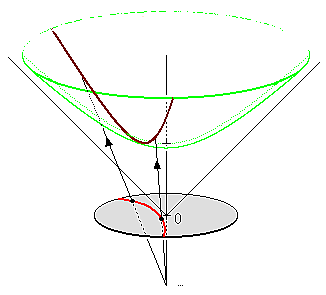
Hyperbolic geometry takes place on a hyperbolic plane, a surface with constant negative Gaussian curvature. You can picture this roughly as a saddle shape, where the surface curves away from itself in opposite directions at every point.
The key axiom that separates hyperbolic geometry from Euclidean geometry is the hyperbolic parallel postulate:
Given a line and a point not on , there are infinitely many lines through that do not intersect .
These non-intersecting lines are called ultraparallel lines. Compare this to Euclidean geometry, where there's exactly one such parallel line.
The other defining property involves triangles. The sum of angles in a hyperbolic triangle is always less than 180°. For example, a hyperbolic triangle with angles 30°, 45°, and 60° has an angle sum of just 135°. As triangles get larger in hyperbolic space, their angle sum drops further, approaching 0° for extremely large triangles.

Hyperbolic vs. Euclidean Geometry
Here's a side-by-side comparison of the two geometries:
| Property | Euclidean | Hyperbolic |
|---|---|---|
| Curvature | Zero (flat plane) | Constant negative (saddle-shaped) |
| Parallel lines through a point | Exactly one | Infinitely many |
| Triangle angle sum | Exactly 180° | Always less than 180° |
| Circle circumference | ||
| Circle area |
The circle formulas deserve a closer look. In Euclidean geometry, circumference grows linearly with radius and area grows quadratically. In hyperbolic geometry, both grow exponentially because the hyperbolic sine function grows exponentially for large . This means circles in hyperbolic space contain far more area than you'd expect from Euclidean intuition.
Properties and Problem Solving in Hyperbolic Geometry
Properties of Hyperbolic Shapes
Hyperbolic lines are geodesics on the hyperbolic plane, meaning they represent the shortest path between two points. Since we can't easily draw on a saddle-shaped surface, mathematicians use models to represent hyperbolic lines on a flat page:
- Poincaré disk model: The entire hyperbolic plane is mapped inside a circle. Hyperbolic lines appear as circular arcs that meet the boundary circle at right angles (or as diameters of the disk).
- Upper half-plane model: The hyperbolic plane is represented by the region above the x-axis. Hyperbolic lines appear as vertical rays or semicircles with their centers on the x-axis.
Hyperbolic triangles have two remarkable properties:
- The angle defect of a hyperbolic triangle is (in radians) minus the sum of its angles. The area of the triangle is directly proportional to this defect. For a hyperbolic plane with curvature , the area equals the angle defect.
- Example: A triangle with angles 30°, 45°, and 60° has an angle defect of , which equals radians. So its area is (about 0.785 square units).
- Triangles with the same three angles are congruent. This is a huge departure from Euclidean geometry, where you can scale a triangle up or down without changing its angles (similar triangles). In hyperbolic geometry, similar triangles don't exist. If two triangles have matching angles, they must have matching side lengths too.
Applications in Hyperbolic Geometry
Visualizing parallel lines: In the Poincaré disk model, pick any line (an arc perpendicular to the boundary) and a point not on it. You can draw infinitely many arcs through that point that never meet the original line. This makes the hyperbolic parallel postulate concrete and visual.
Computing angle sums and area: Given a hyperbolic triangle with angles 40°, 50°, and 55°:
-
Find the angle sum:
-
Confirm it's less than 180° (as expected in hyperbolic geometry).
-
Find the angle defect:
-
Convert to radians:
-
On a hyperbolic plane with , the triangle's area is approximately 0.611 square units.
Using the hyperbolic metric: In the upper half-plane model, distances are measured with the metric . Notice the in the denominator: points closer to the x-axis are "stretched out," so equal-looking distances on the page represent very different hyperbolic distances depending on height. This is why semicircles (not straight horizontal segments) turn out to be the shortest paths between points at the same height.
Key comparison to remember: In Euclidean geometry, shape and size are independent (you can scale any figure). In hyperbolic geometry, angles completely determine size. Bigger triangles must have smaller angle sums, and there's an absolute upper limit on area ( square units for , when the angle sum approaches 0°).