
⚡Electrical Circuits and Systems I Unit 5 Review
5.2 Inverting and Non-inverting Amplifiers
5.2 Inverting and Non-inverting Amplifiers
Unit & Topic Study Guides
Intro to Electrical Circuits
Basic Concepts and Laws
Resistive Circuits
Circuit Analysis Techniques
Operational Amplifiers
Capacitors and Inductors in Circuit Analysis
First–Order Circuits
Second–Order Circuits
Sinusoidal Steady-State Analysis
AC Power Analysis
Magnetic Coupling in Circuits
Operational amplifiers are the backbone of analog circuits, and understanding inverting and non-inverting amplifiers is crucial. These configurations allow us to manipulate signals, providing gain or attenuation as needed in various applications.
Inverting amplifiers flip the input signal, while non-inverting amplifiers maintain its phase. Both types offer unique advantages and limitations, making them suitable for different scenarios. Mastering these concepts is essential for designing effective analog systems.
Inverting Amplifier Circuits
Circuit Configuration and Principles
- Inverting amplifier produces output signal inverted and amplified relative to input signal
- Circuit consists of op-amp with negative feedback
- Input signal applied to inverting input through resistor
- Feedback resistor connects output to inverting input
- Non-inverting input typically connected to ground
- Virtual ground concept creates ground potential at inverting input due to negative feedback
- Closed-loop gain determined by ratio of feedback resistor to input resistor
- Gain formula:
- Negative sign indicates 180° phase shift between input and output
- Input impedance approximately equal to input resistor value
Design Considerations and Analysis
- Calculate closed-loop gain using
- Input impedance (approximately equal to input resistor)
- Output impedance (very low, ideally zero)
- Effect of finite open-loop gain on closed-loop gain accuracy
- Actual gain = Ideal gain / (1 + Ideal gain/AOL)
- AOL represents open-loop gain of op-amp
- Bandwidth considerations
- Gain-bandwidth product of op-amp limits maximum achievable gain at higher frequencies
- Constant bandwidth over wide range of closed-loop gains
- Examples:
- For and , gain = -10
- Input signal of 0.5V results in -5V output (inverting amplifier with gain of -10)
Non-inverting Amplifier Circuits

Circuit Configuration and Principles
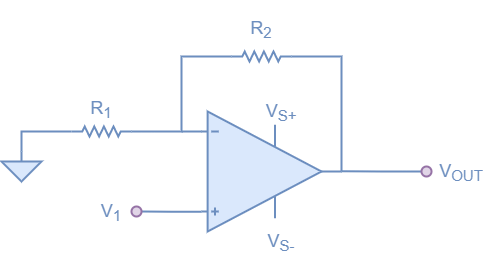
- Non-inverting amplifier produces output signal in phase with and amplified relative to input signal
- Circuit consists of op-amp with negative feedback
- Input signal applied to non-inverting input
- Voltage divider feedback network connected between output and inverting input
- Inverting input connected to junction of two resistors forming feedback voltage divider
- Closed-loop gain determined by ratio of feedback resistors
- Gain formula:
- represents feedback resistor, represents resistor connected to ground
- Output signal in phase (0° phase shift) with input signal
- Input impedance very high (ideally infinite)
- Provides better common-mode rejection compared to inverting configuration
Design Considerations and Analysis
- Calculate closed-loop gain using
- Input impedance (very high, ideally infinite)
- Output impedance (very low, ideally zero)
- Bandwidth decreases with increasing gain
- Minimum gain of unity (cannot attenuate signals without additional circuitry)
- More susceptible to input-referred noise at high gains
- Examples:
- For and , gain = 10
- Input signal of 0.5V results in 5V output (non-inverting amplifier with gain of 10)
Amplifier Characteristics
Performance Metrics
- Closed-loop gain accuracy dependent on resistor tolerances and op-amp open-loop gain
- Slew rate limits large-signal performance
- Affects maximum rate of change of output voltage
- Example: Slew rate of 10 V/μs limits 1 MHz sine wave to 10 Vpp amplitude
- Output voltage swing limited by op-amp power supply voltages and saturation characteristics
- Example: ±15V supply typically allows ±13V output swing
- Common-mode rejection ratio (CMRR) measures ability to reject common-mode signals
- Non-inverting configuration generally provides better CMRR
- Gain-bandwidth product (GBP) determines maximum achievable gain at specific frequencies
- Example: Op-amp with 1 MHz GBP can achieve gain of 10 up to 100 kHz
Impedance Considerations
- Inverting amplifier input impedance approximately equal to input resistor value
- Can be a disadvantage in some applications due to loading effects
- Example: 1 kΩ input resistor results in 1 kΩ input impedance
- Non-inverting amplifier input impedance very high (ideally infinite)
- Minimizes loading effects on input source
- Advantageous in applications requiring minimal source loading
- Example: Input impedance >1 MΩ common in non-inverting configurations
- Output impedance for both configurations very low (ideally zero)
- Allows driving of various loads with minimal effect on output voltage
- Example: Typical output impedance <100 Ω
Inverting vs Non-inverting Amplifiers
Comparative Advantages
- Inverting amplifier advantages
- Achieves gains less than unity (attenuation) without additional components
- Example: Gain of 0.5 with and
- Easier implementation of summing amplifier configurations
- Example: Multiple inputs summed through separate input resistors
- Constant bandwidth over wide range of closed-loop gains
- Achieves gains less than unity (attenuation) without additional components
- Non-inverting amplifier advantages
- Very high input impedance minimizes loading effects on input source
- Example: Input impedance >10 MΩ common in many designs
- Non-inverted output signal maintains phase relationship with input
- Better common-mode rejection ratio compared to inverting configuration
- Example: CMRR of 100 dB possible in well-designed non-inverting amplifiers
- Very high input impedance minimizes loading effects on input source
Comparative Limitations
- Inverting amplifier limitations
- Lower input impedance compared to non-inverting configuration
- Example: 1 kΩ input impedance vs. >1 MΩ for non-inverting
- Inverted output signal may be undesirable in some applications
- Example: Phase-sensitive demodulation circuits may require non-inverted signal
- Potential for increased noise due to virtual ground at inverting input
- Lower input impedance compared to non-inverting configuration
- Non-inverting amplifier limitations
- Minimum gain of unity (cannot attenuate signals without additional circuitry)
- Bandwidth decreases with increasing gain
- Example: Gain of 100 reduces bandwidth to 1% of op-amp's unity-gain bandwidth
- More susceptible to input-referred noise at high gains
- Example: Noise gain increases proportionally with signal gain