
🌈Earth Systems Science Unit 5 Review
5.3 Soil formation, composition, and classification
5.3 Soil formation, composition, and classification
Unit & Topic Study Guides
Earth Systems Science: An Introduction
Earth's Structure and Composition
Plate Tectonics: Earth's Dynamic Crust
Earthquakes & Volcanoes: Earth's Geohazards
Weathering, Erosion & Soil Formation
Hydrologic Cycle & Freshwater Systems
Ocean Circulation & Marine Ecosystems
Atmosphere: Composition and Structure
Weather Systems and Climate Patterns
Biogeochemical Cycles: C, N, and P
Terrestrial Biomes and Ecosystems
Climate Change & Air Pollution Impacts
Water Resources and Pollution
Human Impacts on Land and Soil
Biodiversity Loss: Human Impact & Conservation
Earth Systems: Interactions & Feedbacks
Earth Observation & Remote Sensing Technologies
Earth Systems Modeling: Methods & Uses
Sustainable Resources and Policy
Soil Formation and Composition
Soil formation is a slow, complex process shaped by climate, organisms, topography, parent material, and time. Understanding how soils form, what they're made of, and how we classify them connects directly to the bigger picture of weathering and erosion. Soils aren't just "dirt" sitting on top of rock; they're dynamic systems that support ecosystems, regulate water flow, and sustain agriculture.
Parent Material and Organic Matter
Parent material is the underlying geological material from which soil develops. It can be solid bedrock, loose sediments deposited by glaciers, or material carried in by wind or water. Because it's the source of most inorganic content in the soil, parent material has a direct influence on soil texture, mineral content, structure, and fertility.
- Granite parent material tends to produce sandy, acidic soils because granite is rich in quartz and feldspar.
- Limestone parent material often yields finer-textured, calcium-rich soils that tend to be more alkaline.
- Glacial till is a mixed bag of particle sizes deposited by glaciers, producing soils with highly variable textures.
Organic matter consists of decomposing plant and animal residues, living microorganisms, and humus, which is the stable fraction of organic matter that resists further decomposition. Organic matter improves soil structure by helping particles clump into aggregates, increases water and nutrient retention, and serves as a food source for soil organisms.
In mineral soils (like mollisols), organic matter content typically ranges from 1–6%. In organic soils (histosols), found in wetlands and bogs, it can exceed 20%.
Clay Minerals and Pedogenesis
Clay minerals are secondary minerals that form through the chemical weathering of primary minerals in the parent material. They're critical to soil fertility and structure because of their extremely high surface area and electrical charge, which allow them to attract and hold onto water molecules and nutrient ions.
Three common clay minerals worth knowing:
- Kaolinite has a low surface area and low charge. It's common in highly weathered tropical soils and doesn't hold many nutrients.
- Smectite has a very high surface area and swells significantly when wet. It holds lots of nutrients but can cause drainage problems.
- Illite falls in between, with moderate surface area and charge. It's common in temperate-region soils.
Pedogenesis refers to the overall process of soil formation and development over time. The five factors that control it are often remembered by the acronym ClORPT: Climate, Organisms, Relief (topography), Parent material, and Time.
Within a developing soil, four types of pedogenic processes operate:
- Additions — material entering the soil, such as organic matter accumulating on the surface or dust settling from the atmosphere
- Losses — material leaving the soil, such as nutrients and minerals removed by leaching (water carrying dissolved substances downward and out)
- Transformations — material changing form within the soil, such as primary minerals weathering into clay minerals
- Translocations — material moving from one horizon to another, including eluviation (washing out of a layer) and illuviation (deposition into a lower layer)
Soil formation is slow. Developing a recognizable soil profile typically takes hundreds to thousands of years, depending on conditions.
Soil Physical Properties
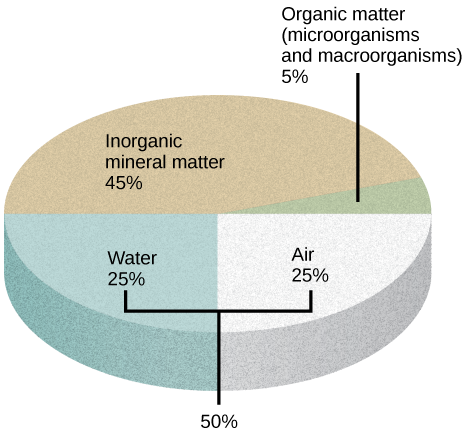
Soil Horizons and Texture
As pedogenic processes operate over time, they create soil horizons, which are distinct layers within a soil profile that differ in color, texture, chemistry, and biological activity.
The major horizons, from top to bottom:
- O horizon — a surface layer of organic material (leaf litter, decomposing matter), most prominent in forests
- A horizon — the topsoil, where organic matter mixes with mineral particles; typically dark in color
- E horizon — a light-colored, eluviated layer where clay, iron, and organic matter have been washed out by percolating water
- B horizon — the subsoil, where materials washed from above accumulate (illuviation); often enriched in clay, iron oxides, or carbonates
- C horizon — partially weathered parent material with little pedogenic development
- R horizon — unweathered bedrock
Not every soil has all six horizons. A young soil might only show A and C horizons, while a mature, well-developed soil in a humid climate might display all of them.
Soil texture describes the relative proportions of three particle sizes:
- Sand: 0.05–2 mm (gritty, visible to the eye)
- Silt: 0.002–0.05 mm (smooth, flour-like feel)
- Clay: less than 0.002 mm (sticky when wet, very fine)
Texture matters because it controls how soil handles water. Sandy soils drain quickly but hold few nutrients. Clay soils retain water and nutrients well but can become waterlogged and are harder to work. Loamy soils, which contain a balanced mix, are generally considered ideal for agriculture.
Texture classes group soils by their dominant particle sizes: sandy soils (sand, loamy sand), loamy soils (loam, silt loam, sandy loam), and clayey soils (clay, clay loam, silty clay). You can estimate texture in the field using the ribbon test (rolling moist soil between your fingers to see how long a ribbon it forms) or measure it precisely in a lab using the hydrometer method.
Soil Structure
Soil structure describes how individual soil particles clump together into larger units called aggregates or peds. While texture is about particle size, structure is about how those particles are arranged.
Structure affects water infiltration, air movement, root penetration, and erosion resistance. The main structural types are:
- Granular — small, roughly spherical aggregates; common in A horizons with good organic matter content; excellent for root growth and water movement
- Blocky — angular or subangular blocks; common in B horizons; moderate drainage
- Prismatic — vertically elongated columns; found in B horizons of some clay-rich soils; can restrict horizontal water movement
- Platy — thin, horizontally layered plates; often caused by compaction; restricts downward water movement and root growth
What builds good structure? Organic matter acts as a binding agent. Biological activity (earthworms, fungal hyphae, root growth) creates and maintains aggregates. What destroys it? Excessive tillage breaks aggregates apart, and heavy machinery causes compaction.
Well-structured soils have a balance of macropores (large spaces between aggregates that allow water to drain and air to circulate) and micropores (small spaces within aggregates that hold water against gravity for plant use).
Soil Chemical Properties

Soil pH and Nutrient Availability
Soil pH measures how acidic or alkaline a soil is, on a scale that typically ranges from about 3.5 to 9.5 in natural soils. This single measurement has an outsized influence on nutrient availability, microbial activity, and plant health.
Most plants grow best in slightly acidic to neutral soils, around pH 6.0–7.5, because that's the range where the greatest number of essential nutrients are simultaneously available in soluble form.
When pH drops below 6.0 (acidic conditions):
- Aluminum and manganese become more soluble and can reach levels toxic to plant roots
- Beneficial soil bacteria tend to decline, slowing decomposition and nutrient cycling
When pH rises above 7.5 (alkaline conditions):
- Iron, manganese, zinc, and phosphorus become less available because they form insoluble compounds or get adsorbed onto particle surfaces
- Plants may show deficiency symptoms even when these nutrients are technically present in the soil
Soil pH can be adjusted:
- Liming (adding calcium carbonate or similar materials) raises pH in acidic soils
- Adding elemental sulfur or certain types of organic matter lowers pH in alkaline soils
Soil Classification
Soil Taxonomy and Orders
Soil taxonomy is a hierarchical classification system that organizes soils based on measurable properties and the processes that formed them. The USDA system, which is the standard in the United States, has six levels from broadest to most specific: order → suborder → great group → subgroup → family → series.
There are 12 soil orders, each defined by dominant soil-forming processes and diagnostic features. Four that frequently come up:
- Mollisols — grassland soils with thick, dark A horizons rich in organic matter. They're among the most fertile soils on Earth and dominate the Great Plains and prairies. Their high organic matter content comes from dense grass root systems that decompose in place.
- Alfisols — moderately weathered forest soils with significant clay accumulation in the B horizon. Common under deciduous forests in temperate climates, they're generally fertile and productive for agriculture.
- Aridisols — desert soils that form under very dry conditions. They have little organic matter and often accumulate salts or calcium carbonate near the surface because there isn't enough rainfall to leach these materials downward.
- Ultisols — highly weathered, acidic soils with low base saturation (meaning most nutrient cations have been leached away). They're common in warm, humid regions like the southeastern United States and the humid tropics.
Below the order level, soils are divided into suborders based on moisture and temperature regimes, great groups based on diagnostic horizons and specific features, and progressively finer categories down to the series level, which describes soils with very specific, locally defined properties.