5.2 Applications to counting problems

🧮Combinatorics Unit 5 Review
5.2 Applications to counting problems
🧮 Combinatorics
The Principle of Inclusion-Exclusion (PIE) is a powerful tool for solving complex counting problems. It helps us calculate the number of elements in unions and intersections of multiple sets, avoiding overcounting or undercounting when dealing with overlapping categories.
PIE's applications extend to various areas, including surjective functions and onto mappings. By using this principle, we can tackle tricky problems involving set theory, combinatorics, and probability, making it an essential skill for advanced counting techniques.
Counting with Inclusion-Exclusion
Understanding the Principle of Inclusion-Exclusion
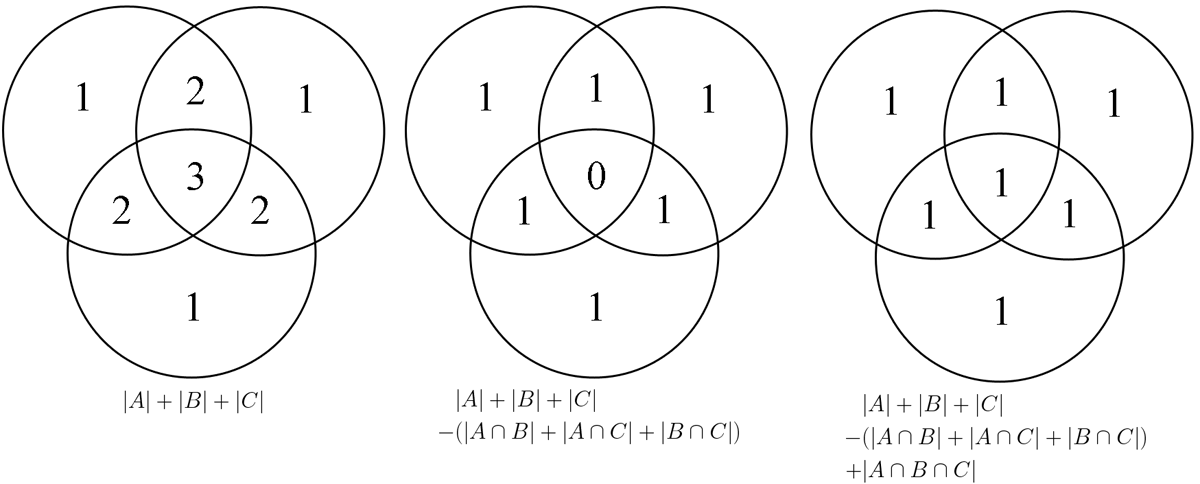
- Principle of Inclusion-Exclusion (PIE) calculates the number of elements in the union of multiple sets
- Basic PIE formula for two sets A and B
- General PIE formula for n sets
- Accounts for overcounting or undercounting when adding individual set cardinalities
- Alternating sum ensures correct counting of elements in multiple intersections
- Venn diagrams visualize PIE for small numbers of sets
- Become impractical for larger numbers of sets
- PIE applications include combinatorics, probability theory, and set theory problems
- Example: Calculating the number of students who play at least one sport given the number of students who play each individual sport and their combinations
Applying PIE to Counting Problems
- PIE solves complex counting problems involving multiple sets or conditions
- Steps to apply PIE in counting problems
- Identify the sets or conditions involved
- Determine the cardinality of individual sets
- Calculate the cardinalities of intersections
- Apply the PIE formula to find the total count
- Example: Counting numbers from 1 to 100 divisible by 2, 3, or 5
- Set A: numbers divisible by 2
- Set B: numbers divisible by 3
- Set C: numbers divisible by 5
- Apply PIE: |A ∪ B ∪ C| = |A| + |B| + |C| - |A ∩ B| - |A ∩ C| - |B ∩ C| + |A ∩ B ∩ C|
- PIE extends to problems with complementary conditions
- Example: Counting derangements (permutations where no element is in its original position)
Intersection of Multiple Sets

Adapting PIE for Intersections
- PIE adapts to find the number of elements in the intersection of multiple sets
- Formula for intersection of n sets:
- U represents the universal set
- Aᶜ denotes the complement of set A
- Utilizes De Morgan's laws (complement of union equals intersection of complements)
- Expands formula for union of complements using standard PIE
- Useful when direct intersection calculation proves difficult
- Often involves subtracting elements not in each set from the universal set total
- Transforms complex problems into more manageable calculations with unions and complements
Solving Intersection Problems
- Steps to solve intersection problems using PIE
- Identify the universal set and individual sets
- Determine complements of each set
- Apply PIE to find the union of complements
- Subtract the result from the universal set cardinality
- Example: Finding students taking all three subjects (Math, Physics, Chemistry) given total students and those not taking each subject
- Universal set: Total number of students
- Complements: Students not taking each subject
- Apply PIE to find students not taking at least one subject
- Subtract from total to get students taking all subjects
- Applications in set theory, logic, and probability (calculating joint probabilities)
Surjective Functions and Inclusion-Exclusion
Counting Surjective Functions
- Surjective (onto) function maps every codomain element to at least one domain element
- PIE crucial for counting surjective functions to avoid undercounting or overcounting
- Formula for number of surjective functions f: X → Y (|X| = n, |Y| = m):
- Formula explanation
- alternates addition and subtraction for correct overlap counting
- represents ways to choose k elements from codomain to be mapped to
- represents functions from X to k-element subset of Y
- Essential in combinatorial problems (calculating Stirling numbers of the second kind)
Applying PIE to Surjective Function Problems
- Steps to solve surjective function problems using PIE
- Identify domain and codomain sizes
- Apply the surjective function formula
- Simplify and calculate the result
- Example: Counting surjective functions from a set of 5 elements to a set of 3 elements
- n = 5 (domain size), m = 3 (codomain size)
- Apply formula:
- Expand and calculate each term
- Applications in computer science (analyzing algorithm possibilities, data structure configurations)
Onto Functions and Inclusion-Exclusion
Counting Onto Functions
- Onto functions between finite sets directly apply the PIE formula for surjective functions
- Number of onto functions from A to B (|A| = n, |B| = m):
- S(n,m) represents Stirling number of the second kind
- Stirling number of the second kind formula using PIE:
- Formula accounts for all ways of mapping n elements to m elements, subtracting cases where not all B elements are used
- m! factor represents ways to arrange m partitions to m elements of B
Solving Onto Function Problems
- Steps to solve onto function problems
- Identify domain and codomain sizes
- Calculate Stirling number of the second kind using PIE formula
- Multiply result by m! to get total onto functions
- Example: Counting onto functions from a set of 6 elements to a set of 4 elements
- Calculate S(6,4) using PIE formula
- Multiply result by 4! for total onto functions
- Applications in discrete mathematics and computer science
- Analyzing algorithms or data structures
- Counting functions with specific properties (bijections, restricted domain/codomain conditions)
See Fiveable more often in Google
Mark Fiveable as a preferred source and Google is more likely to show you our guides in Top Stories, with a "preferred" badge in AI Mode and AI Overviews.