20.1 Types and properties of stem cells

🦠Cell Biology Unit 20 Review
20.1 Types and properties of stem cells
🦠 Cell Biology
Stem Cell Types and Properties
Stem cells stand out because of two defining abilities: they can copy themselves (self-renew) and they can become specialized cell types (differentiate). These properties make them central to embryonic development, tissue repair, and regenerative medicine. This section covers the major stem cell types, their levels of potency, and how self-renewal and differentiation are regulated.
Key Characteristics of Stem Cells
Four core properties distinguish stem cells from ordinary cells:
- Self-renewal is the ability to divide and produce identical daughter cells, maintaining the stem cell population over time. Without self-renewal, the pool of stem cells would be depleted as cells differentiate.
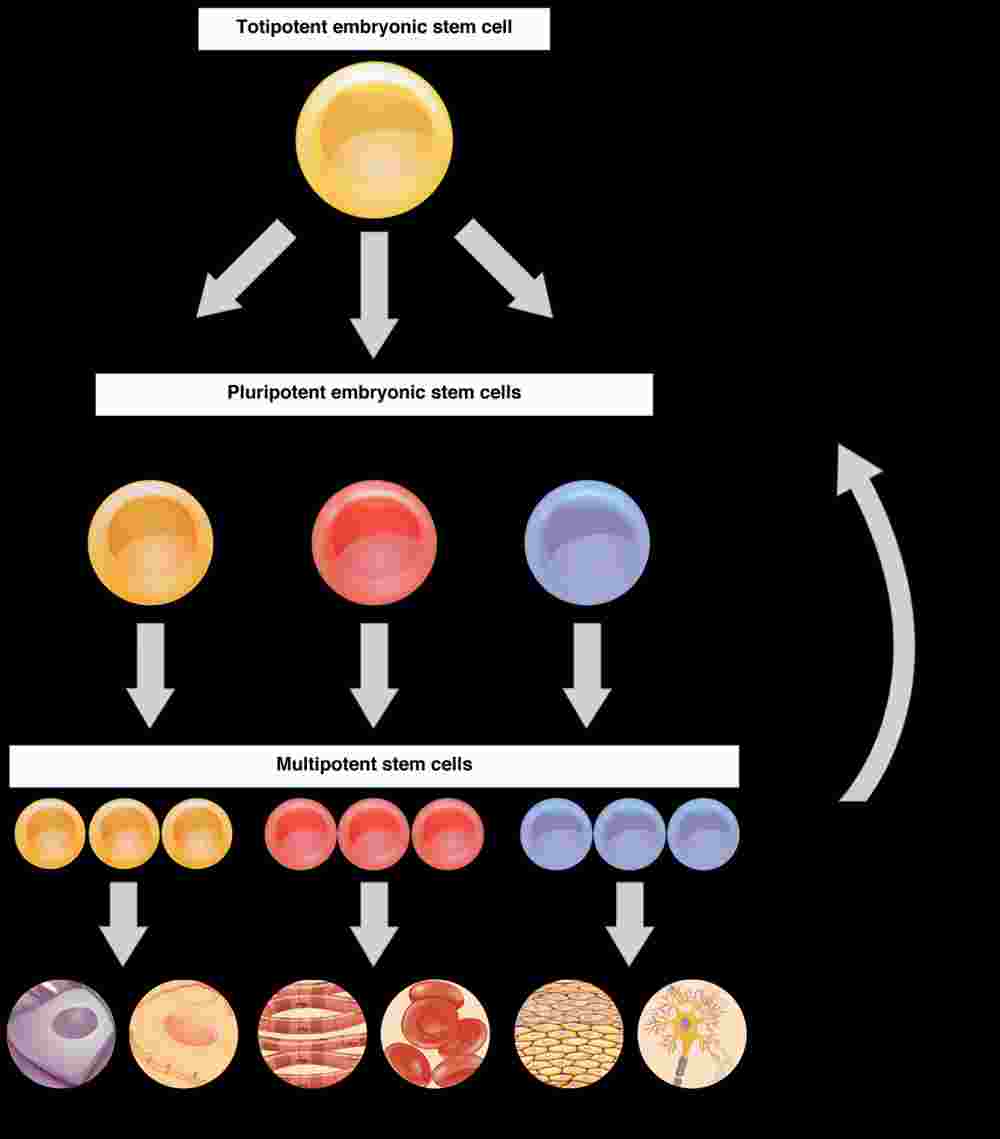
- Potency refers to the range of cell types a stem cell can become. It spans from totipotent (can form all embryonic and extraembryonic tissues) down to unipotent (can form only one cell type). The higher the potency, the more versatile the stem cell.
- Asymmetric division is one strategy stem cells use to balance these two jobs. A single division produces one daughter cell that remains a stem cell and one that begins to differentiate. This way, the stem cell pool stays stable while specialized cells are continuously generated.
- Niche dependency means stem cells don't operate in isolation. They rely on a specific microenvironment (the stem cell niche) that provides signaling molecules, cell-cell contacts, and extracellular matrix cues that tell the cell whether to self-renew or differentiate.
Types of Stem Cells
Three major categories come up most often in cell biology:
Embryonic stem cells (ESCs) are isolated from the inner cell mass (ICM) of blastocyst-stage embryos, roughly 5–7 days after fertilization in humans. They are pluripotent, meaning they can differentiate into cells of all three germ layers (endoderm, mesoderm, ectoderm) but not extraembryonic tissues like the placenta. Because isolating them requires destruction of the blastocyst, their use raises significant ethical concerns.
Adult stem cells (ASCs) reside in specific tissues throughout the body, including bone marrow, adipose tissue, the gut lining, and the brain. They are generally multipotent, meaning they can give rise to multiple cell types but only within their tissue lineage. Common examples include:
- Hematopoietic stem cells (bone marrow) → all blood cell types
- Mesenchymal stem cells (bone marrow, adipose tissue) → bone, cartilage, fat cells
- Neural stem cells (brain) → neurons, astrocytes, oligodendrocytes
Induced pluripotent stem cells (iPSCs) are created by reprogramming differentiated somatic cells (such as skin fibroblasts) back to a pluripotent state. Shinya Yamanaka's lab showed in 2006 that introducing four transcription factors, often called the Yamanaka factors (Oct4, Sox2, Klf4, and c-Myc), is sufficient to achieve this reprogramming. iPSCs bypass the ethical issues tied to ESCs and open the door to patient-specific cell therapies, since they can be derived from a patient's own cells.

Levels of Stem Cell Potency
Potency is best understood as a hierarchy, from most versatile to most restricted:
| Potency Level | Differentiation Capacity | Examples |
|---|---|---|
| Totipotent | All embryonic and extraembryonic cell types (entire organism + placenta) | Zygote, early blastomeres (up to ~4-cell stage) |
| Pluripotent | All three germ layers (endoderm, mesoderm, ectoderm) but not extraembryonic tissues | ESCs, iPSCs |
| Multipotent | Multiple cell types within a single lineage | Hematopoietic stem cells, mesenchymal stem cells |
| Unipotent | Only one cell type | Spermatogonial stem cells, muscle satellite cells |
A useful way to remember this: potency decreases as development proceeds. The zygote is totipotent, ICM cells are pluripotent, and most adult stem cells are multipotent or unipotent.
Self-Renewal and Differentiation Potential
Self-renewal can occur through two modes of division:
- Symmetric division produces two identical daughter stem cells, expanding the stem cell pool. This is common during development when large numbers of stem cells are needed.
- Asymmetric division produces one stem cell and one cell that begins to differentiate. This is the primary mode in adult tissues, where maintaining a steady stem cell population matters most.
Both intrinsic factors (transcription factor networks, epigenetic state) and extrinsic factors (signals from the niche) regulate which mode a stem cell uses at any given time.
Differentiation potential depends on the cell's potency level and is guided by specific signaling pathways. Two of the most important are Wnt signaling, which often promotes self-renewal, and Notch signaling, which frequently influences cell fate decisions between neighboring cells. Epigenetic modifications, particularly DNA methylation and histone modifications, lock in gene expression patterns as cells commit to a lineage, progressively restricting potency.
Plasticity refers to the surprising ability of some adult stem cells to cross lineage boundaries and differentiate into cell types outside their normal tissue, a process called transdifferentiation. This has been observed under specific experimental conditions, though its extent in normal physiology is still debated.
Proliferative capacity in stem cells is maintained in part by telomerase, an enzyme that rebuilds telomeres (the protective caps on chromosome ends) after each division. Most somatic cells lack sufficient telomerase activity, so their telomeres shorten with each division, eventually triggering senescence. Stem cells express telomerase at higher levels, allowing them to divide extensively without this limit.