1.5 Major Keys and Key Signatures

🎶AP Music Theory Unit 1 Review
1.5 Major Keys and Key Signatures
🎶 AP Music Theory
A major key means a passage centers on a particular major scale, and the key signature is the set of sharps or flats at the start of each staff that tells you which notes stay sharp or flat. There are 12 major key tonic pitches, but 15 commonly written major key signatures because some keys are enharmonic pairs (like F♯ major and G♭ major) that sound the same but are spelled and notated differently.
Why This Matters for the AP Music Theory Exam
Reading key signatures quickly is a foundation skill you will use across the whole course. On the multiple-choice section you may need to identify the key of notated music, and the boundary for this topic is identifying major keys and key signatures in notated music. The same skill supports melodic dictation, where you notate a performed melody in a given major key and have to spell pitches correctly for that key and place them in the right octave. The faster you can name a key from its signature, the easier scale degrees, intervals, and later harmonic analysis become.
Key Takeaways
- A passage is "in" a major key when it uses that major scale and treats its tonic as the central pitch.
- A key signature is the ordered group of sharps or flats placed right after the clef; it applies to those notes for the whole staff line unless an accidental changes them.
- Sharps always appear in the order F C G D A E B; flats appear in the reverse order B E A D G C F.
- Notes that belong to the key are diatonic; notes outside the key are chromatic.
- There are 12 major-key tonic pitches but 15 standard written major key signatures because of enharmonic spellings.
- The circle of fifths arranges keys so closely related keys (those sharing most of their notes) sit near each other.
Reading Key Signatures
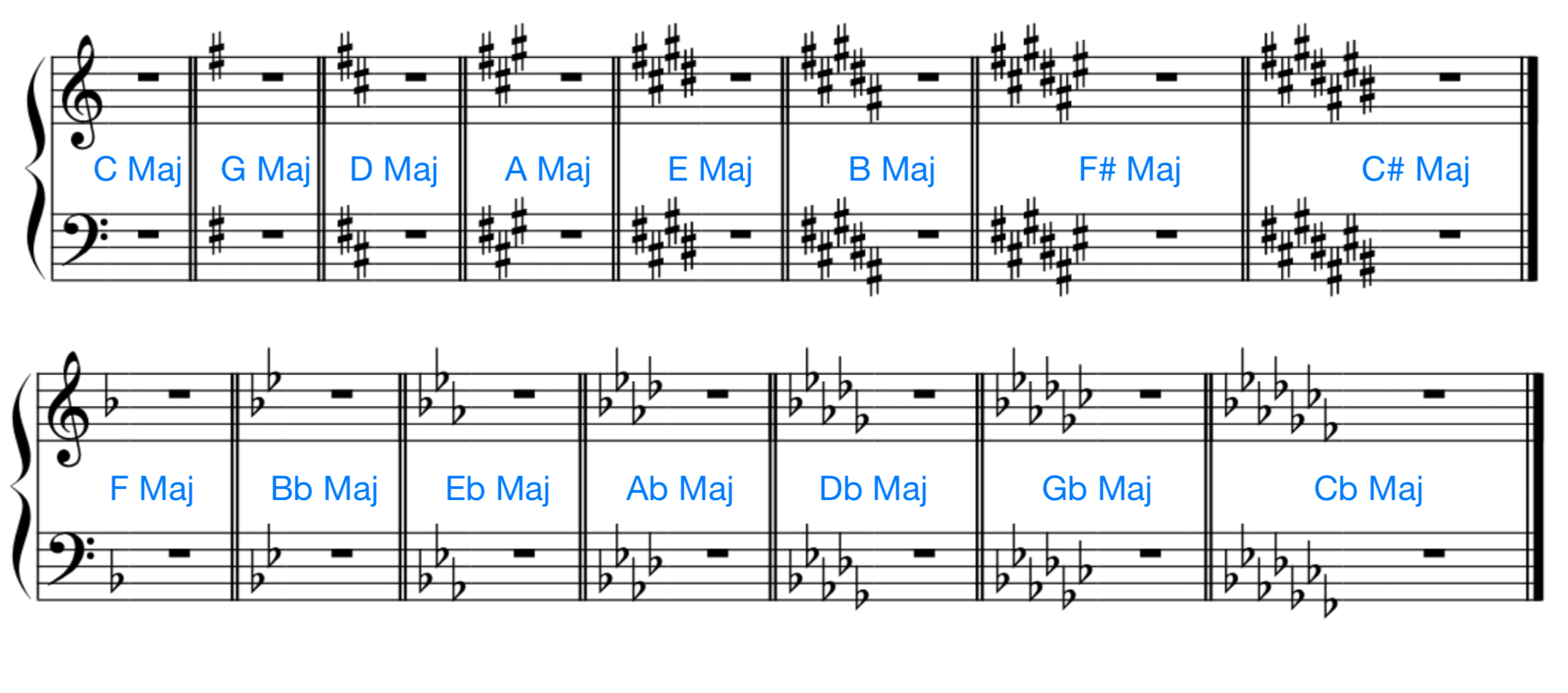
When most of a passage uses the pitches of a major scale and treats that scale's first note as the central pitch, the music is in that major key. For example, a passage built on the F major scale that keeps returning to F is "in the key of F major."
A key signature is a group of sharps or flats placed right after the clef at the start of each staff. It tells you which notes are raised or lowered for the entire line, so you do not have to mark every accidental individually. C major has no sharps or flats, so its key signature is empty, but the empty signature still counts as a key signature that signals C major.
The sharps and flats always appear in a fixed order:
- Order of sharps: F C G D A E B
- Order of flats: B E A D G C F (the reverse of the sharps)
Pitches that belong to the key are called diatonic. Pitches that do not belong are called chromatic.
12 Tonics but 15 Key Signatures
There are 12 different pitch classes that can serve as a major-key tonic. But when you count the standard written key signatures, you get 15, because some keys are enharmonic pairs: they sound the same but are spelled and notated differently. For example, F♯ major and G♭ major share the same sounding pitches but use different key signatures. Treat enharmonic keys as one sound with two valid spellings depending on context.
Naming a Major Key From Its Signature
You can memorize the signatures, but two shortcuts speed things up.
Which Key Has 3 Flats?
A major key signature with three flats is E♭ major. The flats appear in order as B♭, E♭, and A♭. For flat keys with more than one flat, the second-to-last flat names the major key, so E♭ is the answer.
For sharps: find the last sharp in the signature and go up a half step. If the last sharp is D♯, the key is E major.
For flats: the second-to-last flat names the key, and keep the flat in the name. If the signature has B♭, E♭, A♭, D♭, then A♭ is the second-to-last flat, so the key is A♭ major. The one flat key you simply memorize is F major (one flat, B♭).
A signature with one sharp points to G major (or E minor), two sharps to D major (or B minor), one flat to F major (or D minor), two flats to B♭ major (or G minor), and so on. The minor option is the relative minor, which you will study more in Unit 2.
The Circle of Fifths

The circle of fifths is a diagram that arranges keys so closely related keys sit near each other. Starting on C major and moving clockwise by a fifth gives G major; moving counterclockwise by a fifth gives F major. Each step around the circle adds or removes one sharp or flat.
Closely related keys share many of the same notes and have similar key signatures. C major and G major are closely related because they sit a fifth apart and differ by only one sharp. C major and F major differ by only one accidental too, so they are also close. Keys far apart on the circle share fewer notes, even if their tonic pitches are close on the keyboard. You will use these relationships later when you study modulation in Unit 5.
Optional context: the circle of fifths is a Western music idea, and many rich musical traditions around the world do not organize pitch this way. AP Music Theory focuses on Western tonal practice, but the larger field of music covers far more.
How to Use This on the AP Music Theory Exam
MCQ
- Practice naming a key from its signature in under a few seconds using the sharp and flat shortcuts.
- Be ready to spot whether a written note is diatonic or chromatic for the stated key.
- Recognize enharmonic key spellings so a written F♯ major signature does not trip you up.
Melodic Dictation
- When a starting pitch and key signature are given, figure out which scale degree the first note is. It is often the tonic, and another common choice is the dominant (fifth scale degree).
- Once you find the tonic, use your sense of the major scale (do-re-mi) to fill in the rest instead of measuring every interval from scratch.
- In a major key, expect few or no accidentals. If you suddenly have many accidentals, you likely placed an early note wrong and are comparing everything to that mistake.
- Spell pitches correctly for the given key and place them in the right octave.
- A common workflow is to lock in pitches first and add rhythm second, though some students prefer the reverse. Sight-singing practice strengthens the same skill.
For interval reference songs that help with these melodies, see the half steps and whole steps guide.
Common Misconceptions
- "There are 12 major key signatures." There are 12 major-key tonic pitches, but 15 standard written key signatures, because enharmonic keys like F♯ major and G♭ major are written differently.
- "C major has no key signature." C major has a key signature; it just contains no sharps or flats, and that empty signature is what tells you it is C major.
- "Keys that are close on the keyboard are closely related." Relatedness depends on shared notes, not keyboard distance. E major and E♭ major sit next to each other but share few pitches.
- "The last flat names the flat key." For flats it is the second-to-last flat that names the key (except F major, which you memorize), and you keep the flat in the name.
- "A key signature only affects the notes written on its exact lines and spaces." The sharps or flats apply to those letter names in every octave for the whole staff line, unless an accidental cancels them.
Related AP Music Theory Guides
Vocabulary
The following words are mentioned explicitly in the AP® course framework for this topic.Term | Definition |
|---|---|
bass clef | A musical clef symbol used to notate pitches in the lower register, commonly used for bass voices and lower-pitched instruments. |
central pitch | The primary pitch around which a musical passage is organized, typically the tonic or first scale degree of a key. |
chromatic | Pitches that do not belong to a given major or minor scale. |
circle of fifths | A visual diagram that illustrates the degree of relatedness among keys, with closely related keys appearing in close proximity to each other. |
diatonic | Pitches that belong to a given major or minor scale. |
dictation | The process of listening to performed music and notating the pitches and rhythms heard. |
flat | An accidental that lowers a pitch by one semitone. |
key signature | A grouping of sharps or flats presented in a specific order at the beginning of a musical staff that indicates which pitches belong to a particular major or minor scale. |
major key | A key or tonal center based on a major scale, characterized by a specific pattern of whole and half steps. |
major scale | A diatonic scale consisting of eight pitches with a specific pattern of intervals that serves as the basis for music in a major key. |
melody | A succession of pitches through time, produced by pitch and rhythm together, that expresses a musical statement. |
minor key | A key or tonal center based on a minor scale, characterized by a different pattern of whole and half steps than major keys. |
octave | The interval spanning eight letter names, representing a doubling or halving of frequency. |
pitch | The highness or lowness of a sound, determined by its frequency. |
rhythm | The pattern of durations of notes and rests in music. |
sharp | An accidental that raises a pitch by one semitone. |
tonic | The first scale degree and the primary harmonic center of a key, providing the sense of resolution and stability. |
treble clef | A musical clef symbol used to notate pitches in the higher register, commonly used for soprano, alto, and tenor voices and many instruments. |
Frequently Asked Questions
Which key has 3 flats?
E-flat major has three flats: B-flat, E-flat, and A-flat. In a flat key signature with more than one flat, the second-to-last flat names the major key.
What is the order of flats in a key signature?
The order of flats is B-E-A-D-G-C-F. A common memory aid is that it is the reverse of the order of sharps.
What is the order of sharps in a key signature?
The order of sharps is F-C-G-D-A-E-B. For major sharp keys, the tonic is a half step above the last sharp.
How do you identify a major key from sharps?
Find the last sharp in the key signature and go up one half step. For example, if the last sharp is D-sharp, the major key is E major.
How do you identify a major key from flats?
For flat signatures with at least two flats, the second-to-last flat names the major key. The one-flat exception is F major, which you should memorize.
Why are there 15 major key signatures but only 12 tonic pitches?
Some major keys are enharmonic pairs, such as F-sharp major and G-flat major. They sound the same on equal-tempered instruments but use different spellings and key signatures.