
Limits of Resolution and the Rayleigh Criterion
Every optical system has a built-in limit on how much detail it can reveal. The Rayleigh criterion gives you a way to calculate that limit, connecting the wavelength of light and the size of the aperture to the smallest detail you can resolve.
Rayleigh criterion for resolution limits
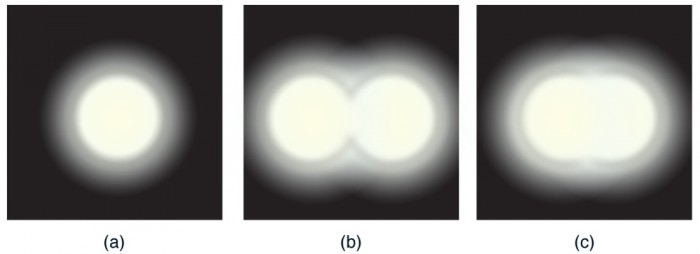
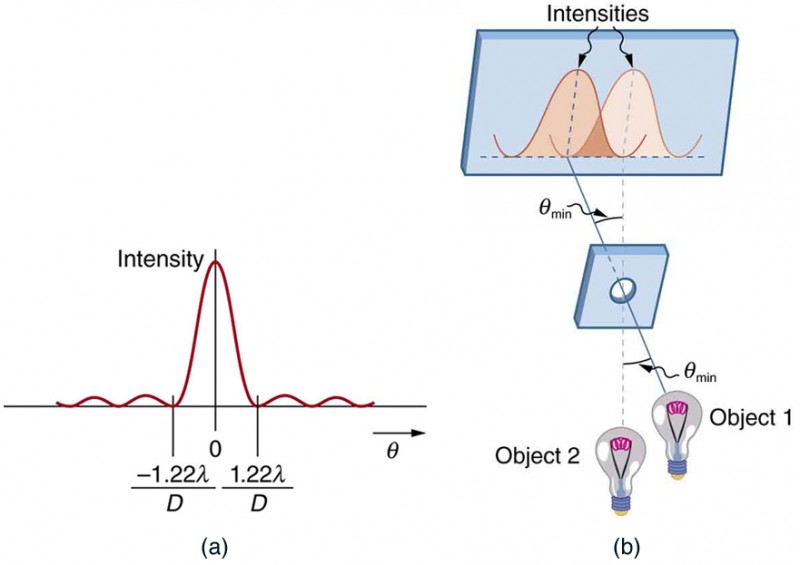
When light from a point source passes through a circular aperture (like a telescope lens), it doesn't form a perfect dot. Instead, diffraction spreads the light into a pattern called an Airy disk: a central bright spot surrounded by faint rings. Every point source you observe gets spread out this way.
Now imagine two point sources close together in the sky. Each one produces its own Airy disk. If those disks overlap too much, the two sources blur into one and you can't tell them apart.
The Rayleigh criterion defines the threshold: two point sources are just resolved when the central maximum of one Airy disk falls exactly on the first minimum (first dark ring) of the other. At that spacing, there's a noticeable dip in brightness between the two images, just enough to tell them apart.
This sets a fundamental limit on the resolving power of any optical system, whether it's a telescope, microscope, or camera. Two factors control this limit:
- Wavelength of light (): Shorter wavelengths produce smaller Airy disks, so resolution improves. That's one reason electron microscopes (with very short de Broglie wavelengths) can resolve far finer detail than visible-light microscopes.
- Diameter of the aperture or lens (): Larger apertures also produce smaller Airy disks. This is why research telescopes have such large mirrors.
Minimum angular separation calculations
The Rayleigh criterion is expressed as:
- = minimum resolvable angular separation (in radians)
- = wavelength of light (in meters)
- = diameter of the aperture or lens (in meters)
The factor 1.22 comes from the mathematics of diffraction through a circular aperture (specifically, the first zero of the Bessel function divided by ). For a rectangular slit, this factor would be 1.00, but most real optical systems use circular openings.
How to use the formula:
- Identify and , making sure both are in meters.
- Plug into .
- Your answer is in radians. To convert to degrees, multiply by .
Example: A telescope has a lens diameter of 10 cm and observes light at 550 nm (green light).
- Convert units: ,
- In degrees:
That's an extremely small angle. Two stars separated by less than this couldn't be distinguished as separate objects through this telescope.
Diffraction effects on image resolution
Diffraction is the bending and spreading of light waves as they pass through an opening or around an obstacle. You can't eliminate it; it's a fundamental wave behavior.
In any optical instrument, light passing through the aperture diffracts and forms an Airy disk pattern rather than a perfect point. The key relationship is:
- Smaller aperture → larger Airy disk → worse resolution. The diffraction pattern spreads out more.
- Larger aperture → smaller Airy disk → better resolution. The light stays more concentrated.
When two point sources are too close together, their Airy disks overlap so much that no dip in brightness is visible between them. They look like a single blurred spot. This is what "diffraction-limited" means: diffraction itself, not any flaw in the lens, is what prevents you from seeing finer detail.
Strategies for improving resolution:
- Use shorter wavelengths. Ultraviolet light resolves finer detail than red light. X-ray imaging pushes this even further.
- Increase the aperture diameter. Large telescope mirrors and wide microscope objectives both exploit this.
- Use adaptive optics. These systems correct for atmospheric distortion in real time, helping ground-based telescopes approach their true diffraction limit.
Advanced Resolution Concepts
- Sparrow criterion: An alternative to the Rayleigh criterion. It defines the resolution limit as the point where the combined intensity profile between two sources becomes flat (no dip), rather than requiring a dip. This gives a slightly smaller (tighter) angular separation than Rayleigh.
- Spatial frequency: A measure of how rapidly brightness changes across an image. High spatial frequencies correspond to fine detail. An optical system's ability to transmit high spatial frequencies determines how sharp the image looks.
- Optical transfer function (OTF): Describes how well an optical system transmits each spatial frequency from object to image. It provides a more complete picture of image quality than the Rayleigh criterion alone.